
Informations for pedagogical professionals
Kontakt

Informations for pedagogical professionals

Dear pedagogical professionals,
on the following pages we have provided some information about the EuLe-F project for you. Additionally, you will find a printable flyer with all the relevant information below.
Best regards,
EuLe-F Team
In order to capture the emergent literacy skills of children in the age range of four to seven years and to support them in the best possible way, we are developing a tablet-based assessment app (EuLeApp©) with integrated support offers as part of the EuLe-F project.
Insights into the app
For the development of the EuLeApp©, the procedure for recording narrative and reading skills (EuLe 4-5, Meindl & Jungmann, 2019) was digitised and further developed into a support and process diagnostic tool for narrative and reading skills in the transition from kindergarten to primary school.
The items of the EuLeApp© were embedded in a child-friendly, motivating framework story about an adult owl and her three owl children. At the beginning, the children choose one of the three owl children as their avatar, with whom they playfully explore the world of writing together. The adult owl guides the children through the various items on the six scales. Once all the tasks in a skill area have been completed, the chosen owl child receives digital gifts that go into their rucksack. In this way, the kindergarten owl child gradually becomes a school owl child.


At the end, the app displays the results of the individual children in a profile overview, which shows at a glance how the children's performanceis categorised (red = strongly below average, orange = below average, yellow = borderline to below average, green = average and dark green = above average) and which support needs arise in everyday life. The support treasure chest specially developed in the project starts directly there and offers numerous games and impulses to compensate for potential support needs in the area of early literacy.
Insights into the material
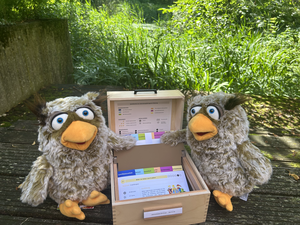
In line with the early literacy skills areas of the EuLeApp©, an everyday integrated support concept was developed, the framework of which is the support map "The Owl Island". It consists of six landscape areas with a hidden object character that represent the six early literacy skills areas. The children can explore these together with the hand puppet Eulalie from Living Puppets (cf. Stuhr et al., 2023).
The accompanying support treasure chest contains a total of 103 ideas for analogue, everyday integrated support games and 31 support impulses in index card format, which are assigned to six early literacy competence areas: Writing Awareness, Writing Knowledge, Word Awareness, Phonological Awareness, Letter Knowledge and Narrative Skills. They can be used to promote early literacy skills in every day-to-day situation at the daycare centre. The front of the cards contains a short, illustrative description of the game, information on suitable everyday situations (e.g. looking at a picture book or morning circle), the estimated duration, the recommended age range of the children, the number of people, the difficulty and the materials required for implementation. On the back of the support cards you will find ideas for further game variations, possible questions for the children, reflection questions for educational professionals and tips for further reading and materials.
For each of the six early literacy skills areas, you will find the corresponding landscape area of the Owl Island and an exemplary support card below.
Awareness of writing

The "Village of Writing" promotional landscape area is particularly well suited as a framework for impulses and games centred around writing awareness. Writing can be discovered in many places in the real village or town. For example, teachers and parents can draw the children's attention to the meaning of shop names, logos, writing on road signs or street names. For example, set up a writing office in a corner of the group room (Impulse 2) to give the children an active and playful approach to writing. Or - based on the story of the lion who couldn't write - explore together with the children what writing is and what writing is (Impulse 7). Below you can see an example of the front and back of a support card from the area of writing awareness:


Written knowledge

Through the impulses and games assigned to the "Lake of Writing Knowledge" development landscape area, children are encouraged to expand their knowledge of writing conventions. Where is the title of their favourite book that they took to the picnic by the lake? Eulalie explains to the stork and the frog where to start reading on the pages of the book.
Reading a book together is a great way to discuss with the children
- where the front of the book is,
- where the name/title of the book is,
- which page to read first,
- where to start reading,
- that you read from left to right,
- which is the first/last line, where the back of the book is.
Below you can see an example of the front and back of a support card from the area of writing knowledge:


Word awareness

The stimuli and games in the Moor landscape area make it easier to recognise words in sentences and to deal with the properties of words and the special features of compound words. The children discover that there are long and short words without this having anything to do with the actual size or length of the object they denote and they learn that some words belong to a family because they share the same root word.
In the game 31 "Rescue in the bog", a moving landscape with tyres is laid out to illustrate this, symbolising the solid ground in a bog landscape. Each child is given a picture card with a noun made up of two words. They spread out outside the tyres. The aim is for the children to land in a tyre - otherwise they risk sinking into the moor. They now point to the tyres one after the other and say the word shown in the tyre on the picture card, e.g. "rain", "boat" and "tooth". Now the children have to look at their picture cards and run to the tyre that contains their word, e.g. "umbrella" to "rain", "sailboat" to "boat" and "dandelion" to "tooth". The cards can then be redistributed. Below you can see an example of the front and back of a support card from the word awareness section:


Phonological awareness

The stimuli and games associated with the forest landscape area initially encourage children to listen carefully (listening games). A listening walk (Impulse 37) can be wonderfully undertaken in the forest, but also in other surroundings. In game 39, the children become "detectives in the forest of words". Their task is to find rhyming pairs, which promotes phonological awareness in a broader sense. Game 42 "Forest walk" is an example of the promotion of phonological awareness in the narrower sense. All the words discovered during the (digital) or real walk in the forest are segmented together into syllables (clapping, tapping, jumping). Finally, the sounds are named.
Below you can see an example of the front and back of a phonological awareness support card:


Letter recognition

The impulses and games in the meadow landscape area promote the recognition of different letters, their shapes and letter combinations. For example, you can talk to the children about which insects, flies and snails live in the meadow and which different meadow flowers, grasses and trees there are in a meadow. In addition to the animals and plants that are already pictured, other pictures with the children's ideas can also be pinned to the meadow. Which letter do the words start with? Do you write the letter in lower or upper case? What can you do in a meadow and what do the different plants and animals do? Which letter do the different activity words (verbs) start with? Do you write the letter in lower or upper case? In the game 70 "Letters with ...", the children's attention is also focussed on the shape of the letters with which the activity words begin. Four large circles are drawn on a piece of cardboard with the design feature (as a symbol) underneath:
- letters with dashes (T E F)
- letters with dots (i j)
- letters with tunnels (n m h)
- letters with a belly (d q b p)
The letters are written on small cards and the children match them to the features.
Below you can see an example of the front and back of a support card from the letter recognition section:


Narrative ability

The impulses and games assigned to the "beach" landscape area can be used to encourage everyday storytelling, retelling stories and, above all, the active telling of fictional stories. Most children have already been to the beach. Collect their favourite experiences together with them. This can be combined well with the game 89 "A beach suitcase for storytelling". What did they experience? What did they particularly like? Which shells or animals did they discover? The Kamishibai, Impulse 26, is suitable, for example, for presenting the pictures of the story "Marius the Seagull" one after the other in a stage-like setting and allowing the children to experience them. Or act out the story with your own hands or rod puppets in shadow theatre, Impulse 28.
Below you can see an example of the front and back of a support card from the area of storytelling skills:

