

COFONI-COVISION
COFONI-COVISION
COVISION app freely available to researchers
For our own daily surveys of people affected by post-COVID, we have developed a progressive web app that enables short questionnaires and cognitive tests to be carried out via smartphone (doi: 10.5281/zenodo.21278265). Further information and the source code are publicly available on GitHub (BigDataInMedicine/COVISION-PWA).
News from COVISION
- Successful kick-off meeting on 27 November 2023
- COVISION showcased itself at the “Uni in der Stadt” pop-up store
- COVISION at conferences in summer 2024
- COVISION at the autumn conference of the Family Sociology Section of the DGS
- The Refreshed Brain: Open Day
- Poster presentation at the “International ME/CFS Conference”
- Ann-Kathrin Knak awarded a scholarship by the German National Academic Foundation
- COVISION Closing Symposium
Current status
No more test subjects are being sought. We are currently finalising the last surveys.
Our aim is to investigate how fatigue, cognitive impairment and other post-COVID symptoms change on a daily basis.
The results will be used to improve the rehabilitation of patients, especially with the help of apps.
Modelling neurocognitive symptom trajectories, determinants and long-term effects on life and work after COVID disease
Fatigue, attention and memory disorders are three of the most common long-term symptoms after COVID-19. These post-COVID-19 consequences represent the greatest barriers to social participation. Therefore, it is crucial to understand the pathomechanisms underlying neurocognitive losses, to study the course of these losses and to find out how the social context can mitigate the negative consequences. Standardised neurocognitive tests have rarely been used to objectively measure symptoms. We know little about the long-term development and possible fluctuations in symptoms and about factors that can improve them. There is also a need for ecologically valid phenotyping with contextual factors to gain a pathomechanistic and individualised understanding of neurocognitive symptoms that can serve as a basis for future interventions. Our aim is to model the progression of neurocognitive symptoms after COVID-19 and make predictions based on demographic, immunological and neuronal markers. We also want to achieve detailed phenotyping and explore the role of social determinants and impact on daily life.
Our research project
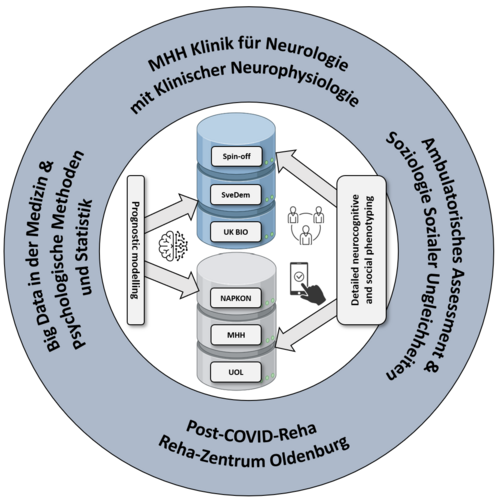
We are currently developing an interoperable web-based application. This is used to record neurocognitive symptoms of post-COVID-19 and factors that could influence them using standardised neuropsychological tests. The app is based on the specifications of the COFONI technology platform and uses openEHR data models so that we can integrate collected data into the COFONI technology platform. In a spin-off study, the application will be used to record the symptoms of post-COVID-19 patients over a period of several weeks and thus contribute to a more detailed phenotyping of post-COVID courses.
In addition, we calculate prognostic models that describe the course of post-COVID symptoms over a longer period of time and identify different phenotypes. In doing so, we investigate which markers contribute to differences between patients and which can be considered as possible protective factors or starting points for interventions. We use different longitudinal data sets to develop these models (e.g. NAPKON database, UK Biobank, data sets collected by UOL and MHH) and then test them (e.g. SveDem cohort).
Project funding
Funded as part of the COVID-19 Research Network Lower Saxony (COFONI) https://www.umg.eu/forschung/corona/cofoni/ by the Lower Saxony Ministry of Science and Culture (MWK)
Key area 5: Interdisciplinary research into the long-term consequences of the SARS-CoV-2 pandemic