
Message archive
Message archive
New publication: "Polyphonic History"

Anna Langenbruch: "Polyphonic History: On Histoire Croisée as a Method of Musicological Exile and Migration Research", in: W. Gratzer, N. Grosch, U. Präger and S. Scheiblhofer (eds.): The Routledge Handbook of Music and Migration: Theories and Methodologies, London: Routledge 2023, DOI: 10.4324/9781003309437, pp. 287-308, DOI: 10.4324/9781003309437-49.
News from the team
We welcome Gesa Finke as deputy professor (50%) in the research area Cultural History of Music

We are delighted to welcome musicologist Dr Gesa Finke as a 50% substitute professor in the Cultural History of Music research area! After her studies in Cologne and Aberdeen, Gesa Finke completed her doctorate at the University of Oldenburg in 2012 with a thesis on Constanze Mozart (published in 2013 under the title The composer's widow Constanze Mozart. Preserving music and shaping memory published by Böhlau-Verlag). She is currently working on a habilitation project on graphic forms of notation from the 1950s to the 1970s.
Gesa Finke was a research assistant at the University of Oldenburg, the Hochschule für Musik und Tanz Köln and the Hochschule für Musik, Theater und Medien Hannover.
New publication: "Geschichte polyphon"

Anna Langenbruch: "Geschichte polyphon: Zur Histoire croisée als Methode der musikwissenschaftlichen Exil- und Migrationsforschung", in: W. Gratzer, N. Grosch, U. Präger and S. Scheiblhofer (eds.): Musik und Migration: Ein Theorie- und Methodenhandbuch, Münster: Waxmann 2023, DOI: 10.31244/9783830996309, pp. 294-323.
New publication: "Beethovens Vermächtnis". Mit Beethoven im Exil
Report on the international symposium in Bonn, 1 to 3 March 2018 with an edition of the study of the same name by Paul Bekker
Schriften zur Beethoven-Forschung 32
Edited by Anna Langenbruch, Beate Angelika Kraus and Christine Siegert
ISBN: 978-3-88188-167-8
Bonn, 2022

This volume examines Beethoven reception and Beethoven practices in German-speaking exile between around 1933 and 1945. The various contributions show how central Beethoven was as a fixed point for the musical and political self-image of German-speaking exiles, who took Beethoven with them into exile in the USA, South America, the Soviet Union, Sweden and China as a kind of baggage of ideas. At the centre are the scholarly, literary or journalistic thinking and writing about Beethoven, the political, everyday and musical dealings with Beethoven, the images of the composer that exiles took with them, found and transformed, as well as the confrontation with Beethoven's music in concerts and in the media. The authors also explore the question of how the interweaving of National Socialist, exiled and international Beethoven discourses took shape in musical practice.
The starting point of the volume is the rediscovery and first publication of the study "Beethoven's Legacy" by music publicist Paul Bekker, which was written around 1934 and was long thought to have been lost.
With contributions by Sebastian Bolz, Susanne Borchers, Patrick Bormann, Esteban Buch, Annegret Fauser, Sophie Fetthauer, Daniela Fugellie, Reinhard Kapp, Beate Angelika Kraus, Anna Langenbruch, Sigrid Nieberle, Matthias Pasdzierny, Henrik Rosengren, Dietmar Schenk, Joachim Schlör, Dörte Schmidt, Glenn Stanley, Melanie Unseld and Stefan Weiss.
New publication: "Performing the Past"

Anna Langenbruch: "Performing the Past: Music and Public History", in: Public History Weekly 10/6 (2022), DOI: 10.1515/phw-2022-20326.
The essay has been published simultaneously in English and German (under the title "Performing History: Music and Public History") and is freely accessible.
New publication: "Les rêves d’Offenbach"

Anna Langenbruch: "Les rêves d’Offenbach: réflexions sur l’histoire de la musique sur scène", in: J.-C. Yon, A. Jacobshagen und R.-O. Schwarz (Hg.): Offenbach, musicien européen, Arles: Actes Sud 2022, S. 437–450.
Lecture by Anna Langenbruch
"Staging the musical canon? Music history in contemporary opera"
12th German-Israeli Frontiers of Humanities Symposium "Fluctuations in Stability: Confronting Uncertainties"
Alexander von Humboldt Foundation and Israel Academy of Sciences and Humanities
8-10 November 2021
Anna Langenbruch appointed to the professorship "Cultural History of Music"
Anna Langenbruch has been appointed to the professorship for "Cultural History of Music" at the Institute of Music at the University of Oldenburg on 1 April 2021. You can read the university's press release online here.
Report on research group published

An article about the research group "Music History on Stage: Constructions of the Musical Past in Music Theatre" has been published in the Carl von Ossietzky University's research magazine. In the current issue of Insights, Anna Langenbruch and Daniel Samaga report on their research and the activities of the Emmy Noether junior research group.
Communication
Since 1 April 2017, the professorship "Cultural History of Music" has been administered by Dr Cornelia Bartsch.
New publication
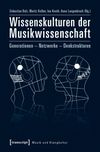
Wissenskulturen der Musikwissenschaft
Generationen – Netzwerke – Denkstrukturen
Edited by Sebastian Bolz, Moritz Kelber, Ina Knoth and Anna Langenbruch
What could sociologically based and historically informed musicological research look like? What possibilities does it offer, where does it reach its limits? How does musicology "work"? The contributors from different generations and disciplines scrutinise the historical and sociological conditions of research practice and knowledge production. They examine generations and networks, thought structures, languages and cultures, methods and media of musicology.
In this way, subject-specific questions of musicology are linked with general reflections on the history and sociology of science.
Communication
Since 1 October 2016, Melanie Unseld has no longer been working at the Institute of Music, following an appointment at the University of Music and Performing Arts Vienna.
Newly published!
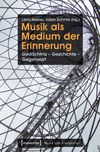
Lena Nieper, Julian Schmitz (Hg.): Musik als Medium der Erinnerung. Gedächtnis - Geschichte - Gegenwart, Bielefeld: transcript 2016 (= Musik und Klangkultur 17).
A project with the participation of the "Oldenburg" musicologists Melanie Unseld, Carola Bebermeier, Friederike Bunten, Elisabeth Reda and Tom Wappler.
Marcel Proust's Madeleine in "A la recherche du temps perdu", the quotation technique in the works of B.A. Zimmermann, the "ars memoriae" of the Middle Ages or the pictorial atlas "Mnemosyne" by Aby Warburg are examples of how memories can manifest themselves as memory processes in content, form and theories.
However, music as a medium of memory has so far received little attention in memory research. The contributions collected in this volume are dedicated to the subject of music and demonstrate the relevance of memory theory concepts in the field of (musicological) reception from an interdisciplinary perspective.
With contributions by Helga de la Motte-Haber, Melanie Unseld, Jan Assmann, Thomas Burkhalter and Ana Hofman, among others.
University press release
043/16 2 February 2016 Research
How knowledge about music is created
Anna Langenbruch accepted into the DFG's Emmy Noether Programme
Oldenburg. Oldenburg musicologist Dr Anna Langenbruch has been accepted into the prestigious Emmy Noether Programme of the German Research Foundation (DFG). The five-year funding of 1.1 million euros will enable Langenbruch to set up a junior research group at the Institute of Music at the University of Oldenburg on the subject of "Music History on Stage". more...
Research project on tour
The research project "Music Culture in English Salons around 1800" was invited to the International Bilingual Conference "The European Salon: Nineteenth-Century Salon Music", from 2 to 4 October 2015 at Maynooth University in Ireland. There will also be an exhibition on the subject and the discussion concert "'I've brought some Songs' Insights into English Salon and Concert Culture" at the Hanover University of Music, Drama and Media.
Further information can be found at www.fmg.hmtm-hannover.de/de/aktuelles/ausstellungen/ive-brought-some-songs-einblicke-in-die-englische-salon-und-konzertkultur/
Newly published!
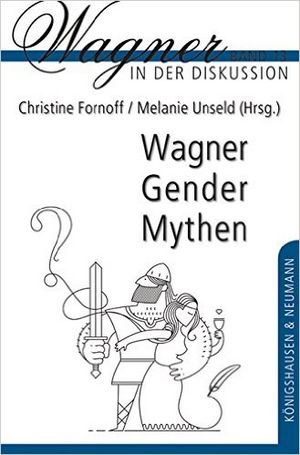
Christine Fornoff, Melanie Unseld (Hg.): Wagner - Gender - Mythen, Würzburg: Königshausen & Neumann 2015 (= Wagner in der Diskussion 13).
The aim of the conference is to initiate sociologically and historically based academic research in musicology. The conference's four panels - Generations and Networks, Languages and Cultures, Structures of Thought and Concepts of Knowledge, Public Spheres and Media - not only draw a map of the subject of musicology, but also trace the interaction between research and social structures in general. Musicology will be used as an example to reflect on the connections between communication, power and knowledge.
A concluding roundtable entitled "Why science studies?" will pose the question of the benefits of approaches from the history and sociology of science. The conference offers a cross-generational discussion forum for scientists from various disciplines and will give a voice to the young generation of researchers in particular.
Organisation: Dr. Anna Langenbruch (University of Oldenburg), Dr. Ina Knoth (University of Hamburg), Sebastian Bolz, M.A. (Ludwig-Maximilians-Universität München), Moritz Kelber, M.A. (University of Augsburg)
Website: www.denkstrukturen.wordpress.com
Richard Wagner conceived a new type of singer for the heroic figures in his music dramas. But how did this "heroic tenor" interact with the contemporary heroic discourse? Wagner also thought intensively about the "woman of the future". But how did these considerations relate to the discourse on femininity of his time? And how did Wagner conceptualise the relationship between the sexes? The one on stage, where - as in Tristan and Isolde - hero and woman meet as lovers, and the one in the reality of life, for which Wagner sketched a utopia of the "future of marriage"? The terms hero - woman - artist , so central to Wagner, are not only to be understood as configurations within the gender discourse of the 19th century. On the contrary, they invite us to re-mythologise them and offer current ideas for Wagner as an artistic personality and for his music dramas.
Newly published!
Melanie Unseld: Biographie und Musikgeschichte. Wandlungen biographischer Konzepte in Musikkultur und Musikhistoriographie, Köln/Weimar/Wien: Böhlau 2014 (= Biographik. Geschichte - Kritik - Praxis 3).
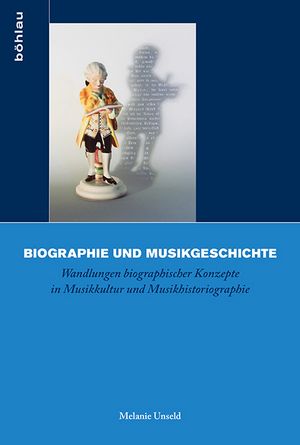
Fundamental changes were decisive for the inclusion of musicians in cultural memory: the bourgeoisification and at the same time historicisation of musical culture, but above all the associated appreciation as "noble musical artists". This is how the idea of the biographical worthiness of musicians emerged in the 18th century and thus the basis for including them in the culture of remembrance through biographical writing. Using various biographical media, the author sheds light on the different ways in which biographical concepts have developed up to the present day, and also explores the ambivalent relationship between musicology and music biography.
Newly published!
Danielle Roster, Melanie Unseld (Hg.): Komponistinnen in Luxemburg. Helen Buchholtz (1877-1953) und Lou Koster (1889-1973), Köln/Weimar/Wien: Böhlau 2014 (= Musik - Kultur - Gender 13).

Geographically at the centre - peripheral in terms of music history? Luxembourg's musical culture has hardly been the focus of musicology to date. When this volume looks at two Luxembourgish female composers of the late 19th and early 20th centuries, it is therefore necessary to address some fundamental aspects of musicology and music historiography: Helen Buchholtz and Lou Koster offer a concrete occasion to reflect on national and cultural identity formations, on the relationship between musical analysis and gender, on the reception of music as "kitsch", and on questions of memory, legacy and archive.
Distinction
Anna Langenbruch receives Associated Junior Fellowship at the Hanse-Wissenschaftskolleg
Anna Langenbruch has been awarded an Associated Junior Fellowship from the Hanse-Wissenschaftskolleg Delmenhorst for her work in the research field of "Music History on Stage". The funding programme offers outstanding postdocs from the social sciences and humanities in the north-west region the opportunity to enrich and broaden their academic training in conjunction with the Hanse-Wissenschaftskolleg.
In this context, Anna Langenbruch will organise an interdisciplinary conference at the end of 2015 on the topic of "Sound as a historical medium", which aims to change perspectives in historiography and the history of knowledge: The centre of the conference will be the question of how sounds construct history, how people perceive, use, stage, interpret, remember and link them to (historical) concepts of knowledge.
Newly published!
Anna Langenbruch: Topographien musikalischen Handelns im Pariser Exil. Eine Histoire croisée des Exils deutschsprachiger Musikerinnen und Musiker in Paris 1933-1939, Hildesheim 2014.

Between 1933 and 1939, Paris was one of the great cultural centres of German-speaking exile, including the still little-researched musical exile: Alongside singers such as Lotte Schöne and Marianne Oswald and composers such as Paul Arma, Kurt Weill and Erich Itor Kahn, the city attracted performers, musicologists, music critics and music educators in equal measure. In Paris, they encountered a highly developed network of musical spaces and cultural activities within which they had to (re)position themselves.
This complex cultural mixture challenged them to adopt pluralistic approaches that made the diversity of perspectives the principle of representation, as suggested by the histoire croisée approach... more.
See also www.olms.de (search for: Anna Langenbruch).
Newly published!
Melanie Unseld, Christian von Zimmermann (Hg.): Anekdote - Biographie - Kanon. Zur Geschichtsschreibung in den schönen Künsten, Köln / Weimar / Wien 2013.
How do life and artistic creation intertwine? What role does the personality of the creator play in the communication of art, music and literature? What functions do anecdotes have in this process? And what influence do artists' biographies have on historiography and canonisation? The contributions collected here from literary studies, history, comparative studies, classical studies, English studies, Scandinavian studies, art history and musicology provide different answers to these questions and offer insights into current interdisciplinary biographical research.
Newly published!
Susanne Binas-Preisendörfer, Melanie Unseld (Hg.): Transkulturalität und Musikvermittlung. Möglichkeiten und Herausforderungen in Forschung, Kulturpolitik und musikpädagogischer Praxis, Frankfurt a. M. 2012.
No music culture can do without questions of alterity and transculturality. However, it still seems to be a challenge to think productively about these questions and to address them in the teaching of music. In view of the educational and academic policy challenges posed by the topic, this volume provides an overview of the state of research that has only just begun and gives young academics from various disciplines in particular a platform for argumentation that goes beyond the
boundaries of their subjects to examine the culturally and educationally highly sensitive connection between transculturality and the teaching of music as a 'subject'. Both the significance of theoretical axioms for practical scenarios of music education and, conversely, the practice of music education as a challenge for theory formation will be discussed.