Archive
Archive
Research-oriented workshop with Dr Maria Witek
"Why beats are fun! - Sound, rhythm, pleasure: fundamentals and recent developments in music cognition research from a cultural studies perspective"
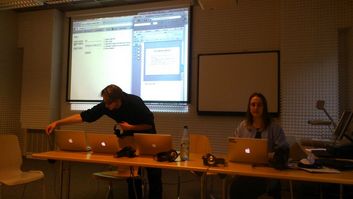
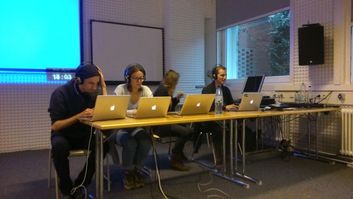
On 29 and 30 January 2016, Prof. Binas-Preisendörfer welcomed Dr Maria Witek (Center for Music In the Brain, Aarhus University, Denmark) to the Institute of Music for a research-oriented workshop integrated into the seminar "The sound is the thing you recognise ". Around 20 students, doctoral students and staff from the Chair of Music and Media spent two days exploring music psychology research in the fields of loudness, enjoyment and groove.
Dr Witek used the question "How is it that we want to move to music and why does it feel good?" as the starting point for her introduction to brain physiology and evolution. The participants familiarised themselves with the connections between physiological functions, areas of the brain and groove music. Witek spoke about models that relate the connections between pleasure, expectation and reward to music in a goal-orientated way and explain them using an optimum level of complexity.
Building on this information, Dr Witek worked with the workshop participants to develop knowledge about music psychology methods in general and experiments in particular. Witek's subsequent short lecture on the topic of loudness research and enjoyment proved to be highly compatible with the research perspective developed at the Chair of Music and Media. Finally, the group put the knowledge they had acquired into practice in an experiment. This investigated the relationship between loudness, willingness to take risks (determined by the size of a balloon to be inflated) and genre preference.
On Saturday morning, Witek presented a critical reading of goal-oriented models of music enjoyment and introduced alternatives such as embodiment, extended mind, predictive coding and phenomenological approaches.
After a lively discussion, the participants turned to the statistical analysis of the data generated in the experiment the day before and then refined the research design.
In the concluding roundtable, Prof Binas-Preisendörfer, Dr Maria Witek and Stefanie Alisch, M.A. explored compatibilities between empirical approaches and methods based on cultural studies or ethnography.
Detailed report on the workshop here.

Short biography
Dr Maria Witek (Aarhus University, Denmark), postdoc in research group "Music in the Brain". Degrees in Musicology (University of Oslo) and Music Psychology (University of Sheffield). 2013 PhD thesis "The Relationship between Embodiment, Pleasure and Groove-Based Music" (University of Oxford). Her research explores the psychology and cognitive neuroscience of rhythm, body movement, pleasure and groove. Numerous international publications and lectures.
As part of the workshop, students can take an examination of 3 CP (partial module examination), which can be credited in all Master's modules specialising in music and media.
radio aporee
radio aporee ::: miniatures for mobiles
Title: The Blankenburg Monastery
Short info: An audio landscape with three audio pieces about the Blankenburg monastery near Oldenburg. The almost 700-year history of the monastery with its dark and colourful sides is illuminated by three audio works. They use original sounds, radio plays, informative material and a variety of soundscapes to explore a contradictory and exciting place. The audio pieces were created as part of the AUDIOGUIDE seminar (2015) at the Institute of Music at the University of Oldenburg under the direction of Dr Fabian Czolbe and with the best support from the Department of Music and Media (Prof Dr Susanne Binas-Preisendörfer).
To be found at: aporee.org/mfm
(under miniatures you can find, search and listen to this miniature)
Experiencing sound situations
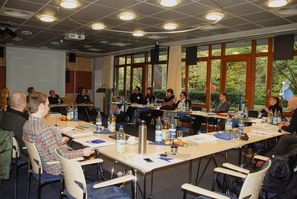
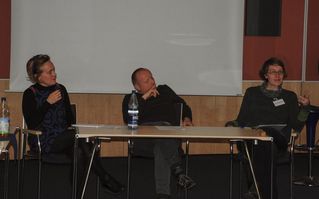
On 30 and 31 October 2015, Prof. Dr Susanne Binas-Preisendörfer (Oldenburg), Dr Anna Langenbruch (Oldenburg) and Prof. Dr Holger Schulze (Copenhagen) led the workshop "Sound - Situations - Experience. Methodological Challenges of Analysing Listening Practices" took place at The Haus des Hörens Oldenburg.
Sound studies, research on popular music and cultural studies-oriented historical musicology are currently very interested in developing adequate methods for investigating sound materials and listening practices. The conviction, established as a result of cultural and performance studies, to place cultural practices at the centre of the investigation and not the successful understanding of a "text", has led to the above-mentioned disciplines recognising the need for a more detailed approach. The conviction established as a result of cultural and performance studies to place cultural practices at the centre of investigation and not the successful understanding of a "text" led to the realisation in the aforementioned disciplines that no meanings are inscribed in an archived sound, a pop song or a score per se, but that these are created in communicative spaces/situations and discursive negotiation processes of interrelated actors and their subject positions.
The two-day workshop "Sound-Situation-Experience" was dedicated to the methodological challenges of this relational and contingent paradigm. Conceived as a deliberately small-format forum and not aimed at the presentation of lectures, it went into methodological depth on the basis of concrete examples from research practice. Along thematic focal points [criteria of documentation; situations of listening and their (historical) reconstruction; experiences of subjectivity and critical reflection of the research standpoint], researchers from Germany, Denmark, Austria and Switzerland entered into an intensive exchange across different disciplinary approaches and perspectives. It became clear that the inconsistent methodological approaches are also rooted in the objects of research and their connection to specific concepts of music. The workshop opened up the possibility of uncovering these aspects and asking which methods are suitable for analysing listening practices from the past and present. In the concluding discussion, the workshop organisers suggested continuing the exchange on a bilateral level and exploring co-operation.
In October 2015 the workshop "Sound - Situation - Experience. Methodical Challenges in Analysing Listening Practices" took place under the direction of Prof. Dr Susanne Binas-Preisendörfer (Oldenburg), Dr Anna Langenbruch (Oldenburg) and Prof. Dr Holger Schulze (Copenhagen) at the Haus des Hörens, Oldenburg.
The two-day meeting was designed as a transdisciplinary forum to discuss the development of appropriate methodical approaches to explore the role of sound in cultural practices in past and present times. Based on concrete examples of research from the field of sound studies, popular music studies and culturally oriented historical musicology, the participants reflected upon criteria of documentation, situations of listening and its (historical) reconstruction and experiencing subjectivity, which led to a fruitful methodological dialogue. In this, it became clear that heterogeneous approaches often are attributable to the objects of research and their connection to specific concepts of music.
Newly published!

Susanne Binas-Preisendörfer, Jochen Bonz, Martin Butler (eds.)
POP / WISSEN / TRANSFERS
On the communication and explication of popular cultural knowledge
Series: Popular Culture and Media
The contributions describe specific manifestations of popular cultural knowledge as well as knowledge transfers between disciplines, codes, camps, civil society and commercial actors. In doing so, they undertake something like 'exploratory drilling' in a field of research whose contouring and more precise treatment is still in its infancy, and not only point to the challenge of a differentiated description of these processes, but also show that 'popular cultural knowledge' is fundamentally difficult to grasp for an approach interested in naming and analysing, as it always seems to evaporate when it is to be concretised or explicated as an object of interest.
About the editors:
Susanne Binas-Preisendörfer holds the Chair of Music and Media at the University of Oldenburg. Jochen Bonz is a private lecturer and assistant at the Institute of History and European Ethnology at the Leopold Franzens University of Innsbruck. Martin Butler is Junior Professor for "American Studies: Literature and Culture" at the University of Oldenburg.
Excursion to Berlin
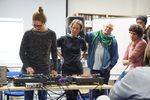
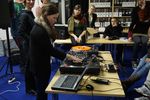
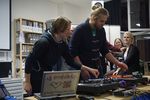
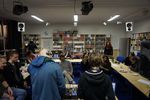
As part of the course "History of Popular Music II. - Youth Cultures", 21 Oldenburg students visited the Archive of Youth Cultures in Berlin on 5 December 2014. The founder and director of the archive, Klaus Farin, provided information on its founding history and current tasks. In the archive's library, the students were able to gain an overview of the collection (especially fanzines) and discuss problems and challenges in viewing and analysing such primary sources from the recent history of popular music with cultural scientist Daniel Schneider. Afterwards, everyone took part in either a rap workshop or a workshop on DJing.






Exhibition information: ShePOP - Women. Power. Music.

ShePOP is a special exhibition at the rock'n'popmuseum Gronau that shows all facets of girls and women in rock and pop music.
It was created in co-operation with the Universities of Oldenburg and Paderborn and is funded by the Ministry for Family, Children, Youth, Culture and Sport of the State of North Rhine-Westphalia.
The exhibition runs from March to September 2013.
More under: ShePOP - Women. Power. Music.
Founding workshop IASPM from 25 to 26 May 2013 in Bern
On 25 and 26 May 2013, a founding workshop of the German-speaking branch of the IASPM (International Association for the Study of Popular Music) will take place in Bern.
Prof Dr Binas-Preisendörfer (President) is looking forward to the participation of students and young academics.
Publication - Sounds in the age of their digital availability

Prof Dr Susanne Binas-Preisendörfer has published her book "Klänge im Zeitalter ihrer medialen Verfügbarkeit. Pop music on global markets and in local contexts" published by Transcript-Verlag.
In it, she examines the relationship between popular music and globalisation, takes a reflective look at the concept of world music and considers the technical and economic conditions of contemporary music culture under the heading of "medial availability".
DFG-Forschungs-Netzwerk Klang in der Medienkultur / Sound in Media Culture
The international research network Sound in Media Culture began its work in May 2010. It is funded by the German Research Foundation (DFG). Susanne Binas-Preisendörfer and Thomas Schopp represent the study and research focus Music and Media at the Institute of Music as permanent members. The aim of the network is to develop aspects of a cultural history of sound. Experienced and young academics come together twice a year in various European cities for working meetings. Renowned international guest scholars complement the group of researchers. A handbook will summarise the results of the intensive specialist discourse. The DFG network Sound in Media Culture will run for three years.
Choir project The17
The17 is an international choir project by the artist Bill Drummond (born 1953). Since 2006, the choir has been performing scores that the Scottish artist and other people have written especially for it. These are not musical scores, but verbal instructions for different situations. In principle, performances by The17 take place without an audience. Furthermore, no recordings are permitted. The choir is not a permanent ensemble. Instead, Drummond always works together with local actors. Musical knowledge is not a prerequisite for taking part in a performance. The participants are merely photographed and presented as new members on the project's homepage.
The17 sees itself as an artistic reaction to the fact that music is now available everywhere and at any time in digital form. Millions of digital music files of all genres and genres are available for download on the Internet. In a short space of time, listeners can create personal music archives with great historical depth and geographical breadth at the touch of a button. Against this background, Drummond states that recorded music has lost its cultural significance. The artist sees the enormous storage capacity of hard discs and the popularity of file-sharing networks as a sign of the need to overcome the commodity character of music. In the 20th century, music was mass-produced, distributed and purchased as an industrial sound carrier. In contrast, The17 choir project is more strongly orientated towards non-commercial and non-professional principles of music. A performance by The17 is intended to be unique, a collective celebration of the here and now in the medium of sound.
The Department of Music and Media at the Institute of Music at the University of Oldenburg is researching, among other things, how music culture has changed depending on auditory technologies (gramophone, tape, microphone, amplifier, CD player, sampler, MP3 format, etc.). Drummond's theses on the crisis of digital music have been widely discussed in journalism and academia. An invitation of the busy artist to Oldenburg was therefore an obvious choice.
Further information: thomas.schopp@uol.de.