

In the middle of the Atlantic, researchers have discovered a previously unknown part of the global carbon cycle. Subterranean microbes break down residues in the ocean crust that their relatives in the open ocean spurn. Thorsten Dittmar from the ICBM and colleagues report this in the journal Nature Geoscience.
It is one of the most exciting mysteries in marine research: there is a rich source of food available in the oceans - but hardly any living organisms utilise it. The nutrient-rich mixture of substances in question is referred to by experts as "dissolved organic matter". The carbon it contains is roughly equivalent to the amount stored in all terrestrial vegetation. Nevertheless, the organic compounds float around untouched in the sea for several millennia on average.
It has now emerged that there are indeed microorganisms that feed on this difficult-to-digest mix. However, they do not live in the open ocean, but deep in the seabed, more precisely: in porous, volcanic ocean crust. There, bacteria apparently consume the waste that their relatives in the sea leave behind. This is the result of a study in which Oldenburg geochemists Prof Dr Thorsten Dittmar and Dr Helena Osterholz from the Institute of Chemistry and Biology of the Marine Environment (ICBM) were involved. The international research team presented their findings in April in the scientific journal Nature Geoscience. Dittmar, head of the Marine Geochemistry Research Group, which is part of the ICBM and the Max Planck Institute for Marine Microbiology in Bremen, was one of the lead authors.
Water cycle in the seabed
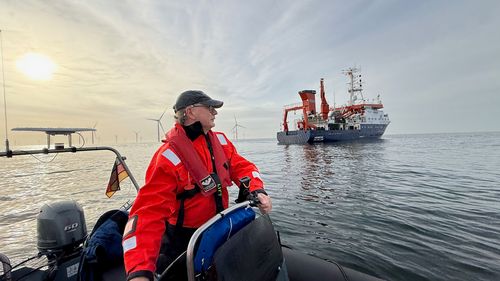
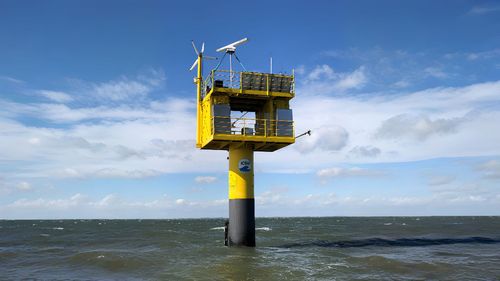
The scientists analysed water samples from several boreholes in the Sargasso Sea east of Florida. The study area is located on the Mid-Atlantic Ridge, a huge underwater mountain range that runs the length of the Atlantic. In 2012 and 2014, scientists on the German research vessel Maria S. Merian took water samples from permanently installed observatories in several boreholes within an ocean basin more than 4,000 metres deep at the edge of the mountain range. The boreholes reach down to 300 metres into the seabed, where solid but porous volcanic rock is found. "The observatories allow us to study the decomposition of the dissolved organic material over long periods of time - something that would not be possible in any laboratory experiment," reports Osterholz. The composition of the dissolved organic material was analysed at the ICBM, where one of the world's most powerful mass spectrometers is located.
The researchers discovered that the seabed resembles a natural bioreactor: according to their measurements, seawater circulates in the volcanic crust, from which a considerable proportion of the organic material mixture gradually disappears. Isotope measurements revealed that microbes are involved in the decomposition process. "The bacteria there are waste recyclers. They have to eat what arrives," explains Osterholz. The subterranean microorganisms are apparently only selective to a limited extent: the researchers proved that the molecular composition changed in a way that is typical for microbial degradation. Nevertheless, a great similarity to the original material from the sea remained.
Starved microbes devour the remains
Although each litre of seawater contains only around one milligram of dissolved organic substances, globally the amount of carbon contained in it adds up to around 700 billion tonnes. The main sources of this diverse mixture of substances are algae and bacteria, which release their metabolic products into the water or dissolve after their death. Material is also carried in from the land. But why don't marine bacteria utilise this abundant food source? "The mixture of substances consists of many different molecules. It may not be worthwhile for bacteria to initiate a special metabolic pathway for individual compounds that they rarely encounter," Dittmar explains one hypothesis. The deep biosphere, on the other hand, that starving community of microbes underground, is apparently less demanding in this respect - and also has much more time.