
To satisfy one’s own thirst for knowledge, gain new insights, become a good teacher and lay the foundations for an academic career – there are many reasons to pursue a PhD. Two doctoral candidates in Computing Science are leading the way.
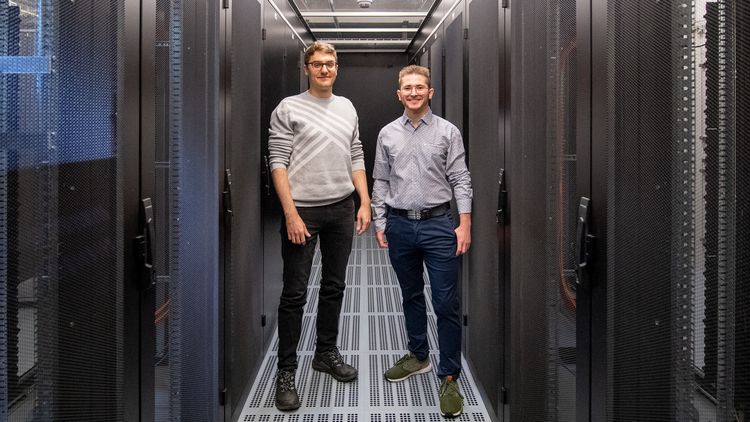
Computers, data processing and analysis: even as a young man, Nils-Steffen Worzyk was fascinated by technology and automated processes. He has been studying Computing Science in Oldenburg since 2010. First at Bachelor’s level, then at Master’s level, and now as part of the Research Training Group ‘System Correctness under Adverse Conditions’ (SCARE). In Prof. Dr Oliver Kramer’s ‘Computational Intelligence’ research group at the Department of Computing Science, he is currently conducting research into self-learning machines. What drives him? “I’d like to know, for example, how areas of public life can be made safer for people,” says Worzyk.
After all, wherever new technologies come into play, new dangers also lurk. Take artificial intelligence (AI), for instance, which can be deliberately manipulated – for example, in self-driving cars. Where there is actually a stop sign, the vehicle suddenly perceives a give-way sign, leading to accidents. In his PhD thesis, Worzyk is researching suitable methods for detecting and preventing such manipulation. “I’m right at the cutting edge of scientific discovery – it’s brilliant,” says the 27-year-old enthusiastically.
Exchange on equal terms
His PhD not only satisfies his thirst for knowledge but also gives him the opportunity to develop many other skills. Worzyk was the student representative for SCARE and supervises Master’s theses. This has honed not only his organisational skills but also his critical thinking. “I try not only to point out what can be improved, but also to suggest how this can be achieved. That’s my own standard, and the students tell me they learn a great deal from it,” he says. He has also been able to improve his ability to present his research clearly and coherently, for example in seminars or at conferences. Academic conferences, particularly international ones, are a highlight for him: “As a doctoral candidate, I really value the exchange with more experienced academics in particular. It’s not about personal vanity, but about the subject matter. It’s a great sense of community!” says Worzyk.
Passing on his knowledge to young people is particularly important to him. “A PhD provides a good foundation for teaching roles like this,” he says. The extent to which he will teach in future will, of course, also depend on how his academic career progresses: “I hope to defend my doctoral thesis in April or May. After that, I’d like to continue my research abroad, because unfortunately there are very few permanent academic posts in Germany.”
The logical next step
Jonas Prellberg, also a doctoral candidate in Kramer’s research group, isn’t giving such matters much thought at the moment. He will complete his PhD at the end of the year. Like Worzyk, he was already at the University of Oldenburg before starting his PhD, having completed his Bachelor’s and Master’s degrees in Computing Science there. Prellberg was fascinated by computers from an early age; he was already writing his own programmes at the age of 14. However, the 25-year-old hadn’t initially considered AI as a research focus. “That changed after a lecture by Oliver Kramer. After that, I wanted to explore it in depth,” he explains. He subsequently chose intelligent image recognition as the topic for his Master’s thesis, with Kramer supervising him then as he does now for his PhD. As Kramer’s research group is funded by the German Research Foundation (DFG), Prellberg has access to excellent facilities.
For him, the PhD was the logical next step towards engaging even more intensively with this field of research: “I think it’s brilliant to expand on the knowledge that humanity has accumulated so far. And I’m learning things that no one before us has ever recorded.” In his PhD research, he combines the advantages of deep neural networks and evolutionary algorithms. Deep neural networks analyse large amounts of data and consist of algorithms that, much like the human brain, pass on information when certain thresholds are exceeded. They are used, for example, in intelligent image recognition. Evolutionary algorithms optimise solutions to problems by randomly modifying them through mutation and recombination – much as happens in nature. Prellberg applies this method to automatically generate deep neural networks.
Research to help
In his research, the early-career researcher not only explores the fundamentals of AI but also applies his knowledge in practical ways. The doctoral candidate focuses primarily on medical issues. For example, how computers can be made to distinguish between healthy and diseased human cells on the basis of image data. “Particularly in regions where there is no access to expensive laboratory equipment, such applications are very useful in cancer detection. Advances in this field therefore make a significant difference to many people affected by the disease,” says the Computing Science expert.
During his PhD, Prellberg is also learning not only about the subject matter but also about methodology. For instance, he has developed a special technique for checking his work for gaps. “I prepare my results as early as possible, as if I were presenting them in a lecture. I will definitely continue with this approach, as it gives me lots of new ideas,” he says.
As for what comes after his PhD, he can envisage both options: staying in academia or moving into industry. But he is already grateful for his time in Oldenburg: “I have brilliant colleagues and I feel very much at home here. Our supervisor supports us, provides resources and places a great deal of trust in us. I really appreciate that.”