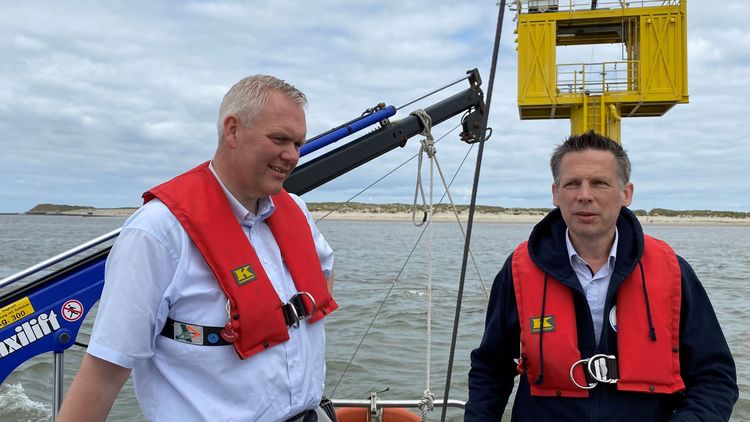


Protecting our coasts and strengthening ecosystems at the same time is the goal of the Gute Küste Niedersachsen research network. Last week, Science Minister Thümler accompanied the researchers on a measurement campaign off Spiekeroog.
What is a good coast where we can live and work sustainably and responsibly, safe from natural hazards, in harmony with nature and embedded in the cultural landscape? This is the central question addressed by the "Good Coast Lower Saxony" project, a research network of Leibniz Universität Hannover (spokesperson), the University of Oldenburg and the Technical University of Braunschweig.
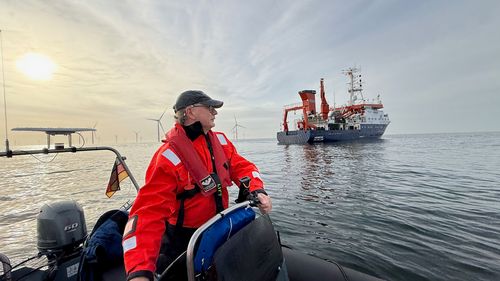
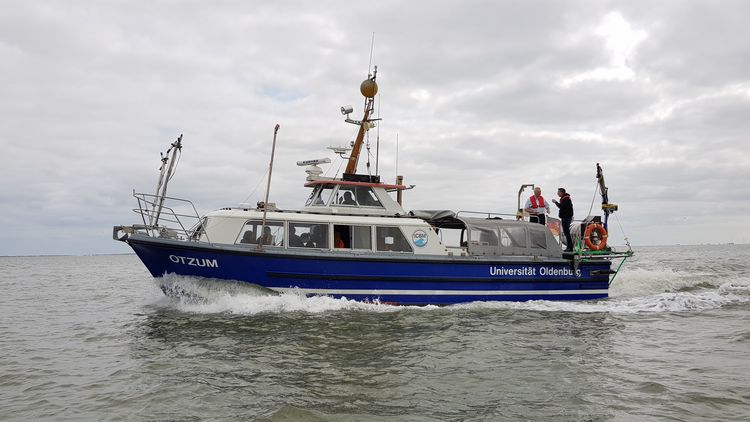
In the past two weeks, an extensive summer measurement campaign of the project took place on the North Sea coast, which the Lower Saxony Minister for Science and Culture, Björn Thümler, was informed about. Those responsible for the project explained to Mr Thümler on the research boat Otzum the measurement activities in the Harle, the sea inlet between Wangerooge and Spiekeroog, and the Otzumer Balje, the sea inlet between Spiekeroog and Langeoog. The extensive data collection serves to record and describe the typical effects of swell and tidal currents and the resulting transport processes.
Sustainable solutions for effective coastal protection
"For Lower Saxony, with a coastline of around 750 kilometres, coastal protection is one of the key issues," says Lower Saxony's Science Minister Björn Thümler. "The recent flood events in the south and west of Germany have once again shown us how dependent people are on protective structures. The effects of the climate crisis can now be felt everywhere and pose particular challenges for these structures. I am therefore delighted that scientists from the 'Gute Küste' network have already taken up these highly relevant topics as part of transdisciplinary research and in combination with research into sustainable solutions. Effective coastal protection and intact nature need not be a contradiction in terms. This is why the state is funding the project with five million euros from the Niedersächsisches Vorab programme."
Against the backdrop of climate change, the scientists from the three universities are developing comprehensive options for action and management in coastal protection in needs-orientated research together with the responsible state authorities and the local population. The area around Spiekeroog is one of the "real laboratories" within the project. The background to the measurements there is the planned renewal of a large coastal defence structure, a groyne, in the Harle.
The purpose of the measurement campaign is to gain a better understanding of the flow conditions in the vicinity of the groyne and to investigate whether, for example, pollutants accumulate at certain points. The project team wants to gain an overview of the current state of the environment by making a direct comparison with the measurements in the unobstructed Seegatt in order to draw conclusions about the changes that have been triggered.
Authorities and civil society involved
"By closely involving the relevant authorities, civil society and leading research institutions, we aim to lay the foundations for our research questions to not only meet with acceptance during the design and implementation of supplementary, ecosystem-promoting measures, but also to generate mutual knowledge and, after the end of the project, possibly even find broad imitation beyond the borders of Lower Saxony," explains spokesperson Prof Dr Torsten Schlurmann from the Ludwig-Franzius-Institute of Hydraulic, Estuarine and Coastal Engineering (LuFi) at Leibniz University Hannover (LUH).
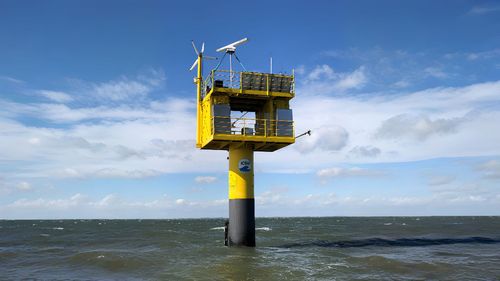
"With the help of innovative technologies and measurement strategies that we use at the Spiekeroog coastal observatory, we provide a sound data basis for developing and evaluating measures for ecologically sustainable coastal protection," says Prof Dr Oliver Zielinski, head of the Marine Sensor Systems working group at the Institute of Chemistry and Biology of the Marine Environment (ICBM) at the University of Oldenburg. "The surface drifters we have developed enable us, for example, to investigate the influence of coastal defence structures on the complex current conditions in the Wadden Sea," adds ICBM scientist Dr Thomas Badewien.
Harmonising people, infrastructure and nature
Together with local authorities such as the Wilhelmshaven Waterways and Shipping Authority (WSA) and the Lower Saxony Water Management, Coastal Defence and Nature Conservation Agency (NLWKN), the national park administration and various nature conservation associations, concepts will then be developed for how the groyne can be designed in future to strengthen both coastal protection and the protection of the ecosystem.
"The interactions between our coastal defences and the surrounding nature, such as salt marshes, dune stretches and mudflats, must be considered more holistically than before. The aim is to harmonise infrastructure, people and nature," says Prof Dr Nils Goseberg from the Leichtweiß Institute of Hydraulic Engineering at the Technical University of Braunschweig.
The 2021 summer measurement campaign is part of the "Observation and Analysis" work package within "Gute Küste Niedersachsen". In order to understand the interactions between the coastal protection elements, the mudflats and the North Sea, both continuous measurements and individual campaigns at different times of the year are necessary. Institutes from LUH, the University of Oldenburg and TU Braunschweig are involved in the measurements off Spiekeroog. In addition to our own measuring boats Otzum and Seekatze, the research catamaran Egidora from Kiel University is also involved.
Considering regulating ecosystem functions
The joint project "Gute Küste Niedersachsen", which is funded with five million euros from the Volkswagen Foundation's Niedersächsisches Vorab, addresses the tensions that people in coastal regions have always faced, as Dr Jan Visscher, Senior Engineer at the Ludwig Franzius Institute in Hanover, explains: "How can we protect ourselves from the power of the sea while at the same time using its resources and preserving its valuable ecological functions?" Today, this wealth of experience is reflected in the discipline of coastal engineering and is enshrined in law in general plans for coastal protection.
In addition to the protection of living and economic areas, the question of ecosystem-strengthening coastal protection is becoming increasingly important. Exposed dyke sections or dyke forelands are analysed in the "Gute Küste Niedersachsen" real-world laboratories. These are supplemented by ecosystem-promoting elements and systems such as salt marshes or seagrass meadows in order to establish regulating ecosystem services such as wave attenuation or sediment accumulation and simultaneously investigate their effects. (Source: University of Hanover)