


Success for Oldenburg marine scientists: a new research group led by biodiversity expert Helmut Hillebrand is investigating how biodiversity develops on islands. The German Research Foundation (DFG) is funding the project with three million euros for an initial period of three years.
Food webs and biodiversity in landscapes that are constantly changing, such as the Wadden Sea, are the focus of the new research group. The scientists aim to investigate the role played by the distribution of, and interactions between, different organisms – specifically in systems that have an island-like character. The basis for this is the so-called theory of island biogeography – a successful concept in ecology that scientists established just over 50 years ago.
With the help of this theory, researchers can analyse the role played by the dynamic balance between the arrival of new species and the extinction of others in determining the total number of species on an island. “This theory has now become highly significant – including in practical nature conservation. This is because the fragmentation of landscapes has given rise to many island-like, isolated habitats,” says Hillebrand. “However, the theory does not allow us to predict which species will colonise such island habitats and how they will interact.” This information, however, is necessary to be able to predict how environmental changes – such as those caused by climate change – will affect the dynamics of ecosystems.
International reputation
“Biodiversity research in Oldenburg enjoys an international reputation. The German Research Foundation’s approval of the research group underlines this success,” says University President Prof. Dr Dr Hans Michael Piper. “The interdisciplinary collaboration between the participating scientists will significantly advance our understanding of the processes in dynamic ecosystems.”
The project, entitled DynaCom (Spatial community ecology in highly dynamic landscapes: from island biogeography to metaecosystems), involves researchers from the University’s Institute of Chemistry and Biology and the Institute of Biology and Environmental Sciences, as well as researchers from the Senckenberg Institute, the Universities of Frankfurt, Göttingen and Münster, as well as the German Centre for Integrative Biodiversity Research Halle-Jena-Leipzig. The Lower Saxony Wadden Sea National Park Authority in Wilhelmshaven is also a project partner.
Ecological characteristics of organisms
The researchers now wish to investigate in greater detail which characteristics of organisms determine their ability to establish themselves within an ecosystem and what role they play in a food web. In this so-called trait-based research, scientists do not focus on individual species, but rather on typical characteristics or functions of various species – for example, how they disperse (by flying, swimming or passively) or how they obtain their food. Such findings can be more easily generalised and applied to other food webs and ecosystems worldwide.
The DynaCom scientists intend to investigate these various traits using the Wadden Sea ecosystem as a case study. Here, environmental conditions change rapidly, both regularly due to the tides and randomly. “As terrestrial and marine organisms come together in the Wadden Sea, we can analyse the spatial and temporal dynamics of both parts of the food web and test our theoretical concepts,” explains Hillebrand. In doing so, the researchers are drawing on fundamental, existing knowledge about the occurrence of organisms in the region.
Artificial islands in the Wadden Sea
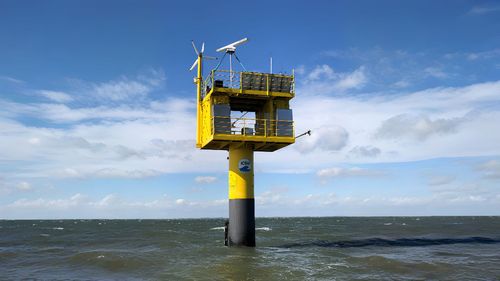
In addition, the consortium is using twelve artificial islands – which were constructed in the Wadden Sea near Spiekeroog back in 2014 – for observations and targeted experiments. Here, within a small area, the researchers can investigate, amongst other things, how quickly certain organisms colonise specific habitats and how events such as storm surges affect the communities. In order to draw more general conclusions about the development of ecological communities, the scientists also use mathematical models and datasets derived by experts worldwide from studies of island ecosystems.