
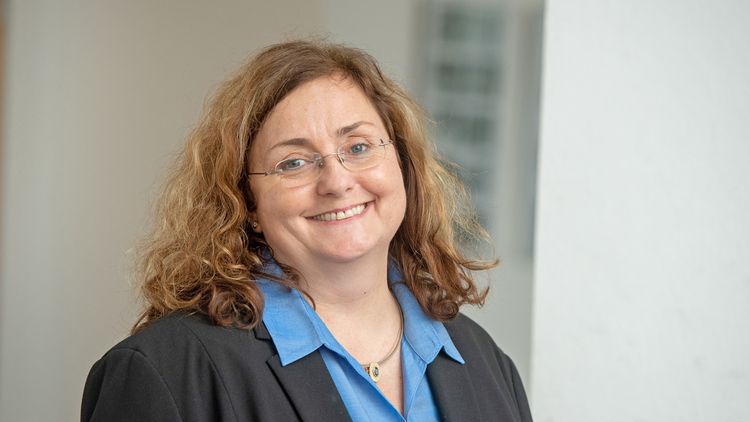


Supporting young female researchers on their career path – that is the aim of a new mentoring programme at the university. Annett Thiele, Vice-President for Early-Career Researchers and Gender Equality, explains the background.
Why is the career move to a professorship still difficult for female academics?
For many female researchers, the phase of qualifying for a professorship coincides with the phase of starting a family or the time when young children need looking after. Both areas – career development and personal life planning – demand a great deal of time and attention. Added to this is often the uncertainty associated with fixed-term posts and high mobility requirements during the PhD and postdoctoral phases. If, during this time, there is a lack of encouragement from their personal circle and from their academic supervisors, women in particular often find it difficult to commit to the uncertain path towards a professorship – especially as the statistical likelihood of attaining such a position remains relatively low.
What is the University of Oldenburg doing to support female researchers on their career path?
The University has long regarded the support of early-career researchers in general, and the support offemale researchers in particular, as a strategic priority. It therefore strives to continuously improve conditions, for example for studying and undertaking doctoral research whilst raising children, through initiatives such as those offered by the Family Service. However, it is not just about structures. What is important is a culture in which female academics are encouraged to achieve their ambitious career goals. This begins with raising awareness amongst teaching staff and line managers about a leadership culture that is gender- and diversity-inclusive; it is reflected in recruitment policies and, not least, in staff development programmes specifically aimed at female academics who are in the process of gaining qualifications or on the cusp of taking up a leadership role.
This also includes the new ‘Progressio’ mentoring programme. Who exactly is it aimed at?
‘Progressio’ is one of two strands of the University’s new Helene Lange Mentoring Programme. It is aimed at female researchers who already have their sights firmly set on a professorship, who may be on the verge of their first appointment or who have just taken up their first post as a professor – in other words, experienced postdoctoral researchers, early-career research group leaders, junior professors and tenure-track professors. It is important to me to emphasise that we wish to reach out to all female academics who identify as women, including all trans*, inter* and non-binary people. The aim of the mentoring programme is to encourage highly qualified female academics to continue pursuing their career goals with determination.
To what extent is an individual mentoring relationship helpful in this regard?
It can provide precisely what many young female researchers have often lacked up to now: mentors can offer personal and moral support, as well as sharing their experiences of the research system and the written and unwritten rules of the academic world. They possess a wealth of personal experience, as well as informal knowledge of the factors for success and the pitfalls in the academic sector, which they can share with their mentees in confidential discussions. The absence of hierarchy is crucial: mentors and mentees are not in a relationship of dependency; this is an essential prerequisite for mutual openness.
Who are you looking to recruit as mentors?
Our idea is that the mentees themselves choose a mentor who has already achieved the goal they are still striving for – and who is a good fit for their specific needs. If, at the start of the programme, someone does not yet have a clear idea of who might be suitable, the preparatory workshop can be used to help them with the selection. Of course, the programme coordinator, Dr Susanne Elpers, and I will support the mentees in establishing contact with their chosen person and securing them as a mentor. However, we’d also be delighted if female and male professors or senior university staff members who are interested in taking on a mentor group role were to get in touch with us. Depending on the mentees’ interests, leaders from other sectors may of course also be considered.
What do you hope to achieve with the programme?
We hope that ‘Progressio’ will enable female researchers who have the professional and personal qualities required to realise their ambition of becoming a professor. This would make an important contribution to counteracting the so-called ‘leaky pipeline’ – that is, the phenomenon whereby the proportion of women at higher career levels in academia continues to decline.
Is the programme intended to be offered on a permanent basis?
Two rounds are currently planned, in 2020 and 2022. Our mentoring programme is funded by the ‘Professorinnenprogramm’, a funding scheme run by the Federal Ministry of Education and Research, the third phase of which runs until 2022. What happens after that has yet to be finalised.
Shouldn’t targeted support for early-career female researchers start earlier?
It certainly should. That is why, from next year, the university will also be offering a mentoring programme for female researchers at an earlier stage in their careers. This programme, entitled ‘Potentiale. Career Guidance and Planning for Female Academics*’, is designed to support female PhD students and postdoctoral researchers shortly after completing their doctorates in identifying their career goals. This may be a goal within academia, but it could just as easily be one outside the university sector. In this case, too, the focus is on empowering participants to make their own personal decisions and then to pursue that goal accordingly.
Interview: Ute Kehse