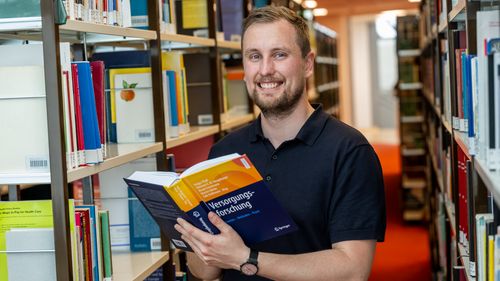
What does the TV series “Buffy” have to do with Plato? That is just one of the questions the academic articles in the new student online journal `forsch!´ aim to answer. Other topics in the first issue include: fashion blogs, guilt and remorse, and marriage as an event.
Everyone can read it – and write for it too: students at the university will in future be able to publish their academic papers in their own online journal. ‘forsch!’ is the name of the student research magazine, the first issue of which is now available to download from the university’s website.
“During their studies, students conduct research and write academic papers with truly remarkable results. These are usually presented to fellow students in seminars and then often end up gathering dust in a drawer. We want to change that,” explains Dr David Kergel, an educational scientist who coordinates the online journal. `forsch!´ offers a platform to publicise students’ research findings and essays beyond the boundaries of their respective disciplines and to present them to an interested public.
The idea for `forsch!´ arose as part of the ‘Focus on Research-Based Learning’ (FLiF) project, funded by the Federal Ministry of Education and Research. The aim of FLiF is to develop innovative teaching and learning concepts and to introduce students to all phases of research and academic work, thereby combining learning and research. With `forsch!`, students are given the opportunity to go through an entire research cycle – from the research question to publication.
Undergraduate and postgraduate students from all disciplines can submit their research papers, essays or academic articles to `forsch!`. An editorial team, comprising academics from the university, assesses the academic standards of the work and supports students with the publication process. In addition, there is a co-operation with the Lernwerkstatt at the Central Study Counselling Service to run an academic writing workshop.
The first issue of the student research magazine reflects a cross-section of student research activities: Academic essays examine the ‘study workload of students studying one subject or two subjects at the Bachelor’s level’ or explore whether the US fantasy series ‘Buffy’ is a modern adaptation of Plato’s Allegory of the Cave.
An academic exposé analyses the ‘future of civic engagement’ and looks back on 15 years of the Enquete Commission. An essay examines the UN Convention on the Rights of the Child and its significance in Germany. The ‘Experimental Format’ section features a video piece on fashion blogs. The first issue also showcases award-winning final-year dissertations.
‘forsch!’ is published twice a year, and special editions are also planned, for example to cover student conferences or large-scale seminars.
More on the topic
<media 117086 - - "TEXT, forsch Ausgabe1, forsch_Ausgabe1.pdf, 10.1 MB">First issue of `forsch!'</media> (published at the end of 2014)
Research-based learning in focus (FLiF) and research-oriented teaching (FoL)
Contact
Maren Petersen
Project Coordination FLiF
Tel: 0441/798-4850
maren.petersen@uni-oldenburg.de