

Can insects and other stream inhabitants be relocated from an ecologically intact body of water to a species-poor stream in order to improve the ecological quality there? This question is the focus of a new research project by Oldenburg biologist Prof Dr Ellen Kiel and her working group on aquatic ecology and nature conservation.
The aquatic ecologists at the University of Oldenburg are following up on a pilot project with their research: From 2015 to 2018, they developed and tested suitable "relocation mobiles" for aquatic animals made from natural materials such as wood and leaves in co-operation with regional water associations and the University of Duisburg-Essen. After a two-year dormancy phase, a success review will now show whether specific species have been able to establish themselves in the target water body. The North Rhine-Westphalian State Agency for Nature, Environment and Consumer Protection (LANUV) is funding the project.
"The ecological deficits in many of our watercourses are serious," emphasises Kiel. "Only if snails, crayfish, insects and other animal groups form type-specific species communities and population densities on the river bed is there a chance of ensuring good water quality in the long term from an ecological perspective."
Streams and rivers have served mankind for centuries in many ways, for example by providing drinking water or removing industrial water. As a central element of sophisticated drainage systems, they helped to absorb and drain water. This enabled people in many places to colonise and cultivate wet or temporarily flooded areas.
It was only two decades ago, however, that the European Water Framework Directive established a new view of the quality of streams and rivers with a stronger focus on their ecological functions, says Kiel. "But good water quality and water structure alone are not enough to improve the ecological status of a body of water," she emphasises.
The Water Framework Directive uses the specific animal communities as the central indicator for the "ecological functioning" and quality of watercourses, "because a stream in the Harz Mountains is colonised by different animal species than the Hunte," says Kiel. And the directive sets the goal that all natural water bodies should have a good ecological status in future. "However, the water type-specific fauna that is missing in 'broken' streams does not necessarily return there of its own accord," says Kiel. The reason for this is often weirs and other transverse structures that prevent animal migration, but also unusually high water levels or narrow sections with high currents.
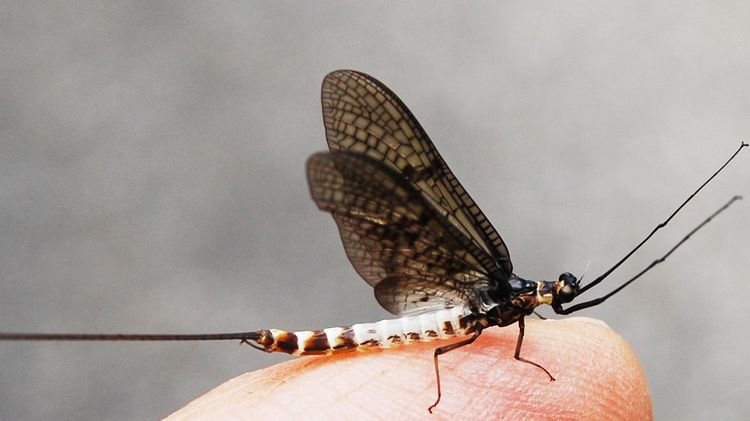
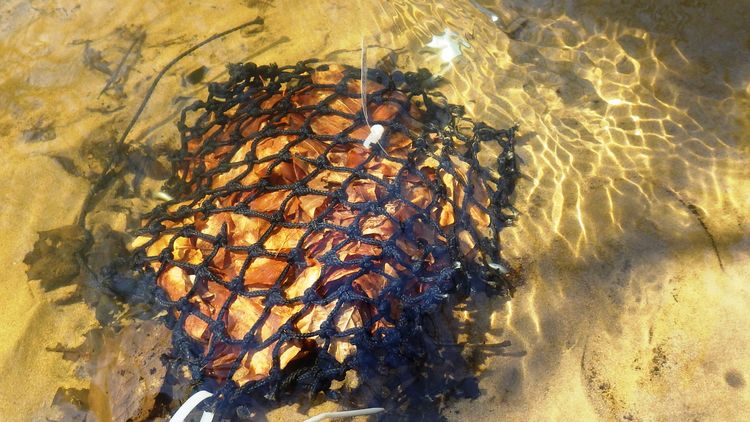
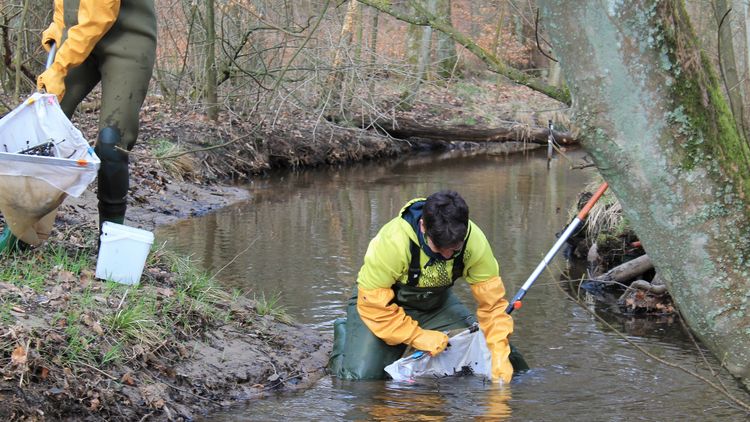
In the search for the optimal "relocation vehicle", aquatic ecologist Kiel, her doctoral student Arlena Dumeier and technical assistant Esther Timmermann used their knowledge of the behaviour and preferences of the invertebrate communities living on the river bed. Leaves, wood and other substrates are naturally abundant there, and a large proportion of the aquatic fauna colonises them. The research team also included employees on the Voluntary Ecological Year programme as well as numerous students, mainly of environmental sciences and landscape ecology, who used the project for field studies and final theses. In the end, a combination of alder wood wrapped in nets with beech and alder leaves proved to be the ideal "home" for certain species of mayflies, stoneflies and caddisflies, for example, but also for specific dragonfly and beetle species.
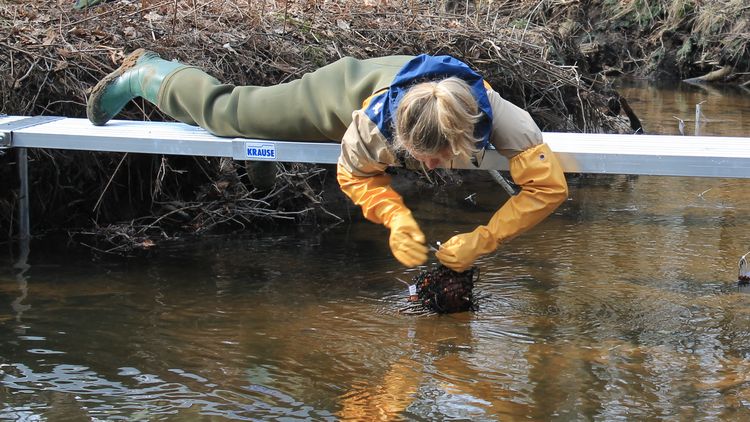
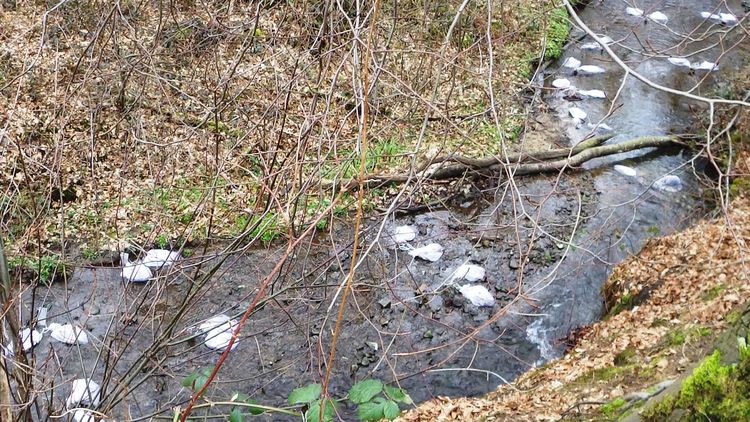
Over the course of the project, the team attached a total of more than 600 of these substrate nets to the bed of the so-called donor watercourse, the Rotbach on the edge of the Ruhr area. After six weeks, the researchers moved the relocation aids and the aquatic fauna they contained - i.e. the animals living at the bottom of the watercourse - to the species-poor recipient watercourse, the Eselsbach near Düsseldorf.
Kiel explains that nature conservation authorities and water associations in North Rhine-Westphalia are already considering where and how the "relocation vehicles" could be used. "In other types of watercourse, however, the method would have to be adapted: A sandy stream works differently to a gravel stream, a loess-loam stream or one in limestone," says the aquatic ecologist. "The species are different, as are their preferences." Kiel's team will now first scrutinise the fauna in the Eselsbach and check whether the resettled species have settled there permanently.