Contact

Press & Communication

+49 (0) 441 798-5446

More podcasts from the world of university

“Abgehört – Didactics for the Ear”


The creators: Thomas Schmidt, Head of Medical Didactics, and Dr Susanne Quintes, project officer at participate@UOL for School V - School of Medicine and Health Sciences.
What it’s about: Current topics in didactics and teaching, as well as various teaching and learning formats, with a focus on medical didactics. The target audience is lecturers and students.
Listen here: uol.de/medizindidaktik/digitale-lehre/e-learning-podcasts

“campus radio podcast”


The creators: Students from the campus radio team
What it’s about: A recording of the monthly programme covering topics relating to the university as well as cultural events in Oldenburg and the surrounding area.
Listen here: Spotify

“Hirn gehört – Oldenburg Knowledge Chat”


The creators: Oldenburg Network for Science Communication, presenters: Jens-Steffen Scherer and Bianca Brüggen
What it’s about: To showcase the diversity of Oldenburg’s research landscape – and, above all, the people behind it
Listen here: hirnvomhahn.de/podcast/

“Ideas from Lower Saxony – SOUVER@N in digital higher education”


The creators: Susanne Schorer and Ioulia Grigorieva, former members of the SOUVER@N project; Yasmin Azim Zadeh and Annika Katharina Schmidt, current members of the SOUVER@N project.
What it’s about: Expert interviews on topics relating to digital teaching and digital learning.
Listen here:
souveraenes-digitales-lehren-und-lernen.de/home/podcast/
Spotify, Deezer, Apple Podcasts, Podcast.de, Leuphana, Science Podcasts

‘Child Protection in Primary Education’ – the science-meets-practice podcast for child protection education

The creators:
Season 1: Prof. Dr Anke Spies, Professor of Educational Science specialising in Pedagogy and Didactics of Early Years and Primary Education at the Institute of Educational Sciences.
Series 2: Prof. Dr Anke Spies and Heike Prüshoff, who holds a diploma in Social Pedagogy and Social Work, and is a professor of Educational Science specialising in Pedagogy and Didactics of Early Years and Primary Education at the Institute of Educational Sciences.
What it’s all about: Three experienced specialists (in accordance with Section 8a of Book VIII of the Social Code) explain and discuss the fundamentals of child protection for primary schools and their staff from the perspective of specialist advisory practice.
Listen here: uol.de/kinderschutz/podcast, Twillo

Note: The second series will be released in autumn 2025.

“OER for Teacher Training”


The creators: Prof. Dr Clemens Hillenbrand, Professor of Pedagogy and Didactics for Learning Disabilities at the Institute of Special Needs Education and Rehabilitation and project leader for OER for Teacher Training, and Nils Wiedemann as presenter
What it’s about: In the three episodes ‘A Bus Called Inclusion’, ‘Good Teaching’ and ‘Having and Needing’, Wiedemann and Hillenbrand discuss the latest findings from the field of special education. The series is aimed at students training to be teachers in general education and university lecturers who train these students, as well as teachers in general education schools and other interested parties.
Listen here: Twillo

“Um Kopf und Kragen – the climate protection podcast”


The creators: Students
What it’s about: “What’s going wrong in climate communication and how can we get it right?”
Listen here: All popular podcast platforms

“You, Me and HIFMB – Stories of Science and the Sea”


The creator: Dr Jan-Claas Dajka, Helmholtz Institute for Functional Marine Biodiversity (HIFMB).
What it’s about: Highlighting the lives and careers of the people behind marine biodiversity research and marine conservation. The latest episodes explore the role that social science perspectives play in marine research.
Listen here: hifmb.de/news/podcast
Spotify, Apple Podcasts, Amazon, Podbean, TuneIn, PlayerFM, Podchaser, Listen Notes

  • Woman with headphones holding mobile phone on which the podcast "Hirn vom Hahn" is displayed.

    Numerous podcasts are produced at the University of Oldenburg. "Hirn gehört: Oldenburger Wissensschnack" is already close to its 50th episode. Photo: Adobe Stock/oatawa

"We tell life from the front"

The 50th episode of the podcast "Hirn gehört - Oldenburger Wissensschnack" will be released in May. We spoke to the presenter duo and provide an overview of more podcasts from the university cosmos.

The 50th episode of the podcast "Hirn gehört - Oldenburger Wissensschnack" will be released in May. We spoke to the presenter duo and provide an overview of more podcasts from the university cosmos.

On "Hirn gehört", you meet a scientist every month and ask them about their personal academic appointments, among other things. Have you ever failed at the podcast?

Brüggen:
Fortunately not, but just last week we had some serious problems. We always meet with our dialogue guests on a special online platform. At first, access to the platform didn't work technically as usual, then the guest's audio track suddenly disappeared. Fortunately, we were able to solve the problem the next day and save the episode.

The first episode appeared in 2021 when the "Hirn vom Hahn" event series was cancelled due to the pandemic. "Hirn vom Hahn" has long since resumed, but the podcast is still available. Why?

Scherer: We were quickly well-rehearsed as a whole team, so the workload for each individual is manageable. The members of the Oldenburg Network for Science Communication, on whose behalf we make the podcast, take care of acquiring the guests. Bianca and I prepare the content for the episodes and conduct the interviews, and our FWJ student Kim Kea Meinen edits the material.
Brüggen: I always say: we just haven't been cancelled yet. (laughs) We also really enjoy it. You get to know a different person every time and, above all, the person behind the research. It's amazing how many coincidences career paths depend on and how many failures even very successful people today have behind them. In hindsight, you can always give a stringent explanation of a CV, but we tell life from the beginning - and get to see all the twists and turns.
Scherer: At the same time, we dive into a new research topic every time - and the next time into the next one. I love that! Episode after episode, a very diverse body of work has emerged. I think we succeed in creating a nice and safe dialogue situation in which researchers can easily open up, and thus convey a completely different facet to "Hirn vom Hahn".

In the current almost 50 episodes, listeners also learn many private details from your interview guests. Which stories are particularly memorable for you - and why?

Brüggen: When I recommend an episode, it's always episode 13 with the visceral surgeon Prof Dr Dirk Weyhe. He tells the story of how, during his training as an emergency doctor, he was called out to an elderly couple and, through a chain of unfortunate circumstances, dismantled parts of their living room. A really funny story that shows once again that something can go wrong for everyone.
Scherer: I was also impressed by Dr Alexandra Pehlken, who was a guest in episode 3. She told us in a very personal way how she came back to Germany from Canada with a doctorate in engineering, didn't find a job after a year on parental leave and was unemployed for the first time. Today she is a successful researcher at OFFIS. The story of paediatrician Prof. Dr Anne Hilgendorff was also very personal. She wrote her doctoral thesis on people with heart transplants, not realising at the time that she herself would receive a heart transplant years later.

More and more podcasts are being created at the university. What advice would you give to beginners?

Brüggen: You should make sure that listeners can relate to themselves. In our podcast, the focus is on encouraging people, which is why the question of failure is so important in my eyes.
Scherer: Once you have a concept, it's important to stick with it. Consistency is like an anchor in the mind and listeners look forward to the established structures. From a technical point of view, good sound quality is particularly important. The time when people forgave podcasts for bad sound is over.

What are your plans for the future?

Scherer: I sometimes wish for more interaction with the listeners and think about possible participation concepts.
Brüggen: And apart from that, we'll carry on as long as people let us. There are plenty of exciting dialogue partners. The twelve slots for 2025 were already allocated at the beginning of the year.

Interview: Sonja Niemann
This might also be of interest to you:

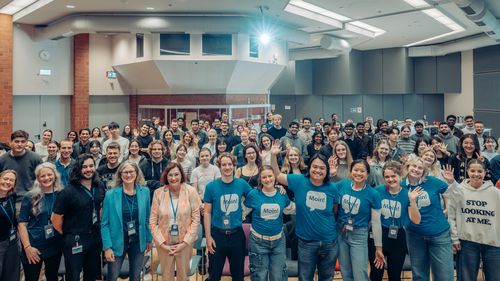
A large group of smiling international students, international tutors and university staff pose together in a brightly lit lecture theatre during the welcome event for international students at the University of Oldenburg.
University of Oldenburg / Marcus Windus
Campus Life International affairs

Welcome to Oldenburg

They come from Brazil, Spain or Indonesia: just over 500 international students are starting their studies in Oldenburg this semester – either as…

more: Welcome to Oldenburg
Sascha Stüber
Campus Life

On Bikes through the City of Science

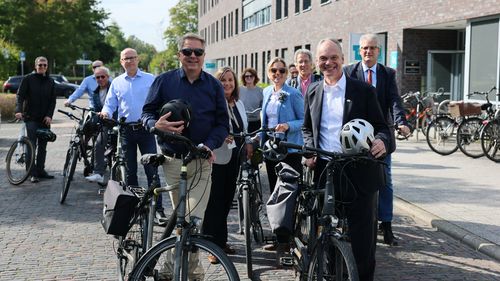
Leading members of the city administration and university continued their regular exchange whilst on the move. Their journey by bike took them past…

more: On Bikes through the City of Science
Photo of Jessica Adaobi Nnamani presenting her project.
Emilia Bondzio
Campus Life

Spotting racism in school textbooks

How do the depictions in school textbooks influence our understanding of culture and racism? And what can teachers do to change this? Jessica Adaobi…

more: Spotting racism in school textbooks
(Changed: 19 Sep 2026)  |  Kurz-URL:Shortlink: https://uol.de/p82n11032en
Zum Seitananfang scrollen Scroll to the top of the page

This page contains automatically translated content.