
Service dogs on the campus
Service dogs on the campus
Assistance dogs are specially trained dogs that support people with disabilities, impairments or chronic illnesses in everyday life.
They help their owners to participate as independently and equally as possible in social life and, here at the UOL, in their studies and/or work. In order for the dogs to do their job well, they need a low-disturbance environment. They should not be touched without being asked and should not have to come into contact with other dogs, especially dogs running free.
On our campus, everyone can meet several assistance dogs at both locations (Haarentor Campus / Wechloy Campus). They usually accompany their owners wherever they go and are therefore present on campus:
Good to know
In order for the dogs to fulfil their tasks reliably, it is important that they are not distracted. In detail, this means for the dogs:
- They must not sniff
- They are not allowed to make contact with other people and/or dogs
- They must always stay by their owner's side
Assistance dogs are therefore given additional support in their task if no contact is made with other people and/or dogs. This means in detail:
- No petting
- No eye contact or staring
- No verbal contact
- No feeding or luring
- No unsolicited photography
Access rights of assistance dogs
Recognised assistance dogs may generally be taken anywhere where other people have access.
Assistance dogs do not pose a medical or hygiene risk. Exceptions therefore apply to them, e.g. in more sensitive areas such as canteens or laboratories. They are allowed in all buildings and rooms that are open to the public (e.g. lecture theatres, libraries, canteens, offices).
This is regulated by law and applies as long as no one is unreasonably burdened and the dog is healthy and well-groomed.
Dealing with assistance dogs
Respectful and considerate treatment of assistance dogs and their owners is crucial. Only then can they participate in campus life safely and without disruption.
Note:
Even if an assistance dog appears calm or playful, it is still working. Distractions can disrupt their concentration and cause risky situations.
How can you recognise an assistance dog?
Assistance dogs are recognisable to everyone, but a distinction must be made between recognised assistance dogs and assistance dogs in training:
Recognised assistance dogs

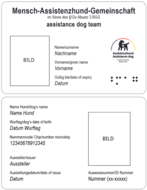
Recognised assistance dogs are tested and certified in accordance with the Assistance Dog Ordinance (AHundV).
They are authorised to enter publicly accessible areas of the university. Registration at the university is not mandatory for recognised assistance dogs, but is expressly recommended in order to make campus life as barrier-free and conflict-free as possible.
Students and employees with assistance dogs who exercise their rights under Section 12e (1) BGG must label their dog. The labelling is done by:
- An official badge in accordance with § 26 AHundV, which is usually visibly attached to the dog's identification blanket or harness, or
- An official assistance dog licence, which can be shown on request.
Assistance dogs in training
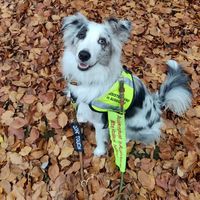
Assistance dogs in training are not yet legally recognised as assistance dogs. They therefore do not have automatic access to university buildings.
In order to provide students with assistance dogs in training with the best possible support, the university allows them to be taken along on condition that
- The dog is visibly and clearly labelled (e.g. with an identification blanket, bandana or similar) and
- The dog is officially registered with the university in advance. To do this, please contact , Division 4: Facility management, directly.
Compulsory use of a lead and carriage of dogs without assistance function
The campus is a common space for everyone. This means that everyone must adhere to the applicable rules.
Rules for dogs without assistance function are
- A dog must be kept on a lead on the university campus
- A dog may not be taken into a building (see House Rules §3 (5)).
These requirements apply to all persons (members, relatives, guests, external persons) on campus.
If you notice that these rules are not being adhered to, it is helpful to point this out to the person(s) in a friendly manner. Furthermore, this can also be reported to this contact:
Why is this important?
Dogs running loose on the premises and unauthorised dogs in buildings can distract assistance dogs from their work or, in the worst case, get into fights.
However, it is not only assistance dogs that can be disturbed or unsettled by unleashed or unauthorised dogs. People with phobias, allergies or physical impairments (e.g. wheelchair users) can also be affected.