
Archive
Archive
New publication: Das Plastik-Dilemma
Simulation game with learning sequences on the topic of "Plastic in the sea" for science lessons in secondary schools I and II

Plastic is omnipresent in almost all areas of our lives, as it makes our everyday lives easier. At the same time, we are aware that we are generating a flood of plastic waste, which is also ending up in the environment and the oceans to a large extent. How can we succeed in promoting a responsible and reflective approach to plastic and thus make a contribution to education for sustainable development?
A simulation game aims to provide an answer to this question: The fictitious city of Siebenstadt is faced with the question of how a responsible approach to plastic can be achieved at regional level.
To this end, a committee of enquiry is convened to decide on the city's future approach to plastic. The committee members represent different interests and are invited to use experiments, research and discussions to build up technical foundations and ethical arguments on the topic of plastic, which are presented and weighed up at the committee meeting.
The simulation game is aimed at teachers, environmental educators and all interested parties whose aim is to promote key scientific skills such as experimentation and argumentation in an application-oriented way in order to enable participation in social debates on the topic of plastics.
by Corinna Hößle, Antje Wichels, Holger Winkler, Laura Thiel, Christina Kieserg, Marie Fischer
Schneider Verlag Hohengehren GmbH, ISBN: 3834021377
Photo exhibition
Mindful experiences of nature on Spiekeroog
"Mindful perception of nature on Spiekeroog" is the name of the photo exhibition that was designed by student teachers at the University of Oldenburg under the direction of Prof. Dr rer. nat. Corinna Hößle and was to be exhibited from 2 to 30 June at The Smart House Oldenburg. As the exhibition could not be shown due to the coronavirus pandemic, the impressions can now be viewed digitally. As part of the seminar entitled 'Teaching and learning in the school laboratory on Spiekeroog', the students focussed not only on teaching pupils about the Wadden Sea and oceans, but also on the question of how it is possible to consciously perceive the beauty and diversity of natural phenomena on Spiekeroog. The students captured their encounters with nature in photographs, which they are presenting in the exhibition.

Opening of the molecular biology student laboratory at the Helene Lange School in Oldenburg
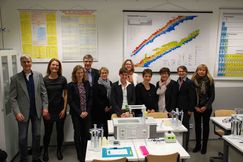
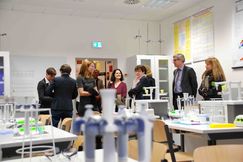
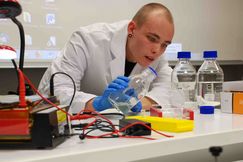
Planning for the new student laboratory at Helene Lange School in co-operation with the biology didactics department began almost two years ago. The laboratory was officially opened on 30 November 2018. The event focussed on thanking all the sponsors and supporters who made this project possible. The EWE Foundation, the LZO Foundation, the Friends of the HLS and the German Chemical Industry Association played a major role in providing the financial equipment and materials. The HLS laboratory enables pupils to carry out processes such as polymerase chain reactions and gel electrophoresis independently under expert guidance and is therefore unique in Oldenburg. The collaboration will be expanded even further in the future. For example, the concept of organising biotechnology laboratory days with pupils is to be expanded to include courses at the university for students studying to become teachers in the subject of biology. All sides benefit from this link: the pupils experience practical laboratory work during their time at school and the future teachers develop, accompany and evaluate themed days in close cooperation with those responsible for the end of project.
The NWZ also reported on the opening ceremony: www.nwzonline.de/oldenburg/bildung/oldenburg-naturwissenschaften-im-top-labor-der-dna-auf-der-spur_a_50,3,2220118305.html
Visit from Japan to the sensory school
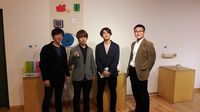
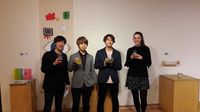
Prof Uchinokura from the university in Kagoshima visited the sensory school with his students on 20 Feb. 2018. Using the English research booklet, the group was able to explore the stations independently.
High-ranking visitor to the Green School
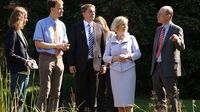
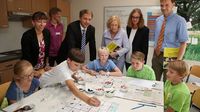
Federal Research Minister Johanna Wanka visited the Green School on 29 August 2016. After a tour of the Botanical Garden, Mrs Wanka was particularly keen to accompany pupils on their research at the Green School and gain an insight into the training of future biology teachers. Wanka looked over the shoulders of some pupils who were researching the dependence of plant colour on the pH value of the environment. The pupils are part of the naturalist group at the cooperating Paulus School and are accompanied by our students (Carolin Albers, Jennifer Brunken) during their experiments.