A bridge to the future
A bridge to the future
Sound installation by Enrico Stolzenburg in collaboration with the Institute of Music to mark the 50th anniversary of Carl von Ossietzky University.
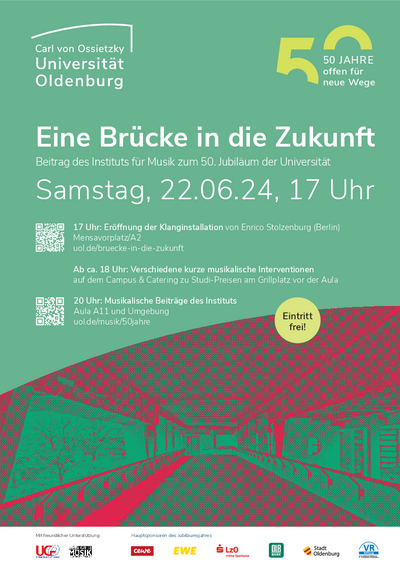
The opening ceremony took place on 22 June 2024 at 5 pm
"The hour will come when everything that is still vaguely future will be present, when time itself will demand an account of what we have done all these years. It will depend on our answer whether we are allowed to share its path or whether it will pass over us"
Carl von Ossietzky: A word about activism, in: Monthly Bulletin of the German Monist League, 1 March 1918.
The sound installation picks up on this quote on the occasion of the 50th anniversary and aims to make the university of the present audible for the future. It was created especially for the location of the bridge and is designed as a permanent installation. It is a co-operative project in which many students and lecturers from the Institute of Music have been involved over the course of a semester. The composition, which can be heard, uses original and transformed sound recordings from very different areas of the university (canteen, library, laboratory...). It documents our everyday life today and builds an artistic bridge to tomorrow.
The installation plays 36 short pieces one after the other.
There are pauses of varying lengths of maximum 3 minutes between the pieces.
The loop starts again after 100 minutes.
The installation runs daily from 8 am to 6 pm. It is open to the public at all times.
Admission is free.


The place
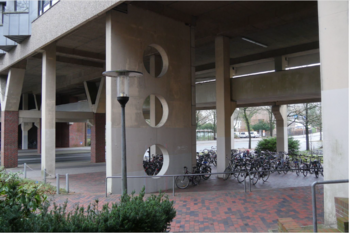
The transition on the bridge to the canteen and library building fascinates from the very first moment with its futuristic form. The clear architecture of a bygone era is outdated, but with its cool exposed concrete it appears both historic and modern and, with a little imagination, looks like the setting for an old science fiction film.
Just as in its shape, there is also a fascinating contradiction in its use. On the one hand, the bridge is very visible and prominent in the centre of a major building complex; on the other hand, it is surprisingly rarely used, even when it rains. The route across the zebra crossing seems more plausible for everyday use.
When there is light car traffic, the path on the bridge becomes interesting not only in terms of appearance and use, but also in terms of sound. Like water on a bank, the vehicles roll in waves and disappear again. In summer, we can hear the birds in the trees and the babble of students' voices on the Mensa forecourt from here. At any time of day, there are bicycles, buses and people walking. These and other everyday noises make the large resonance chamber of the bridge and the building structure a special place in terms of sound.
Procedure
Work step 1
The students and lecturers of the seminars make recordings(field recordings) at the university in dialogue with the Berlin sound artist.
Enrico Stolzenburg has been making his own recordings on site since November 2022
Work step 2
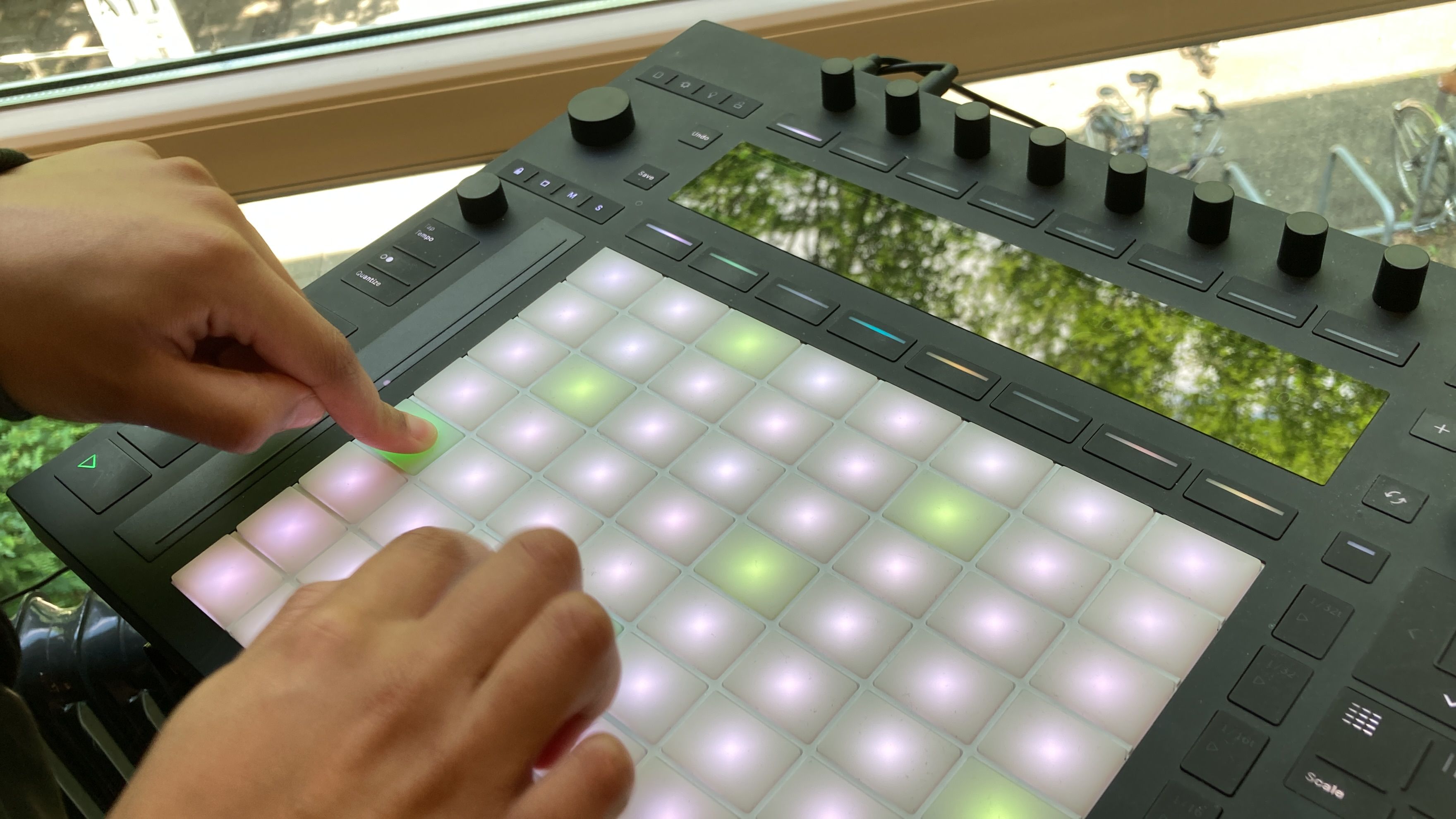
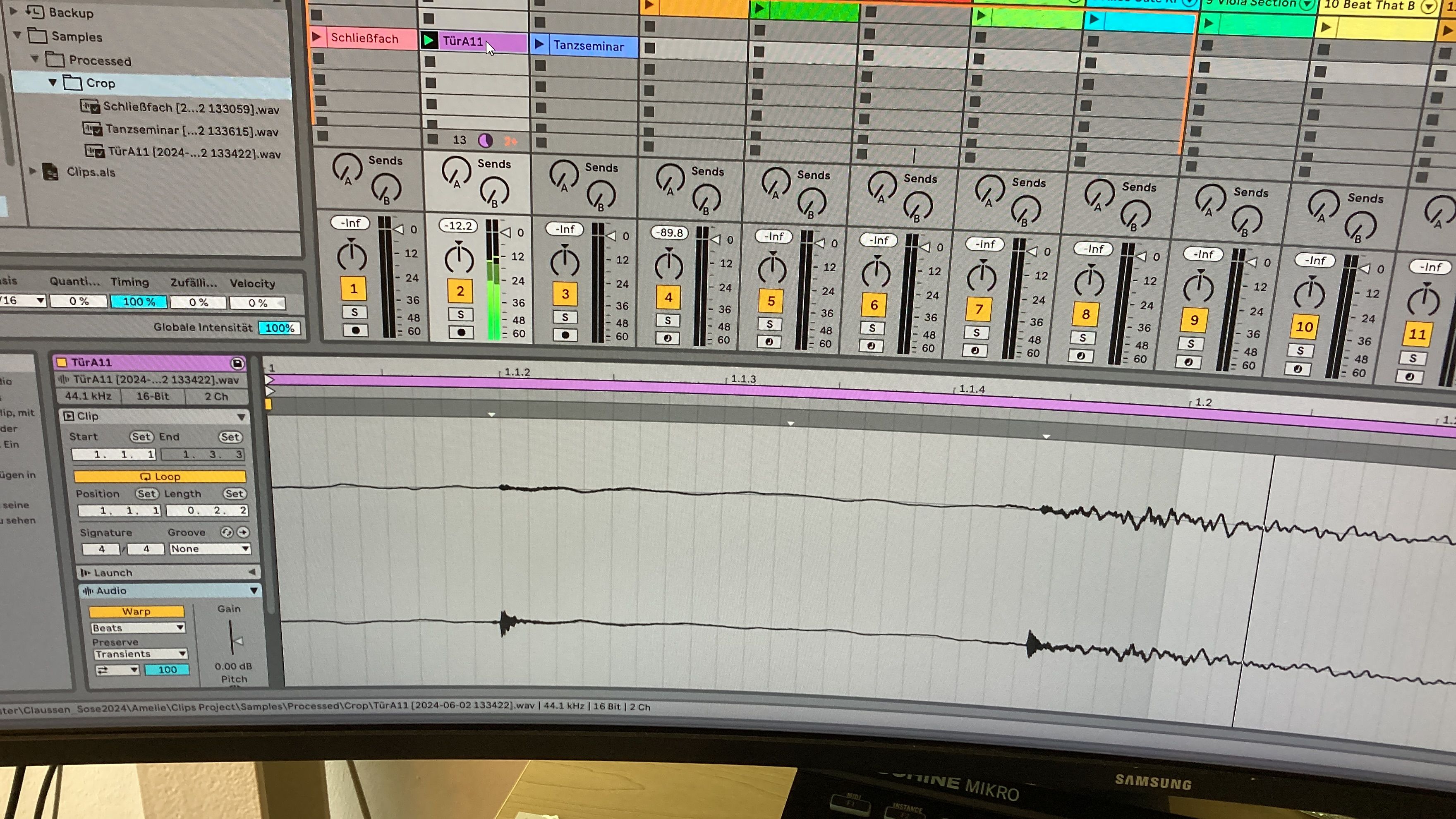
The seminars transform the recordings of the "noises" into instrumental and vocal sounds. In doing so, they consistently adhere to the time structure of the original recordings and a "music" is created. For example, the building site at the zebra crossing becomes a percussion sound, the coffee machine becomes a saxophone solo, the sound of the entrance area becomes a choir, the laboratory becomes a glass harp.
Work step 3
Enrico Stolzenburg takes a compositional approach to the material from the seminars. He supplements, combines, edits and finally produces the final sound tracks, which can be heard in the loop as a feed to the 4-channel sound installation.
The sound installation will be inaugurated on 22 June at 5 p.m. with a live programme.
Contributors
Artistic director: Enrico Stolzenburg
Project leader: Volker Schindel
Project coordination: Nina Aubke & Wiebke Hermsteiner
Technical and artistic collaboration: Hagen Pianka and Hermann Stolzenburg
Chamber choir (conductor: Silja Stegemeier)
Julia Barwig, Hauke Mirco Bents, Aaron Beyersdorf, Ilka Dirksen, Hakon Dorn, Clemens Hupka, Carla Josupeit, Katharina Kaht, Ragnar Kleen, Hanna Kretschmer, Jennifer Lambertz, Luisa Manegold, Jule Manja Molchin, Jan-Daniel Moulai, Clemens Ohlendorf, Lucija Periša, Valentina Josefa Pille, Lina Pokern, Lilli Rhensius, Sophia Rother, Malin Rudolph, Anna Elia Schmidt, Jonas Schmitt, Kajsa-Linn Schnaak, Jordis Antonia Schönlau, Simon Stendel, Jonathan Strehle, Simone Thyen, Louis Wilke
Seminar: Composition(s) for the sound installation "A Bridge to the Future" on the occasion of the 50th anniversary of the CvO University Oldenburg (Director: Olga Riazantceva-Schwarz)
Linnéa Gutekunst, Annette Kurz, Hagen Pianka, Erika Reinhardt, Christin Stefanie Scheibe
Seminar: Musik Macht Theater - sub-project for the CvO anniversary (Head: Christiane Abt)
Julia Barwig, Carina Dirks, Natalie Hagen, Dmitrey Ivanov, Niels Jantschalek, Lisa Klawonn, Wiebke Johanna Legtenborg, Sophia Rother, Frederika Scheifler, Mona Semken, Lara Spechmann, Rouven Thiele, Jan Tschuschke, Sarah Wagner, Janel Zajac
Seminar: Push the Bridge: Live Sampling for A Bridge to the Future (Director: Jan-Torge Claussen)
Alysha Sebastiao, Amelie Trocka, Martain-Louis Wiek
Seminar: Improvisation and playing concepts for musical work with groups WiSe 23/24 and SoSe 24 (Head: Volker Schindel)
Amelie Trocka, Maren Bußmann, Era Freiin von Massenbach, Linnéa Gutekunst, Valeria Hoffmann, Katharina Kaht, Jan-Phillip Köhler, Klaas Kretzmer, Annette Kurz, Melanie Miller, Lars Möllering, Hannah Rameil, Ann-Cathrin Reimann, Simon Stendel, Theresa Stengert
Seminar: Percussive Soundscapes (Director: Gereon Voß)
Jana Düning called Hagemann, Sophia Hilbers, Ragnar Kleen, Leo Rott
Recording locations and file names
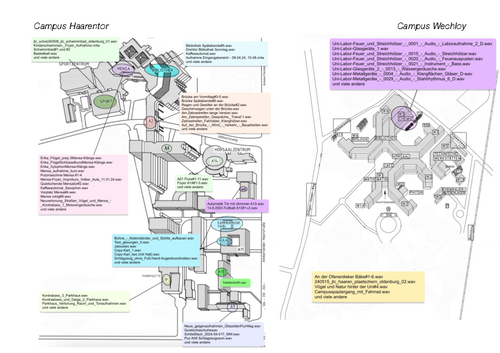
- Canteen
- Bridge A2
- Library
- Sports/Swimming pool
- multi-storey car park
- Institute of Music: A09/A10/ A11
- Corridors A1, A14, A13
- University laboratories Wechloy
- Nature around the campus
... and many other places
Vita Enrico Stolzenburg
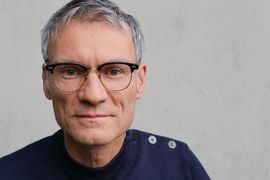
Enrico Stolzenburg, born in 1973, is a theatre director and sound artist.
He was a member of the Berliner Ensemble and resident director at the German National Theatre in Weimar, and has directed productions at venues including the Schaubühne, the Deutsches Theater Berlin and the Theater Freiburg. He has staged world premieres and first performances in Germany and Switzerland, in Athens, for the Festival d’Avignon, at the Viirus Theatre and at the Kiasma-Teatteri in the Museum of Contemporary Art in Helsinki, at the Miryang Theatre Village in South Korea and at the Seika Theatre in Osaka.
His productions have been staged at international festivals such as ‘Premières’ at the Théâtre National de Strasbourg, the Miryang Summer Performing Arts Festival in South Korea, the Autorentheatertage at the Thalia Theatre in Hamburg and the German Theater Berlin, the ‘Auawirleben’ Contemporary Theatre Festival in Bern, and the Hangö-Teaterträff in Finland.
As a sound artist, he works in an interdisciplinary manner with other artists and also as a soloist. He has created site-specific compositions, audio walks and sound installations for, amongst others, the Munich Biennale, the Kunstfest Weimar, the Festival Neue Musik Rümlingen, the Niedersächsische Musiktage, the Münster Symphony Orchestra, the Musikkollegium Winterthur, the Witten Days for New Chamber Music, Zeiträume Basel, Rainy Days Luxembourg, Lieu d’Europe Strasbourg and the Donaueschingen Music Festival.
He has been teaching as a professor of stage direction on the acting degree programme at the Berlin University of the Arts since 2014.