
International Conference
International Conference
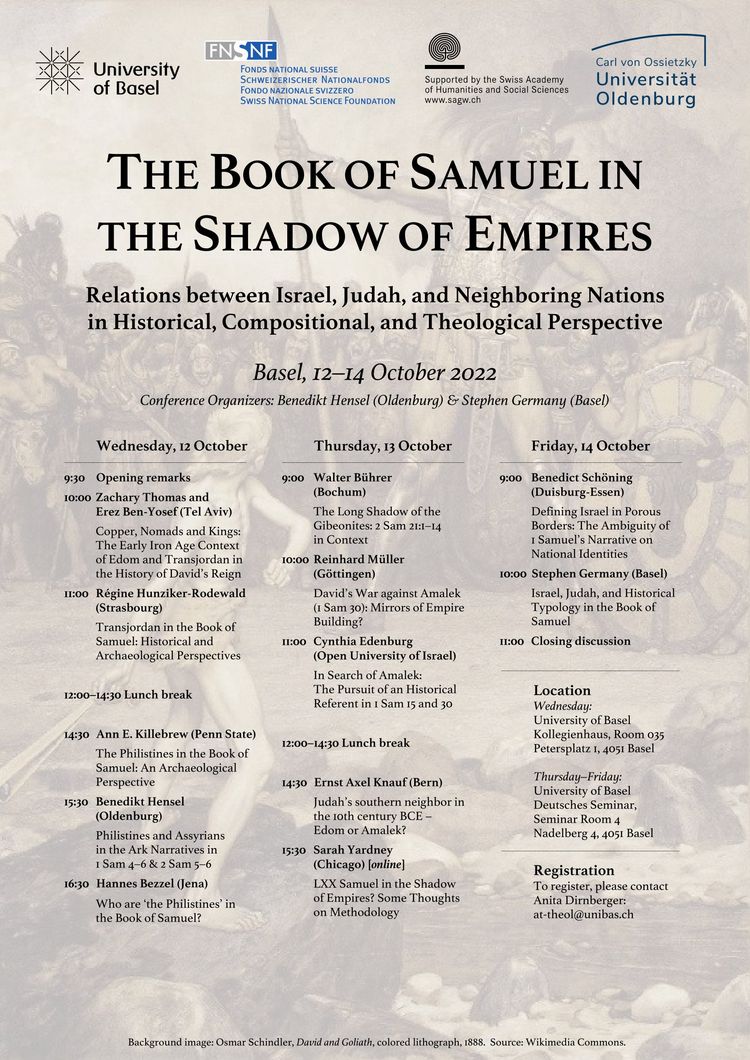
The Book of Samuel in the Shadow of Empires.
Relations between Israel, Judah, and Neighbouring Nations in Historical, Compositional, and Theological Perspective
12-14 October 2022
Organisation
Prof. Dr Benedikt Hensel (Oldenburg)
Dr Stephen Germany (Basel)
Event announcement (for English version see below)
Prof. Dr Benedikt Hensel (University of Oldenburg) and Dr Stephen Germany (University of Basel) are organising an international conference at the University of Basel from 12-14 October 2022 entitled "The Book of Samuel in the Shadow of Empires. Relations between Israel, Judah, and Neighboring Nations in Historical, Compositional, and Theological Perspective", to which interested parties are cordially invited.
The aim of the conference is to provide a more precise understanding of the role of the major imperial powers as well as the neighbouring states and cultures of Israel and Judah. In the Books of Samuel, the neighbouring peoples of Israel and Judah as well as the great imperial powers of the 1st millennium operating in the southern Levant play a more decisive role than in almost any other area of biblical literature, namely, firstly, for the narrative world of the books and, secondly, for the changing historical realities reflected in Samuel and, thirdly, for the literary-historical and, in particular, editorial-historical study of the Books of Samuel.
These questions and objectives of the conference are necessary, possible and worthwhile because of the current and latest developments in historical research and literary-historical debates on the Books of Samuel and their wider contexts (Books of Kings; DtrG; Enneateuch). The description of the nations and great powers as they are reflected on a narrative, text-pragmatic, literary-historical and historical level in the Books of Samuel and their interpretation is thus closely related to the more precise recording of the literary history of the Books of Samuel and its larger literary contexts (Books of Kings, DtrG; Enneateuch).
The complexity of the problem is addressed with a broad multi- and cross-disciplinary approach that includes contributions from archaeology, history, literary history and narratology.
With the "eyepiece" of international and imperial history, which is decisive for this conference, the conference thus makes a decisive contribution to the historical and literary-historical development within current Samuel research.
The conference is generously funded by the Swiss Academy of Humanities and Social Sciences (SAGW) and the Swiss National Science Foundation (SNSF).
For registration please contact: Anita Dirnberger:
About the Conference
Israel's and Judah's relationship with other ancient Near Eastern nations is a theme that permeates the book of Samuel on multiple levels of interpretation. Within the narrative world of the book, the decisive cultural-political transition to kingship is closely tied up with Israel's relations with neighbouring peoples. The book recounts the story of the early monarchy through its main protagonists Samuel, Saul, and David and their contacts and conflicts with neighbouring nations, such as the Philistines, Edomites, Arameans, Moabites, and Ammonites. Given this panoply of neighbouring nations in the book of Samuel, it is all the more striking that not a word is said explicitly of the major ancient Near Eastern empires that presumably loomed in the background at the time when the book was written, namely, the Assyrians, Babylonians, and Persians. And yet, as recent research has shown, the composition and ideology of book of Samuel clearly bear the mark of Israel's and Judah's experiences under the latter empires.
Several questions thus arise: What narrative function do foreign nations and empires serve within the world of the text? What can be said about the nations and empires described in the text from the perspective of extrabiblical evidence, such as archaeology? To what extent does the text reflect the historical conditions of the period in which the narrative is set (i.e., the late Iron Age I) versus those of the later periods in which the book developed? What might the book of Samuel have to say about Israel's and Judah's experiences under the Assyrian, Babylonian, and Persian Empires and biblical scribes' attitudes toward these empires or toward the concept of empire more broadly?
A closer look at the representation of neighbouring nations as well as the theme of empire in the book of Samuel from multiple perspectives - archaeology, compositional development, and his-toriographical and theological function - serves as a gateway to understanding the historical back-ground and literary history of the book of Samuel more broadly. Here, it is crucial to maintain a clear distinction between these different levels of interpretation and methodological approaches (which have not always been adequately distinguished from each other in previous research) in order to reach a historically sound interpretation of the book.
This more nuanced approach to the discourse on foreign nations and empires in the book of Samuel stands at the centre of the conference.
This interdisciplinary conference will place a special focus on integrating the results of ongoing archaeological excavations and international research projects relating to Israel's neighbours (particularly the Philistines, Edomites, and Arameans) with current narratological and literary-historical analyses of the book of Samuel. The major methodological approaches are reflected in the three main sections of the conference: (1) The Nations and Empires of the Book of Samuel: Historical and Archaeological Perspectives; (2) Nations and Empires as a Catalyst in the Formation of the Book of Samuel; and (3) Nations, Empires, and the Construction of Israelite Identity in the Book of Samuel.
Publication of the Conference
The Book of Samuel in the Shadow of Empires: Relations between Israel, Judah, and Neighboring Nations in Historical, Compositional, and Theological Perspective (Series: Orientalische Religionen in der Antike / Research on Israel and Aram in Biblical Times), edited by Stephen Germany and Benedikt Hensel, Tübingen: Mohr Siebeck.