
The Soviet Mass Festival: Symbolic and Ritual Politics in the USSR and the Eastern Bloc
Kontakt
Lehrstuhlinhaber
Team
Institutssekretariat
Anschrift
The Soviet Mass Festival: Symbolic and Ritual Politics in the USSR and the Eastern Bloc
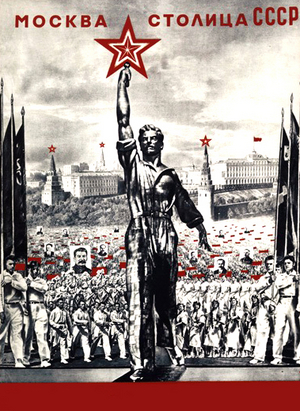
The mass festival as a means of Bolshevik rule is the subject of this research focus. And in a double sense: official festivities served the Bolsheviks and their propaganda apparatus as an instrument that they used to popularise political goals and manipulate people. But it was also a medium through which the regime's policies were realised. Rule made use of festivals, but also produced itself in their realisation. The staging and realisation of rule were interrelated. In the first two post-revolutionary decades, mass festivals occupied an important place in the attention spectrum of the Bolsheviks and their allies. The Soviet Union of the interwar period was not only a "propaganda state", but also a "dictatorship of staging". Propaganda was essentially a public display of dogmas, norms and visions of the future.
The festival had a privileged status in the canon of staging arts. Festive productions and self-presentations of the regime employed a constantly growing apparatus of activists, demanded ever greater resources and mobilised ever more people. This research focus examines the question of how and why the Soviet festival became a privileged medium of the party state between 1917 and 1941 and why it was able to retain this position.
Publications at the end of project
Monographs and edited publications
Soviet Mass Festivals, 1917-1991 [English translation of The Soviet Mass Festival], Pittsburgh: University Press, 2013.(upittpress.org/books/9780822962397/)
Sovetskie massovye prazdniki [Russian translation of The Soviet Mass Festival], Moscow: ROSSPEN, 2009.
Fest und Diktatur / Festivals and Dictatorship, Journal of Modern European History, 3:1 (2006), special issue, co-edited with Dietrich Beyrau.
Das sowjetische Massenfest, Hamburg: Hamburger Edition, 2006(www.hamburger-edition.de/buecher-e-books/artikel-detail/d/2278/Das_sowjetische_Massenfest_%28Print%29/156/).
Sovetskij massovyj prazdnik v Voroneže i Central'no-Černozemnoj oblasti Rossii, 1927-1932 [The Soviet Mass Festival in Voronež and the Central Russian Black Earth Region, 1927-1932], Voronež: Voronež State University Publishing House, 2000.
Essays
"Public Body. Mass festivals", in: Media and Communication in the Soviet Union (1917-1953). General Perspectives, edited by Kirill Postoutenko, Alexey Tikhomirov and Dmitri Zakharine, London: Palgrave Macmillan, 2022. pp. 149-164.
"Creating a Soviet Festival Culture - Forging a New Civilisation: Mass Celebrations and Inner Sovietisation", in: Vielfalt der Disziplinen - Einheit des Kulturbegriffs? Symbols, Approaches, Perspectives, Discourses, edited by Caroline Kolisang, Bielefeld 2020, pp. 127-143.
"Neue kulturgeschichtliche Perspektiven auf autoritäre Regime", in: Diktaturen. Perspektiven der zeithistorischen Forschung, edited by Johannes Hürter and Hermann Wentker Berlin: De Gruyter/Oldenbourg, 2019, pp. 99-108.
"Empty 'spaces of jubilation'. On the Erosion of the Campaign Public Sphere in the Late Soviet Union", in: "Developed Socialism" in Eastern Europe. Labour, Consumption and the Public Sphere, edited by Nada Boškovska, Angelika Strobel and Daniel Ursprung, Berlin: Duncker & Humblot, 2016, pp. 83-108.
"Die Renaissance des Ausnahmezustands im "Zeitalter der Stabilität": Zur sowjetischen Mobilisierungsdiktatur und der Krise des Staatssozialismus in der Breschnew-ra", in: Ausnahmezustände. Entgrenzungen und Regulierungen in Europa während des Kalten Krieges, edited by Cornelia Rauh and Dirk Schumann, Berlin: Wallstein, 2015, pp. 92-112.
"Sovetizacija gorodskogo postranstva: Projektirovanie i perestrojka gorodov v Stalinskich vremen [The Sovietisation of Urban Space: Urban Planning in the Stalin Period]", in: Gumanitarnye nauki v Sibiri, 17:1 (2010), pp. 21-35.
"Canon and Counter-Canon: Official Culture and its Inversion in the USSR", in: Osteuropa. Zeitschrift für Gegenwartsfragen des Ostens, special issue Dissidence and Samizdat, 60:11 (2010), pp. 173-189.
"A Hall of Mirrors. Sovietising Culture under Stalinism", in: Slavic Review. Interdisciplinary Quarterly of Russian, Eurasian, and East European Studies, 68:3 (2009), pp. 601-630.
"Writing a Cultural History of Stalinism in Post-Soviet Times", in: Revista de Historiografia, 10:VI (1/2009), pp. 16-25.
"The beautiful bodies of communism. Sport Parades in the Soviet Union of the Thirties", in: Sport zwischen Ost und West. Beiträge zur Sportgeschichte Osteuropas im 19. und 20. Jahrhundert, edited by Arié Malz, Stefan Rohdewald and Stefan Wiederkehr, Osnabrück: fibre, 2007, pp. 309-325.
"The celebrations of the others: Dissidence and the Soviet Symbolic Cosmos', in Another World? Culture and Politics in Eastern Europe 1945 to the Present. Festschrift für Wolfgang Eichwede, edited by Heidrun Hamersky, Heiko Pleines and Hans-Henning Schröder, Stuttgart: ibidem 2007, pp. 129-137.
"Norm, Abweichung und Aneignung: Kulturelle Konventionen und unkonventionelle Kulturen in der Nachkriegssowjetunion", in: Totalitarismus und Demokratie, Themenheft Opposition im Ostblock, 4 (2007), pp. 223-242.
"Feste imzarischen Russland", in: Enzyklopädie des europäischen Ostens (EEO), Klagenfurt 2007(eeo.aau.at/eeo.aau.at/index9409.html?title=Feste_%28Russland%29#Feste_im_zarischen_Russland).
"Sozialistische Feste", in: Enzyklopädie des europäischen Ostens (EEO), Klagenfurt 2007(eeo.aau.at/eeo.aau.at/index9409.html?title=Feste_%28Russland%29#Sozialismus).
"The festivals of power and the power of festivals. Festivity and dictatorship - an introduction", in: Journal of Modern European History, 3:1 (2006), pp. 39-59.
"The Soviet Mass Festival under Stalinism (1932-1941)", in: History and Society, 32:1 (2006), pp. 69-92.
"Empire and regionality. Sport Parades and Regional Festivals under Stalinism", in: Osteuropa, 56:5 (2006), pp. 99-121.
"Celebrations in times of cultural revolution. The mass festival in the Soviet Union (1917-1932)", in: Historical Anthropology,13:2 (2005), pp. 149-176.
"Between anti-church counter-celebration and popular religious celebration tradition. Festive Culture, Religion and Stalinism in Soviet Russia before the Second World War", in: Jahrbücher für Geschichte Osteuropas, 52:4 (2004), pp. 494-514.
"The Leader's Many Bodies: Leader Cults and Mass Festivals in Voronezh, Novosibirsk, and Kemerovo in the 1930s', in Personality Cults in Stalinism / Personality Cults in Stalinism, edited by Klaus Heller and Jan Plamper, Göttingen: Vandenhoeck & Ruprecht, 2004, pp. 86-97.
"Working Towards the Centre: Leader Cults and Spatial Politics in Pre-war Stalinism", in: The Leader Cult in Communist Dictatorships: Stalin and the Eastern Bloc, edited by Balazs Apor, Jan C. Behrends, Polly Jones and E. Arfon Rees, Palgrave: Macmillan, 2004, pp. 141-157.
"Festivals of Unity and Spectacles of Participation. The Staging of the Public Sphere in the Soviet Union during the First Five-Year Plan", in: Jahrbücher für Geschichte Osteuropas, 50:2 (2002), pp. 163-171.
"Kul'ty ličnosti v gorodskom prostranstve. Voronež, Novosibirsk i Kemerovo v 1930-e gody" [Leader cults in urban space. Voronez, Novosibirsk and Kemerovo in the 1930s], in: Gorodskaja kul'tura Sibiri: Tradicii i novacii, edited by N.N. Pokrovskij and S.A. Krasil'nikov, Novosibirsk: SORAN, 2002, pp. 86-97.
""Life has become easier": Inszenierte Lebensstile zwischen 1927 und 1939 (Voronež)", in Forum für osteuropäische Ideen- und Zeitgeschichte, 1 (2002), pp. 147-175.
"Festivals of the "Red Calendar": the Great Upheaval and the Soviet Order of Time", in: Zeitschrift für Geschichtswissenschaft, 49:2 (2001), pp. 101-118.
"Constructing a Soviet Time. Bolshevik Festivals and their Rivals during the First Five-Year Plan", in: Kritika. Explorations in Russian and Eurasian History, 1:3 (2000), pp. 447-473.