Imperiale Herrschaft im Weichselland: Das Königreich Polen im Russischen Imperium (1864-1915)
Kontakt
Lehrstuhlinhaber
Team
Institutssekretariat
Anschrift
Imperiale Herrschaft im Weichselland: Das Königreich Polen im Russischen Imperium (1864-1915)
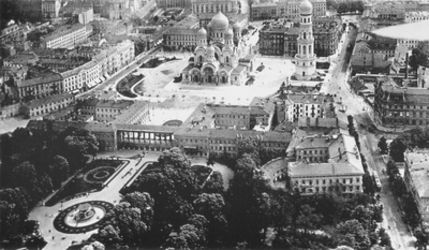
This research project examines Russian rule in the Kingdom of Poland in the late 19th and early 20th centuries and aims to analyse the multi-ethnic and multi-confessional complexity of the Russian Empire using the case study of the imperial elite and its representations in one of the most important imperial peripheries.
As a populous and economically highly developed western periphery, the Kingdom of Poland and especially Warsaw, as the seat of the Governor General and the Chief of Police, was in many ways a laboratory in which practices of nationality politics and imperial rule were tested, rejected and in some cases even invented.
The research project is dedicated to the question of how the cultural identity of those who represented the Russian Empire was formed in the often conflict-laden encounters with a native counterpart. The aim is to investigate how this communication shaped the ideas that the imperial administrative and cultural elite had of the imperial context and to what extent it influenced the practices with which the St Petersburg representatives attempted to implement Russian rule in the Kingdom of Poland. The imperial elite was by no means a homogeneous community, but was itself characterised by multi-ethnicity and internal frictions. The different conceptions of empire that existed among administrative officials, military officers, teachers, lawyers and priests are the subject of the research project, as are the reactions of the Polish and Jewish population. For the actions and behaviour of the representatives of St Petersburg's rule also shaped the image that the Polish and Jewish sides had of the Russian Empire and of "Russian foreign rule", and provided the frame of reference for forms of confrontation, but also co-operation. The research project examines how images of the self and the other and corresponding options for action emerged in mutual communication in the everyday confrontations that the actors involved in the conflict community in the Kingdom and in Warsaw were forced to engage in.
Using the example of the city of Warsaw and exemplary case studies on topics and places where communication was intensified, the aim is to analyse fundamental lines of conflict, but also possibilities of cooperation and crossing borders in the period between the Polish January Uprising of 1863 and the occupation of Warsaw by German troops in 1915 in an everyday history of the empire. Measures of administrative and educational russification, violent clashes during the revolution of 1905 and debates in the context of the four Duma elections of 1906-1912 represent such topics as well as competing imperial representations in the construction of monuments, churches and barracks, the discussions about the infrastructural expansion of the kingdom and the measures to modernise the municipal administration and urban space. Places of an everyday history of the empire included the streets, the churches, the service parlours and the numerous associations, where communication took place partly as conflict and partly as co-operation.
In addition, a transfer-historical perspective is used to examine the repercussions of these encounters and conflicts on the imperial centre and the extent to which the imperial representatives in Warsaw were able to influence political decisions in St. Petersburg. These self-declared "Vistula countries" and authorities in the debates on the so-called "Polish question" attempted to help shape tsarist nationality policy through numerous channels. As imperial officials and lecturers with "border experience", they were later often deployed in other peripheral regions of the empire. With the help of exemplary biographies of such "experts of the foreign", their Warsaw experiences, the resulting political ideas and their implications for the fragile cohesion of the Russian multi-ethnic empire can be explored.
Publications at the end of project
Monographs and edited publications
Imperial Russian Rule in the Kingdom of Poland, 1864-1915, Pittsburgh: University of Pittsburgh Press, 2021(upittpress.org/books/9780822947011/).
Pol'skie zemli pod vlast'ju Peterburga. Ot Venskogo kongressa do Pervoj mirovoj vojny [Poland under the rule of the tsars. From the Congress of Vienna to the First World War], Moscow: Novoe literaturnoe obozrenie, in the series Historia Rossica. Okrainy Rossijskoj imperii, 2020.(www.nlobooks.ru/magazines/neprikosnovennyy_zapas/134_nz_6_2020/article/23252/?sphrase_id=448685).
Rządy imperialne w Kraju Nadwiślańskim. Królestwo Polskie i cesarstwo rosyjskie (1864-1915), Warsaw: Wydawnictwa Uniwersytetu Warszawskiego, 2016(www.wuw.pl/product-pol-5999-Rzady-imperialne-w-Kraju-Nadwislanskim-Krolestwo-Polskie-i-cesarstwo-rosyjskie-1864-1915.html). Nominated by the Polish Historical Association (Polskie Towarzystwo Historyczne) for the "Pro Historia Polonorum" award for the best foreign book on Polish history from 2012-17.
Imperiale Herrschaft im Weichselland: Das Königreich Polen im Russischen Imperium (1864-1915), Munich: Oldenbourg, in the series 'Ordnungssysteme - Studien zur Ideengeschichte der Neuzeit', 2014 (http://www.degruyter.com/view/product/247946). Nominated by the Polish Historical Association (Polskie Towarzystwo Historyczne) for the 'Pro Historia Polonorum' award for the best foreign book on Polish history in 2012-17.
Essays
"What Is the "Russian Cause" and Whom Does It Serve? Russian Nationalists and Imperial Bureaucracy in the Kingdom of Poland", in: The Tsar, the Empire, and the Nation. Dilemmas of Nationalisation in Russia's Western Borderlands, 1905-1915, edited by Yoko Aoshima and Darius Staliūnas, Budapest: Central European University Press, 2021, pp. 67-109.
"Officials on the move. Zu Strukturen und Akteuren imperialer Herrschaft im ausgehenden Zarenreich", in: Migrationen im späten Habsburgerreich, edited by Carl Bethke, Tübingen: TVV-Verlag, 2020, pp. 101-131.
"Towards a new quality of statehood: Bureaucratisation and state-building in empires and nation states before 1914", together with Hannes Grandits and Pieter Judson, in: The Routledge History Handbook of Central and Eastern Europe in the Twentieth Century, Vol. 2: Statehood, edited by Sabina Ferhadbegovic, Joachim von Puttkamer and Włodzimierz Borodziej, London: Routledge, 2020, pp. 41-114.(https://www.routledge.com/The-Routledge-History-Handbook-of-Central-and-Eastern-Europe-in-the-Twentieth/Borodziej-Ferhadbegovic-Puttkamer/p/book/9781138301665)
"Činovniki v raz'ezdach. K voprosu o strukturach i dejstvijuščich licach imperskoj bjurokratii na zakate Rossijskoj imperii [Civil servants and mobility. On structures and persons of imperial bureaucracy in the late Russian Empire]", in: Istoričeskij kur'er, No.1 (2018), pp. 84-102.
"Between State-Building and Local Cooperation: Russian Rule in the Kingdom of Poland (1864-1915)", in: Kritika. Explorations in Russian and Eurasian History, 19:2 (2018), pp. 385-416.
"Co-operation in conflict? The Tsarist Administration in the Kingdom of Poland between State Expansion and Social Activation (1863-1914)", in: Vom Vorrücken des Staates in die Fläche. Ein europäisches Phänomen des langen 19. Jahrhunderts, edited by Jörg Ganzenmüller and Tatjana Tönsmeyer, Cologne: Böhlau, 2016, pp. 35-64.
"Namiestnicy Królestwa Polskiego i generał-gubernatorzy warszawscy po powstaniu styczniowym (do 1914 roku)" [The imperial governors and the Warsaw governors-general after the January Uprising of 1863 (until 1914)], in: Wbrew królewskim aliansom. Rosja, Europa i polska walka o niepodległość w XIX wieku, edited by Łukasz Adamski and Sławomir Dębski, Warsaw 2016, pp. 355-391.
"The Revolution of 1905 and the Transformation of Nationhood in the Russian Empire", in: Revolution, War and the Birth of State and Nation. Staatsbildung in Europa und den Amerikas 1770-1930, edited by Ewald Frie and Ute Planert, Tübingen: Mohr Siebeck, 2016, pp. 193-210.
"Doomsday scenarios and visions of the future: Germany and Russia in the Fin de Siècle. Introduction", with Peter Haslinger, in: Zeitschrift für Geschichtswissenschaft, 63:11 (2015), thematic issue, edited by Peter Haslinger and Malte Rolf, pp. 925- 929.
""Approved by the Censor": Tsarist Censorship and the Public Sphere in Imperial Russia and the Kingdom of Poland (1860-1914)", in: Underground Publishing and the Public Sphere. Transnational Perspectives, edited by Jan C. Behrends and Thomas Lindenberger, Vienna: LIT (Wiener Studien für Zeitgeschichte), 2014, pp. 31-74.
"Imperial Biographies. Lebenswege imperialer Akteure in Groß- und Kolonialreichen (1850-1918) - zur Einleitung", in: Imperiale Biographien, edited by Malte Rolf, Themenheft Geschichte und Gesellschaft, 40:1 (2014), pp. 5-21.
"A Continuum of Crisis? The Kingdom of Poland in the Shadow of Revolution (1905-1915)", in: The Russian Revolution of 1905 in Transcultural Perspective. Identities, Peripheries, and the Flow of Ideas, edited by Felicitas Fischer v. Weikersthal, Frank Grüner, Susanne Hohler, Franziska Schedewie and Raphael Utz, Bloomington: Slavica Publishers, 2013, pp. 159-174.
"Metropolises in a state of emergency? Gewaltakteure und Gewalträume in den Städten des späten Zarenreichs", in: Lenger, Friedrich (ed.), Kollektive Gewalt in der Stadt. Europe 1890-1939, Munich 2013, pp. 25-49.
"Bureaucracy and Mobility in Late Imperial Russia. Reflections on Elite Careering and Imperial Biographies in a Multiethnic Empire", in: Moskauer Vorträge zum 18. und 19. Jahrhundert, No. 16 (2013), edited by Ingrid Schierle(www.perspectivia.net/content/publikationen/vortraege-moskau/rolf_bureaucracy).
"Russification, depolonisation or internal state building? Konzepte imperialer Herrschaft im Königreich Polen (1863-1915)", in: Kampf um Wort und Schrift: Russifizierung in Osteuropa im 19.-20. Jahrhundert, edited by Zaur Gasimov, Göttingen: Vandenhoeck & Ruprecht, 2012, pp. 51-88.
"Imperial Rule in Urban Space: Tsarist Officials and the Urban Public Sphere in Warsaw (1870-1914)", in: Russia's Imperial Power:Integration Strategies and their Reach in a Transnational Perspective, edited by Bianka Pietrow-Ennker, Cologne: Böhlau Verlag, 2012, pp. 123-153.
"Revolution, Repression and Reform: 1905 in the Kingdom of Poland", in: Schlüsseljahre. Central Constellations of Central and Eastern European History. Festschrift für Helmut Altrichter, edited by Lilia Antipow and Matthias Stadelmann, Stuttgart: Steiner, 2011, pp. 219-232.
"Die Durchlässigkeit der Grenze: Einleitende Überlegungen zu Grenzgängern und ihren Lebenswelten in der späten Habsburger- und Romanow-Monarchie", in: Grenzgänger in Vielvölkerreichen: Grenzziehungen und -überschreitungen in Russland und Österreich-Ungarn (1840-1918), Zeitschrift für Geschichtswissenschaft, 59:5 (2011), thematic issue, edited by Malte Rolf and Jörn Happel, pp. 397-404.
"The Imperial Turn in Russian Studies: Ten Years", forum discussion, together with Jane Burbank, Sheila Fitzpatrick, Mark von Hagen, Paul Werth et al, in: Ab Imperio. International Quarterly on the Studies of New Imperial History and Nationalism in the Post-Soviet Space, 1 (2010), pp. 11-33.
"Importing the "Spatial Turn" to Russia. Recent Studies on the Spatialisation of Russian History", in: Kritika. Explorations in Russian and Eurasian History, 11:2 (2010), pp. 359-380.
"Varšava v epochu peremen: Carskoe gospodstvo i gorodskaja modernizacija (1880-1915) [Warsaw in transition: Tsarist rule and urban modernisation (1880-1915)]", in: Rossija 19-20 vv. skvoz' prizmu kul'turnoj istorii. Sbornik statej [Russia of the 19th and 20th centuries from the perspective of cultural history. Festschrift for Igor Narskij], edited by Oksana Nagornaja and Ol'ga Nikonova, Čeljabinsk 2009, pp. 144-183.
"Imperator v Varšave: Vizualizacii imperii na ischode XIX stoletija" [The Emperor in Warsaw: Visualisations of Empire at the End of the 19th Century], in: Oče-vidnaja istorija. Problemy vizual'noj istorii Rossii XX stoletija [Visual history. Problems of the visual history of Russia in the 20th century], edited by Oksana Nagornaja, Igor Narskij, Ol'ga Nikonova et al., Čeljabinsk 2008, pp. 319-338.
"Russian rule in Warsaw: The Aleksandr Nevsky Cathedral in the Conflict Space of Political Communication", in Beyond Tsarist Power. Dimensions of the Political in the Russian Empire 1800-1917, edited by Walter Sperling, Frankfurt/Main: Campus, 2008, pp. 163-189.
"Der Zar an der Weichsel - Repräsentationen von Herrschaft und Imperium im fin de siècle", in: Imperiale Herrschaft in der Provinz. Representations of Political Power in the Late Tsarist Empire, edited by Jörg Baberowski, David Feest and Christoph Gumb, Frankfurt/Main: Campus, 2008, pp. 145-171.
"Russkie v Varšave (1815-1915)" [The Russians in Warsaw (1815-1915)], in: Publications of the Virtual Seminar of the University of Basel and the State University of Čeljabinsk, May 2006(isem.susu.ac.ru/welcen/).