

Pumice stone
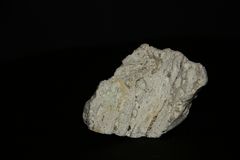
Pumice stone
Pumice stone
Colour, characteristics:
| Colour usually light grey to yellowish, rarely reddish or in dark shades. The structure is determined by numerous pores, which are usually not connected to each other. An amorphous rock mass is referred to in science as rock glass, a porous mass as foamy rock glass. |
Formation:
| During very rapid cooling of a gas-rich and viscous molten rock that has penetrated to the earth's surface. Due to sudden depressurisation at the earth's surface, the gases contained in the lava migrate out and leave numerous cavities in the rapidly solidifying rock mass, which sometimes indicate the direction of flow of the lava flow through an oval shape. |
Locations: | Neuwied Basin/North Rhine-Westphalia, Italy (Lipari Islands), France (Auvergne), Iceland |
Products: | Because of its low weight and good thermal insulation for lightweight building blocks, used as an abrasive in technology and for cosmetic purposes because of its always rough surface. |