MultiFlu
MultiFlu
MultiFlu
Project description
Access to the North Sea coast and the sea, the maritime economy and the UNESCO World Natural Heritage Site, the Wadden Sea, are key factors shaping Lower Saxony’s specialisation. Environmental and climate protection are key determinants of companies’ economic positioning – in shipping, for example, through ‘green shipping’ – whilst, particularly in coastal areas, a multitude of anthropogenic factors, such as nutrient inputs from agriculture, can lead to unintended consequences for the ecosystem and its users, including economic losses. The use of modern bio-optical sensors is now indispensable for protection and compliance with the European FHH area protection measures and the Water Framework Directive (WFD) across large spatial and temporal scales, as well as for the continuous monitoring of process water in shipping.
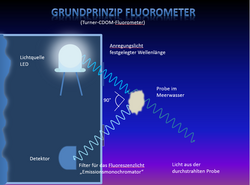
As part of the MultiFlu project, bio-optical fluorescence sensors for water quality measurements are being further developed in co-operation with TriOS, an SME based in Lower Saxony. These include, on the one hand, sensors featuring newly developed fluorescence technology in a multi-channel design and, on the other, those that incorporate the use of mobile devices such as smartphones and tablets for control. Through the systematic implementation and testing of new concepts, the prototypes are being developed into products suitable for practical application and market launch. Furthermore, detailed investigations are intended to provide insights into a possible expansion of the range of applications to include further parameters. To strengthen co-operation with users from the maritime sector and the environmental protection sector, Briese GmbH and the Lower Saxony Wadden Sea National Park Authority are involved, bringing together professional users in shipping and environmental monitoring as well as members of the public and tourists.
The objectives of this project will be achieved through the following steps:
- Validation and optimisation of the sensors’ hardware and software
- Evaluation, specification and standardisation to expand the parameters for
- various types of algae by determining suitable excitation and detection wavelengths,
- extension to cyanobacteria,
- novel algorithms to account for the influence of scattering in turbid samples / scattering caused by particles
- Field testing of prototypes, for example on scientific research vessel campaigns such as the research vessel ‘Sonne’, or with specialist user groups (UNESCO World Natural Heritage Site: Lower Saxony Wadden Sea)
- Optimisation of new control pathways via the sensors’ mobile devices
The concepts presented will also form the basis, beyond the project period, for an extension to sector-specific parameters, such as various polycyclic aromatic hydrocarbons (PAHs) or different (technical) humic substances.
Project Management
Institute of Chemistry and Biology (ICBM), Marine Sensor Systems Group
Contact
project leader:
Collaborating partner
- Institute of Chemistry and Biology at University of Oldenburg, Marine Sensor Systems Research Group
- TriOS Mess- und Datentechnik GmbH, Rastede
- Briese Schiffahrts GmbH & Co. KG, Leer
Duration
3 years (March 2017 – February 2020)
financing
NBank (European Regional Development Fund, ERDF)