Language learning support for DaFZ at Oldenburg schools (from 2023/24)
Job vacancy: Research Assistant (doctoral candidate, E13 TV-L, 65%, 3 years) in the field of German as a Foreign Language (DaF), focusing on language acquisition, language processing, phonetics/phonology, morphophonology and/or psycholinguistics, working under my supervision (K. Schuhmann). Deadline: 20 September 2026
Language learning support for DaFZ at Oldenburg schools (from 2023/24)
Our ‘DaFZ Language Learning Support’ project in Oldenburg’s schools is specifically dedicated to providing language support for children and young people from migrant backgrounds in Oldenburg’s schools. The focus is on practical support in areas that are often neglected in regular language lessons – for example, listening comprehension of spoken (spontaneous) German, as well as pronunciation (stress, rhythm, intonation and articulation), on which we are placing particular emphasis in the initial phase of implementation.
As part of the project, current teaching approaches and the latest research findings from the field of German as a foreign and second language acquisition, as well as from the field of foreign and second language acquisition research, are systematically integrated into practice-oriented language support.
Close collaboration between the University of Oldenburg and local schools in Oldenburg is creating a sustainable and scientifically sound support programme. Students on the UOL’s DaF/DaZ Master’s programme gain valuable practical experience and test current teaching approaches directly in everyday school life. In parallel, we are developing a guide and a virtual toolkit for students and (prospective) teachers to support language support in the long term. Furthermore, the exchange between students and teachers offers a valuable opportunity for a practical integration of theory and the realities of the classroom. Through joint reflection and feedback, not only can trainee teachers benefit from the on-the-ground experience, but teachers can also gain new ideas and inspiration for their own language support practice.
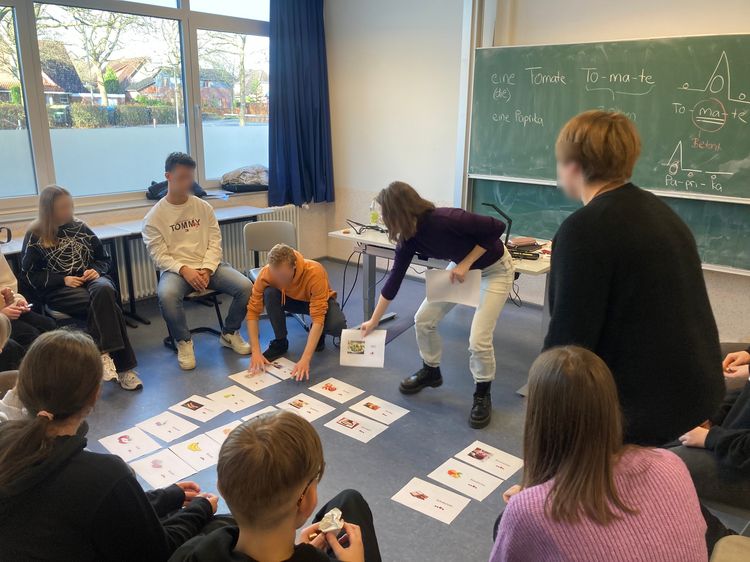
Our initiative began in the winter semester of 2023/24 with a pilot phase in which pupils from Ukraine attended a grammar school in Oldenburg (see photos).
Key features of our project:
- Focus areas: Depending on requirements, we offer different language-specific focus areas – for example, in the first phase, listening comprehension and phonetics/phonology in pronunciation (stress, rhythm, intonation and articulation). The development of these skills is often neglected in mainstream teaching due to a lack of time and resources, yet they are crucial and fundamental skills for language development that should not be overlooked.
- Flexibility & Further Development: Tailoring the linguistic focus areas to the specific needs of pupils, schools and (prospective) teachers.
- Theory meets practice: Students on the UOL’s Master’s programme in DaF/DaZ develop and implement practical applications and didactic materials based on current pedagogical and didactic concepts and research findings in the field of foreign and second language acquisition.
- Sustainable support: Development of a guide and a virtual toolkit for (prospective) teachers to ensure the long-term continuation of language support.
- Social participation: Promoting educational equity and the integration of children and young people from migrant backgrounds through targeted language support.
- Individual collaboration and long-term development: The project will be continued in the long term (for at least the next 3–5 years) and continuously expanded to address the specific needs of the participating schools and pupils. Schools, headteachers and teachers interested in collaborating can contact Prof. Dr Katharina Schuhmann at any time to discuss their requirements or develop joint ideas. We would be happy to devise individual, needs-based language support programmes.