Guest lectures
Häufige Fragen (FAQ)
Antworten auf die häufigsten Fragen rund ums Studium findest du hier.
Kontakt zum Institut
Geschäftsstelle
Adresse
Direktorin
Stellvertretende Direktorin
Contact
Guest lectures
Lecture series: POWER - PLAY - GAZE
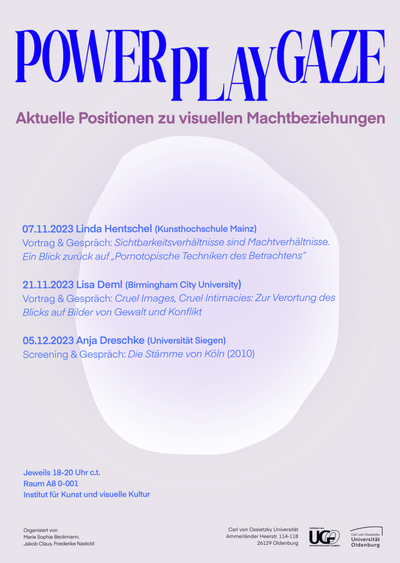
Current Perspectives on Visual Power Relations
This lecture series explores contemporary perspectives and interdisciplinary theories on visual power relations. During the 2023/24 winter semester, Linda Hentschel, Lisa Deml and Anja Dreschke will be invited to present and discuss their research and work on issues of visual language, regimes of the gaze and power relations in contemporary media contexts.
7 November 2023 Linda Hentschel ( Mainz Academy of Fine Arts)
Lecture & discussion: Visibility relations are power relations. A look back at ‘Pornotopic Techniques of Viewing’
21 November 2023 Lisa Deml (Birmingham City University)
Lecture & discussion: Cruel Images, Cruel Intimacies: On situating the gaze on images of violence and conflict
5 December 2023 Anja Dreschke (University of Siegen)
Screening & discussion: The Tribes of Cologne (2010)
The lectures are open to the public and take place every Tuesday from 6 pm to 8 pm (c.t.) in room A8 0-001. No registration is required.
Organised by: Marie Sophie Beckmann, Jakob Claus, Friederike Nastold
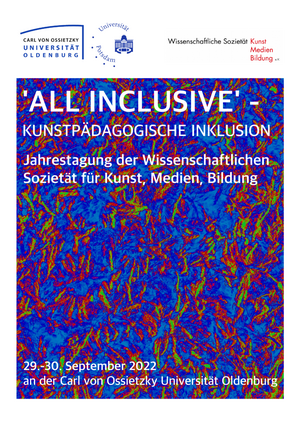
Art education conference: ALL INCLUSIVE'
This year's conference on art education inclusion will take place from 29 - 30 September 2022.
Further information can be found here.
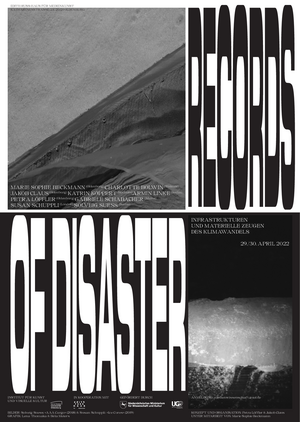
Records of Disaster. Infrastructures and material witnesses of climate change
Workshop on 29 & 30 April 2022
Edith-Russ-Haus for Media Art
Katharinenstraße 23
26121 Oldenburg
While infrastructures form the seemingly stable material and logistical basis of our everyday lives, on closer inspection they are fragile constructs. This becomes clear from the regular collapse of networks that supply people with water, heat, goods and information. Increasingly, such collapses are triggered by ecological disasters, forest fires, floods or tidal waves, which at the same time sensitise us to man-made climate change and its local effects as material witnesses of global warming.
Registration:
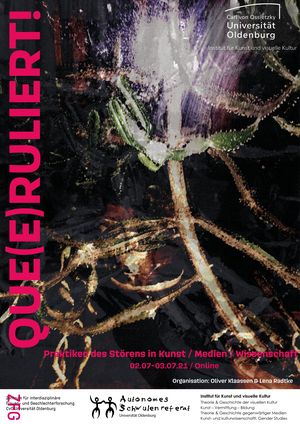
QUE(E)RULIERT! Practices of disruption in art / media / science
2 and 3 July 2021
The conference will take place via the Big Blue Button video conferencing system. Please register by 25.06.21 with a short email to
Further information can be found here.
lesbian, for example (not)
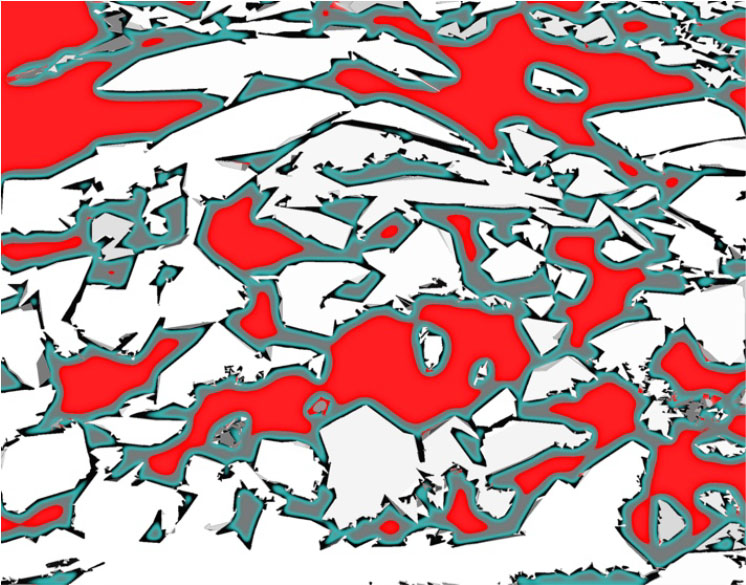
Lecture - Dr Birgit Bosold
lesbian, for example (not)
On the representability of sexual orientation in exhibition projects
on 20 June 2018, 18:15-19:45
Room A08-0-001, University of Oldenburg
The exhibition LESBISCHES SEHEN (10 May - 20 August 2018) curated by Birgit Bosold and Carina Klugbauer at the Schwules Museum Berlin provides the occasion for this lecture. For the first time, artistic positions of queer FLTI* (women, lesbians, trans, inter) from over 100 years are gathered there. The exhibition project is motivated by the finding that, at first glance, there is little that is "lesbian" in art and the question of what we should actually be looking for: the artist's self-definition? The content or form of the artwork? The social contexts within which art is created? Or the interpretation by the viewer? Obviously, the universality of these questions is in tension with the specific uncertainty of their answers when it comes to seeing the 'lesbian' - all the more so when 'lesbian seeing' is questioned at the same time.
Dr Birgit Bosold has been the (first female*) member of the board of the Schwules Museum Berlin since 2006 and was instrumental in its reorientation, including exhibitions on lesbian positions. Together with Vera Hofmann, she is currently curating the "Year of the Woman" - a queer-feminist annual programme at the Gay Museum and is in charge of "Another View. Postcolonial Perspectives at the Gay Museum and Queering Holocaust History. Her academic appointment
is in private banking. After studying and completing her doctorate in literature, she worked for many years at various banks and now works freelance in portfolio management and as a specialist author and lecturer.
As part of the seminar:
Sex is a medium - psychoanalysis and gender studies as (media) theory
Flyer PDF
where the elements of writing are the elements themselves
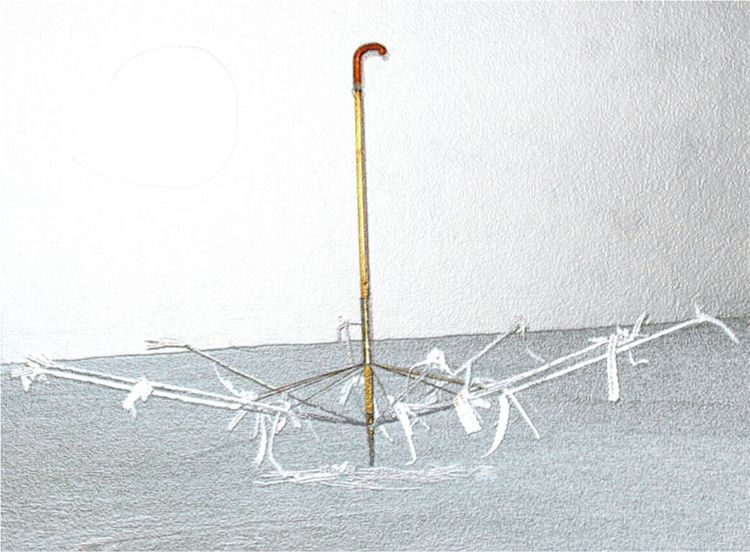
Ginka Steinwachs
where the elements of writing are the elements themselves
on 16 May 2018, 20:15-21:15
Room A08-0-001, University of Oldenburg
Lecture-Picture-Performance
immersion
by MOnd & MUnd or:
who has risen here?
&&&
Literature Prize of the City of Erlangen (1976) International Radio Play Prize Unterrabnitz (1981) 3. Prize at the Ingeborg Bachmann Competition in Klagenfurt (1985) German Literature Fund Annual Scholarship (1986) German Literature Fund New York Scholarship (1987) Literature Scholarship of the City of Munich (1988) Sponsorship Award of the City of Hamburg (1988) New York Scholarship of the Kranichsteiner Literaturtage (1991) Working Scholarship of the State of North Rhine-Westphalia, Künstlerhof Schöppingen (1993/1994) Hubert Fichte Prize (1995) DAAD, Writer in Residence at University College Dublin (1999)
&&&
Thursday, 17. May, 12:15-13:45, Room A08-1.102
akademievorlage: nachrichten aus dem ich
Writing course
Dr Ginka Steinwachs
wortregen
reden ist silber
schreiben ist gold
im Seminar Claudia Reiche:
Writing about art / Writing the future. Von Kunstkritik und Science Fiction,
Seminar guests are also welcome in the writing course!
Flyer PDF
DREAMS REWIRED
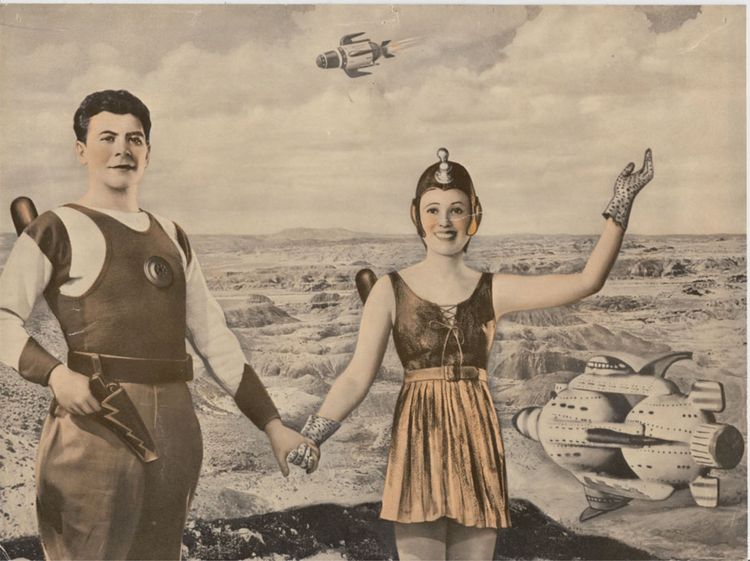
on 17 January 2018, 18:15-21:15
Room A08-0-001, University of Oldenburg
With Thomas Tode, (Hamburg)
Guest at the seminar Claudia Reiche: Repetition, repetition, repetition.
On a basic media concept in art
18:15 - 20:00 Film screening: DREAMS REWIRED. A History of Media Utopia
Where do our (multi-) media past and its future meet? It is only a few steps
from the punch card to mass storage and from the optical telegraph to the fibre optic network. But
what spirit animates these devices, what hopes were and are attached to them? What
do they have to do with us and what perspectives do they open up? The essay film Dreams Rewired is dedicated to these questions and uses numerous film clips from the early days of the media to trace the supposedly new desires and fears back to the birth of the telephone, cinema and television. The journey through time begins with the first media boom of the late 19th century and reveals, piece by piece, how the social upheavals of today's networked world were already mapped out in an age in which the telegraph and punch card were considered revolutionary to the same extent that we see social media and big data today.
The utopia of a better world was immediately ignited by the new technical possibilities of the time. Based on a borderless communication technology that would connect people, prosperity and peace would be promoted and war and social exclusion would be eliminated once it was available to everyone. According to the optimistic assumption, a fairer
place for all would almost inevitably emerge as a result of the media moving closer together.
However, what the media age initially promised and what ultimately became of it could not be more different
. The original openness soon gave way to rules, regulations and
laws of a state monopoly on communication. Today, the new media are insidiously
contributing to the loss of privacy and omnipresent surveillance, thus realising fears
that have always accompanied the hopeful utopias.
20:00 - 21:15 Thomas Tode Lecture / Talk
The eternal return of the same: Technical media and our fears of
privacy screening
Since the end of the 19th century, we have been inventing technical media to serve our
communication: Telephone, phonograph, film, record, radio, television. With each
of these inventions, our fears that these media will be misused
and that our privacy will be scrutinised are repeated. These fears are reflected in
feature films in which we are bugged, spied on and screened. Is
history repeating itself? Are we reproducing established fears again and again? Repetition as
variation of the same old thing or the return of the repressed? Lecture with
film examples.
Flyer PDF
Accidentally, Art!
Frieder Nake
Accidentally, Art!
on 10 January 2018, 20:00-21:30
Room A08-0-001, University of Oldenburg
Guest at the seminar
Claudia Reiche: Art of the Accident. Accidental Art
on media accidents and art by chance
Hans Arp drops snippets from the table and the computer does the maths
We can assume that nothing is too bad or too small or too banal for artists not to become the source of inspiration for a work. The examples are well-known and notorious. But the fact that chance could also come from the computer seems to be a strong piece. After all, aren't computers, as their name suggests, machines for computing? And is computing supposed to be random? How this is supposed to happen, namely that randomness can arise from computation, is made into a problem in the lecture that is explained. The speech could also be called: Coincidence does not exist, or:
Everything is coincidence.
Frieder Nake has been a university lecturer at the University of Bremen since 1972 and has also worked at the University of the Arts in Bremen since 2005. He specialises in graphical data processing. He completed his doctorate in probability theory and now specialises in digital media. In addition to worldwide teaching activities in the computer sciences and extensive scientific publications, he is considered a pioneer of algorithmic art and has been exhibiting internationally since 1965. His works are represented in several museums and private collections. His work is characterised by multiple perspectives from mathematics, computer science, art media and drawing theory as well as art.
His new book "Computers and Signs. Prolegomena to a Semiotic Foundation of Computing."
Flyer PDF
Bowed desire
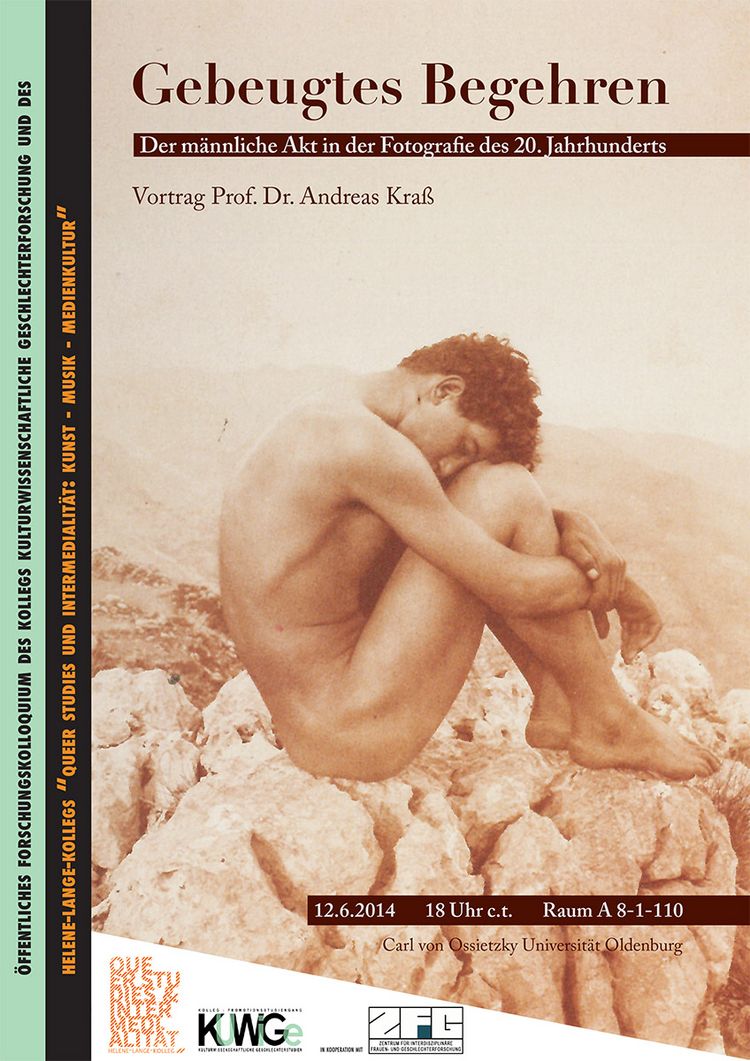
Bent desire. The male nude in 20th century photography
on 12 June 2014 at 18:00
Room A 8-1-110, University of Oldenburg
The painting "Young Man on the Seashore" (1837) by the French painter Jean Hippolyte Flandrin is an icon of the male nude. The pose of the seated man leaning his head on his bent knees has gone down in art history as /Flandrin Pose/. The motif has also been taken up and reinterpreted countless times in photography, including by Fred Holland Day, Wilhelm von Gloeden, Rudolf Koppitz, Robert Mapplethorpe and Pierre & Gilles. What is the fascination of this pose, which simultaneously conceals and exposes the young man's body? The lecture explores this question with a view to the history of the discourse on male homosexuality.
The lecture is part of the public research colloquium of the Centre for Gender Studies in Cultural Studies in co-operation with the Helene-Lange-Kolleg: Queer Studies and Intermediality: Art - Music - Media Culture.
Flyer PDF
Dancing / Not-Dancing

Sabine Nessel (University of Vienna)
Dancing / Not-Dancing.
Filmische Bewegungsbilder vom Tanzen zwischen Präsenz und Abwesenheit
on Tuesday, 28 January 2014
at 7 pm
in A 08 0-001
organised by
Institute of Art and Visual Culture
University of Oldenburg
Shot | against | Shot
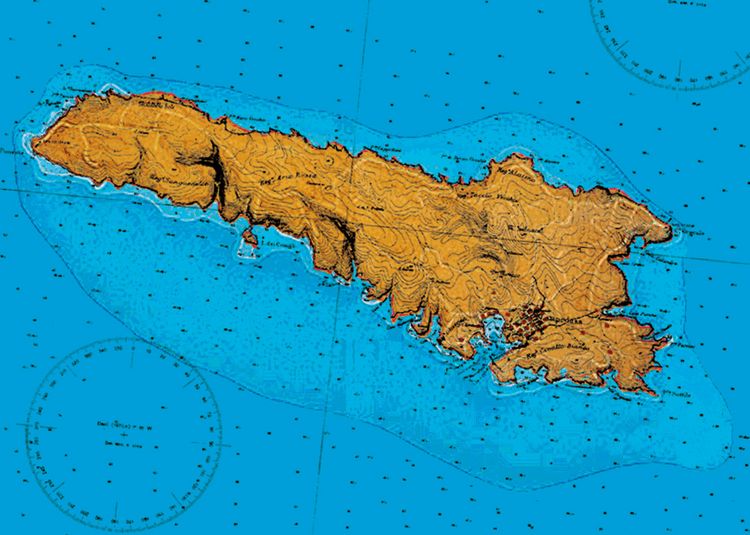
Lampedusa - Image Politics and Representations of Migration
On Wednesday, 22 January 2014
Start 19.00 h | Film starts 21.00 h
Admission free
Cine K, Bahnhofstraße 11
26122 Oldenburg
Reports and images of the Lampedusa refugee drama are circulating around the world. Photographs, film images, headlines and voices remain in our memories. They illustrate and reproduce our perception of migration as a border crossing. In a panel discussion, we want to look at questions of image politics and representations. What reality of migration is created by images? What do they show? What borders are marked by images? What significance do images have in reporting on migration?
In a panel discussion, different positions on the topic will be put into dialogue with each other. After the discussion, we will show the film Lampedusa auf St. Pauli (D 2013; 83 min; director: Rasmus Gerlach), which documents the activism of the Lampedusa group in Hamburg.
Maja Figge, media scientist, University of Oldenburg
Nissar Gardi, educational scientist
Lena Kaiser, journalist at TAZ
Natascha Zaun, social scientist, University of Bremen
Moderation:
Luisa Jansen
Thea Buchholz
Feeling Bad -What is it good for?

Political feelings, queer and artistic interventions
Lecture performance and video screening
with Anja Michaelsen and Karin Michalski
5 December 2013
6 - 8 pm
A8, 1-110
organised by the
doctoral degree programme "Kulturwissenschaftliche Geschlechterforschung"
and
Helene-Lange-Kolleg "Queer Studies and Intermediality: Art - Music - Media Culture"
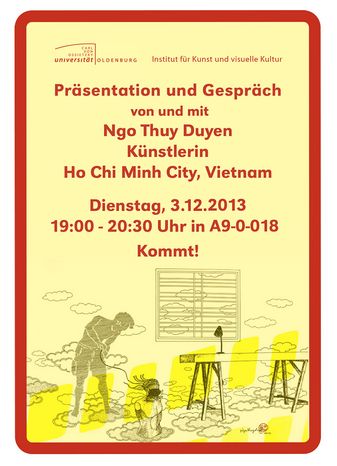
Origin - Transit - Destination (OTD).
Discontinuities in an intercultural collaboration
"Origin-Transit-Destination" is a reflection on the development of a theatre piece by the Australian Performance Exchange (APE) about the situation and experiences of asylum seekers. In OTD I attempt to articulate the convoluted, circular, geo-psychological journey of asylum seekers, but also how this can be articulated without reproducing power relations.
The project began in Sydney in response to a number of dramatic events involving the arrival of asylum seekers off the Australian coast. These are boat people trying to reach Australia from the Middle East via Indonesia. Australian politicians and the media then fuelled a flood of fears among the population about this "invasion".
As a researcher and dramaturg, I want to reflect on the messy, complicated, asymmetrical encounters in the space that Mary Louise Pratt calls the 'contact zone'. For the asylum seekers, Indonesia represents the grey zone (limbo) between home and hope, for the Australians it is a space of 'discovery', connection and reflection and for the Indonesians it is their home where they, as hosts of the Contact Zone, have to deal with the input of their foreign guests.
Dr Monica van der Haagen Wulff is a performer, dancer and academic. She worked for a long time at the University of Technology, Sydney, where she also gained a Doctorate of Creative Arts. Since the beginning of 2011, she has been working as a research assistant at the University of Cologne in the Institute of Social Sciences and Comparative Education in the Chair of Education and Cultural Sociology.
Organiser:
Prof. Dr Eva Sturm, Fak. III Institute of Art and Visual Culture
Prof. Dr Paul Mecheril, Fak. I Centre for Migration, Education and Cultural Studies (CMC)
Time: 01 July 2013, 20.00 hrs
Location: A05-5-513, University of Oldenburg
Staging the Border
A confrontation with the institutional conditions
of racism in the field of tension between art and politics.
A lecture by Farida Heuck, visual artist from Berlin
In my site- and context-related installations, I try to show the institutional preconditions of racism in the medium of art. My focus is on the attribution of migrant as a constructed identity that points to inequality in terms of civil rights and discrimination in the relations of the nation state. In my presentation, I will present examples of my projects that use different artistic strategies to reveal these inequalities, which contradict the understanding of democracy in a society characterised by migration: The "Global Immigration Service" visualises a utopia with which I want to point to real contexts that illustrate the different ways in which migration is dealt with between migrants* who are "useful" to us and those who are seen as "not useful". In the video "Guided Tour", as well as in the action "a worthwhile challenge", I stage realities that illustrate the power relations that determine the view of migration. In doing so, I want to expose the newly created border regulations, which are increasingly losing their physical manifestation, and put up for discussion the connection to the dictate of integration, which serves as an instrument of political power. And why link art with politics? What function does art fulfil when concrete manifestations of government practice, which in turn can be found in everyday racism, are brought under attack in the field of art? Can this serve as an aesthetic form of protest?
Organiser:
Prof. Dr Eva Sturm, Fak. III Institute of Art and Visual Culture
Prof. Dr Paul Mecheril, Fak. I Center for Migration, Education and
Cultural Studies (CMC)
Time: 17 June 2013, 18:00 - 20:00
Venue: A06 0-001, University of Oldenburg
Programme PDF
What you (don't) see is what you (don't) know.
Lecture by Dr Claudia Brunner
31.01.2013, 18 s.t., Room A8 0-001
What you (don't) see is what you (don't) know.
Visualisations of the meaning of the suicide bombing formula in social science knowledge of terrorism
The subject of the lecture is visual representations within the social science knowledge of terrorism, primarily in the form of book covers. They will be analysed to determine which global relations of order, positioning and invisibility between epistemic and political violence can be identified here. On the basis of these supposed by-products of the academic world - so the thesis - ideas and explanations about the knowledge object of suicide bombing are effectively consolidated. The lecture will explain how this happens and what it means. Public research colloquium of the Centre for Gender Studies in Cultural Studies
räumen und reizen - Processual Sculptures by Christine Biehler
Lecture by our current Teaching Artist Christine Biehler
Monday, 21.1.2013, 18 s.t., Room A8 0-001
Christine Biehler is a spatial artist. In her installations and interventions, she uses calculated interventions in spatial situations to develop poetic three-dimensional images that have a lasting influence on or question the perception of the places where they take place.
The works are conceived from the outset as "temporary pieces". Sculpture gains a temporal dimension, which is particularly evident in the use of ephemeral and liquid materials such as wind, ice, reflections, foam and vapour or performative elements. At a certain point, the work takes on a life of its own and becomes an event that engages several senses.
Differences in temperature and odour, interventions in the architecture such as drill holes and breakthroughs, model-like installations or traces of a fictitious event such as the destruction of a gallery space awaken an associative court of personal narratives and memories. In this way, the exhibition space or presentation venue sometimes becomes a building site, a landscape or a place of worship.
In her lecture, Christine Biehler will use many examples from her artistic practice to reflect on her sculptural approach, processual sculptures and sculptural processes.
Christine Biehler (born 1964, currently lives in Hanau) is an artist, art mediator and 2013 Teaching Artist at the University of Oldenburg.
Key concepts in her art and teaching are process-orientation, performativity and contextualisation. She taught as a professor at the universities of Hildesheim and Dortmund and at the Kunsthochschule Kassel until 2009.
Supported by Die junge ÖFFENTLICHE Landesbrandkasse Versicherungen Oldenburg
Invisible Lines
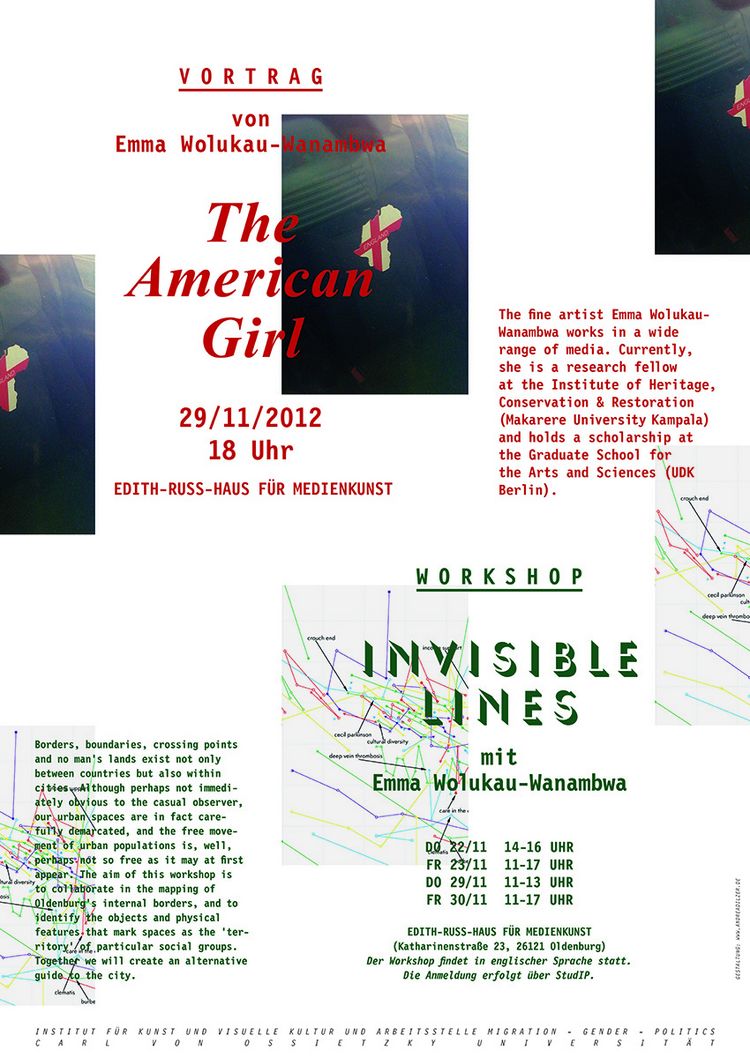
Workshop by Emma Wolukau "Invisible Lines"
(22/23 Nov. and 29/30 Nov. with registration)
Lecture by Emma Wolukau "The American Girl"
29 November, 6 pm at the Edith Russ Haus
The British-Ugandan artist Emma Wolukau-Wanambwa will spend two weeks in November 2012 as a guest at the invitation of the Institute of Art and Visual Culture and EMMIR (European Master Migration and International Relations). A co-operation with the Edith Russ House for Media Art, Oldenburg.
THE APPROPRIATION OF REALITY - DOCUMENTARY STRATEGIES IN FILM AND VIDEO ART

Lecture with film examples by Florian Wüst
Wednesday, 13 June, 2012, 7 p.m.
Room A8 0-001
Documentary and artistic practices have repeatedly overlapped and influenced each other in the history of film. This encounter of different demands on the relationship between subjectivity and objectivity often results in the critical questioning of the image-generating processes themselves. The image itself and the degree of its fictionality seem less important than the process of appropriating the real and the associated role of the "author". Using selected historical and contemporary film examples, Florian Wüst describes the transformation of cinematic practices and explores the question of to what extent and when they can be considered political per se.
With film excerpts from Harun Farocki, Georges Franju, Jean-Luc Godard & Anne-Marie Miéville, Isaac Julien, Renzo Martens, Leonore Mau & Hubert Fichte, among others.
Florian Wüst is an artist and film curator in Berlin. http://www.fwuest.com/
Depictions of violent women in the 1960s and 1970s in West German print media

Lecture by Clare Bielby
26.04.2012, 18.00, Room A08 0-001
The subject of the lecture is the print media, in particular the question of which strategies they use to make the violent woman explainable and sayable.
Public research colloquium of the Centre for Cultural Studies in Gender Studies