Lectures and conferences
Häufige Fragen (FAQ)
Antworten auf die häufigsten Fragen rund ums Studium findest du hier.
Kontakt zum Institut
Geschäftsstelle
Adresse
Direktorin
Stellvertretende Direktorin
Contact
Lectures and conferences
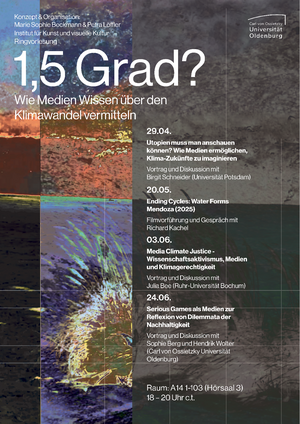
1.5 degrees? - Series of lectures
How the media convey knowledge about climate change
The series of lectures is dedicated to the question of how the media produce and communicate knowledge about climate change. In lectures and discussions, experts from science and artistic practice will discuss pressing questions on sustainability, climate justice and climate change, the role of media representations and mediations and the resulting responsibilities and possibilities for action for university research and teaching.
Further information and dates here
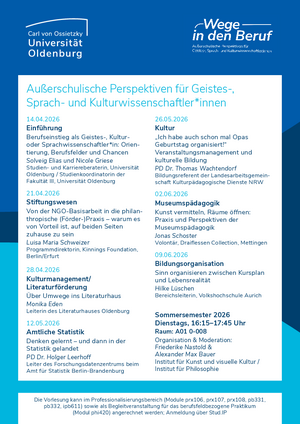
Series of lectures: Pathways to an academic appointment
Extracurricular perspectives for humanities scholars, linguists and cultural scientists
The series of lectures, which takes place each summer semester, is aimed at students of the humanities, linguistics and cultural studies, as well as the social sciences and human sciences, who are not studying with the aim of becoming teachers and who wish to find out about potential career paths and fields of work. A variety of professionals from the field provide insights into their individual career paths and are then available to discuss potential steps, as well as any difficulties, on the path to entering their respective fields of work. Relevant career fields such as the foundation sector, official statistics, culture and cultural management/literary promotion are presented .
Further information here
What Emerges in Submersion? | Experiences, Practices, and Politics from Below (2026)
Film, reading and discussion
Friday, 20.02.2026, 19:30
diffrakt | centre for theoretical periphery, Berlin
Whether as ocean, earth or soil, as a metaphorical or symbolic underworld or as a political figure of thought: the underground has become a central point of reference in current debates on ecological, social and postcolonial conflicts as well as power asymmetries in the humanities and beyond. Turning to the underground, however, is never just a thematic setting. It implies a conceptual and methodological movement - a practice of going underground - that requires a critical reflection on the conditions, technologies, aestheticsand politics of knowledge production.
Further information here
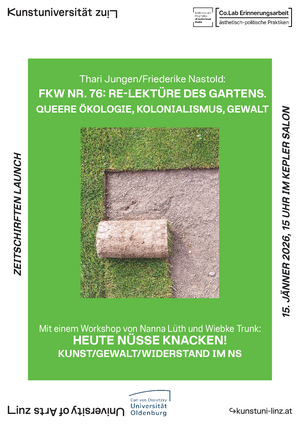
Journal launch of FKW No. 76: Re-reading the garden: transverse ecology, colonialism, violence. (2026)
Thursday, 15 January 2026 at 3 pm in the Kepler Salon
The editors Thari Jungen and Friederike Nastold cordially invite you to the presentation of issue no. 67 of FKW // Zeitschrift für Geschlechterforschung und visuelle Kultur, which was published in November 2025.
Further information here
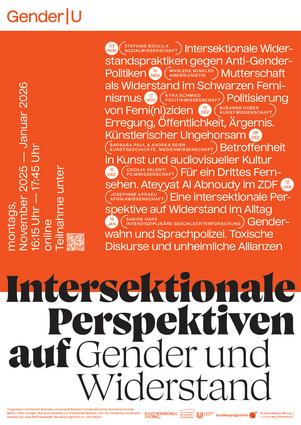
Intersectional perspectives on gender and resistance - series of lectures (2025/26)
In the 2025/26 winter semester, the Institute of Art and Visual Culture (JProf. Dr Friederike Nastold), the Q+ study programme at JGU Mainz and the Mainz Academy of Fine Arts, in collaboration with the University of Bremen and the University of Art and Design Linz, are organising an international, interdisciplinary series of lectures. The series brings together contributions to gender studies that take an intersectional approach to resistance.
Further information here
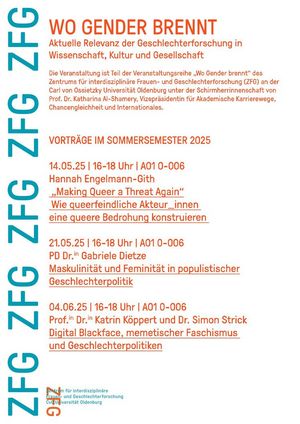
Where gender burns.
Current relevance of gender studies in science, culture and society
Public lecture series of the Centre for Interdisciplinary Women's and Gender Studies/ ZFG of the University of Oldenburg.
Under the patronage of Prof. Dr Katharina Al-Shamery, Vice President for Academic Career Paths, Equal Opportunities and International Affairs at the University of Oldenburg.
Further information here
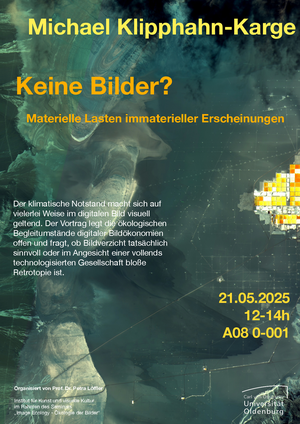
Lecture: Michael Klipphahn-Karge
No pictures? Material burdens of immaterial phenomena
The climate emergency makes itself felt visually in many ways in the digital image. The lecture reveals the ecological circumstances of digital image economies and asks whether renouncing images really makes sense or is mere retrotopia in the face of a fully technologised society.
Organised by Petra Löffler
As part of the seminar "Image Ecology - Ecology of Images
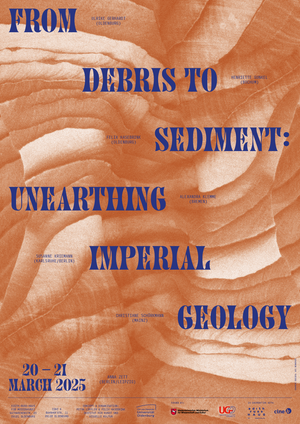
Workshop: From Debris to Sediment: Unearthing Imperial Geology
20-21 March 2025
Edith-Russ-Haus for Media Art & Cine K, Oldenburg
Concept & Organisation:
Petra Löffler & Felix Hasebrink
Institute of Art and Visual Culture
University of Oldenburg
More information here
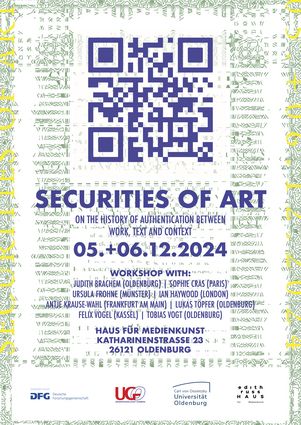
Securities of Art
The workshop "Securities of art. On the history of authentication between work, text and context" will examine artistically conceived authentications that have become constitutive for the status and value of artworks since the early 18th century. [...] The key focus is on exploring an art history of authentication in overarching social, economic and legal-historical contexts on the one hand, and on the other, delineating the theoretical contours of the relationship between the authenticating and the authenticated, between work and parergon, and between text, paratext, and context. We will engage in a historical and theoretical analysis of the shift from the authentication of art to authentication as art.
Further information here
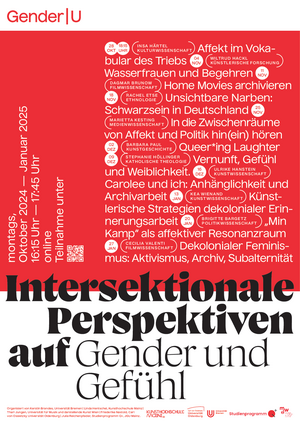
Intersectional perspectives on gender and emotion - series of lectures
In the 2024/25 winter semester, the Institute of Art and Visual Culture (JProf. Dr Friederike Nastold), the Q+ study programme at JGU Mainz and the Mainz Academy of Fine Arts, in collaboration with the University of Bremen and the University of Art and Design Linz, will be organising an international, interdisciplinary series of lectures for the first time. The series brings together contributions to gender studies that focus on feeling, affect and emotion.
Further information here

IMAGE INTERFERENCE
Documentary film as critical practice
"Image Interference" deals with documentary film in its function as a critical practice; documentary film has never been merely a sober representation of reality, but today it intervenes with new vehemence in socio-political discourses and opens up an independent, aesthetic space for reflection with moving images, sounds and language...
Organisation: Jakob Claus & Felix Hasebrink
12.11.2024. // 03.12.2024. // 10.12.2024.
Further information here
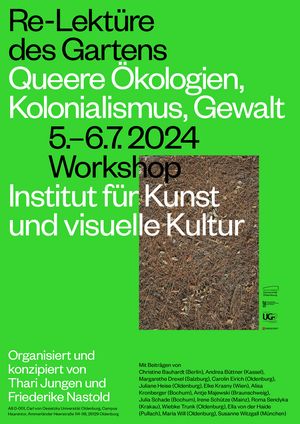
Re-reading the garden: queer ecologies, colonialism, violence
International workshop
05 and 06 July 2024
at the Institute of Art and Visual Culture
at the University of Oldenburg
in building/room A8 0-001
Organised and conceived by
Thari Jungen and Friederike Nastold
Further information here
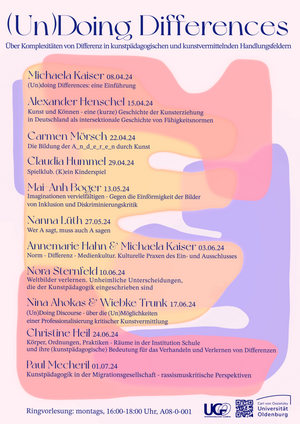
(Un)Doing Difference
On the complexities of difference in art education and art mediation fields of action
Monday, 16:00 - 18:00
From 08.04.2024
Further information here
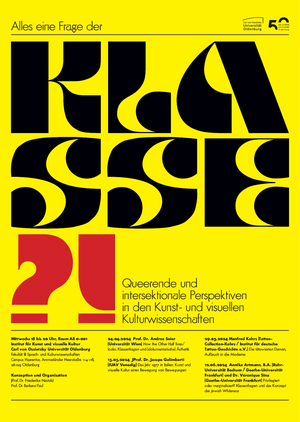
It's all a question of class!
Intersectional and queer perspectives in art and visual cultural studies
Current positions from art, visual culture and media studies will be presented and discussed in order to gain a new perspective on the category of class in queer intersectional entanglements.
Further information here
Organisation and concept:
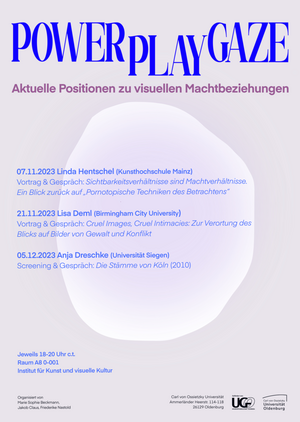
POWER - PLAY - GAZE
Lecture series
Further information here
The lectures are open to the public and take place on Tuesdays from 6 to 8 pm c.t. in room A8 0-001. The dates can be found on the poster. Registration is not necessary.
Organisation: Marie Sophie Beckmann, Jakob Claus, Friederike Nastold
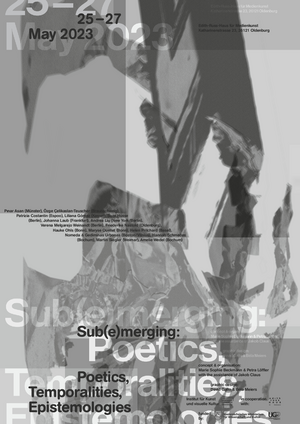
Sub(e)merging: Poetics, Temporalities, Epistemologies
International workshop at the Edith-Russ-Haus for Media Art
25 - 27 May 2023, Edith-Russ-Haus for Media Art
What is submerged lingers below the surface, is in the murk and the dim, barely visible and elusive. Macarena Gómez-Barris (2017) introduced the term "submerged modes" to describe complex and resistant forms of life and knowledge. These exist in specific material and media environments; sites of digital-capitalist oppression as well as industrial and neocolonialist exploitation, while also resisting these powers. Through their intangible density and illegible heterogeneity, these perspectives elude an "extractive view" from above, that is, approaches that aim at totalizing representation, disciplining, and capitalist valorization. Instead, they invite engagement with methods and perspectives that are equally submerged.
Seeking to open and expand the rich repertoire of meanings of Gómez-Barris's concept-and focusing on its generative potential by slightly altering its terminology-the artistic and scholarly contributions of the workshop probe the transformative potentials of operating and perceiving from below, especially in times of political and ecological crisis: Can submerging be turned into an aesthetic strategy? What role do imaging media and technologies play in the visualisation of the submerged? To what extent are forms of representation or supposedly evident spatial, temporal, and historical orders called into question? How does it relate to the underground in its many geological-material and symbolic meanings? And what happens if we take seriously the processes of gathering and evolving inherent in the term submerging? In other words: What emerges in submersion?
Further information here
Registration:
Concept and organisation: Marie Sophie Beckmann & Petra Löffler
With the collaboration of: Jakob Claus
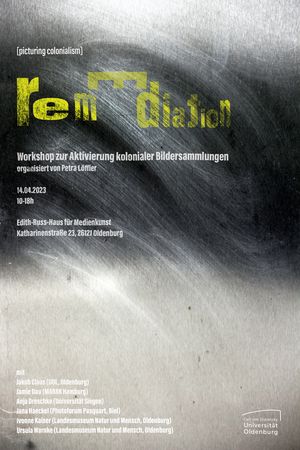
Workshop: remediation
Part 2 - Workshop on the activation of colonial image collections
organised by Petra Löffler
14.04.2023
Further information here
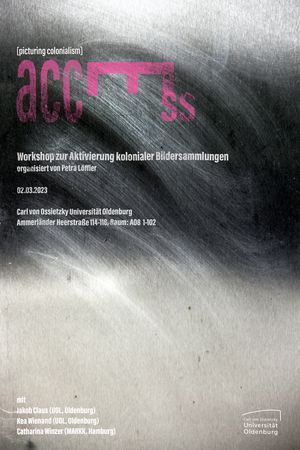
Workshop: access
Workshop on the activation of colonial image collections
organised by Petra Löffler
02.03.2023
further information here.
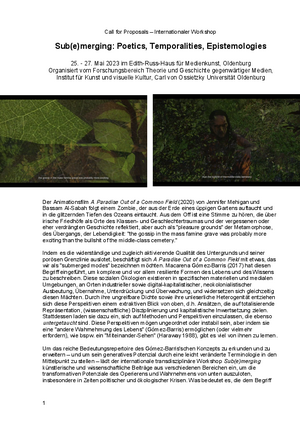
Sub(e)merging: Poetics, Temporalities, Epistemologies (2023)
Workshop - Call for Participation
The international workshop Sub(e)merging: Poetics, Temporalities, Epistemologies will take place at the Edith-Russ-Haus for Media Art from 25 to 27 May 2023.
The research area Theory and History of Contemporary Media invites proposals for artistic or scientific contributions to be submitted by 10 February 2023 to Further information on submission and the content of the workshop can be found here in English and German.
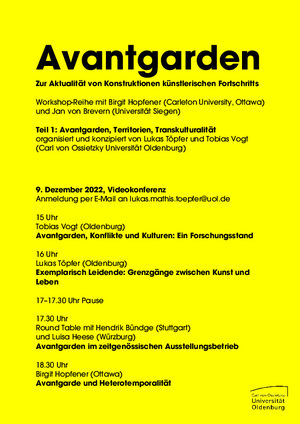
Avant-gardes - On the topicality of constructions of artistic progress
Click here for more information.
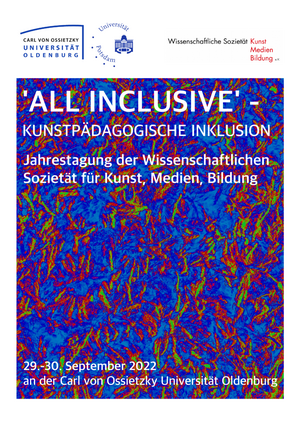
Art education conference: ALL INCLUSIVE'
This year's conference on art education inclusion will take place from 29 - 30 September 2022.
Further information can be found here.
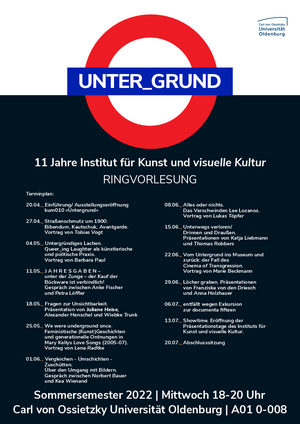
Series of lectures summer semester 2022
The series of lectures for the 11th anniversary of the Institute of Art and Visual Culture takes place every Wednesday from 6 - 8 pm.
A list of the various lectures can be viewed here.
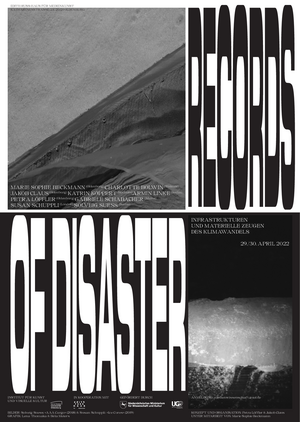
Records of Disaster. Infrastructures and material witnesses of climate change
Workshop on 29 & 30 April 2022
Edith-Russ-Haus for Media Art
Katharinenstraße 23
26121 Oldenburg
While infrastructures form the seemingly stable material and logistical basis of our everyday lives, on closer inspection they are fragile constructs. This becomes clear from the regular collapse of networks that supply people with water, heat, goods and information. Increasingly, such collapses are triggered by ecological disasters, forest fires, floods or tidal waves, which at the same time sensitise us to man-made climate change and its local effects as material witnesses of global warming.
Registration:
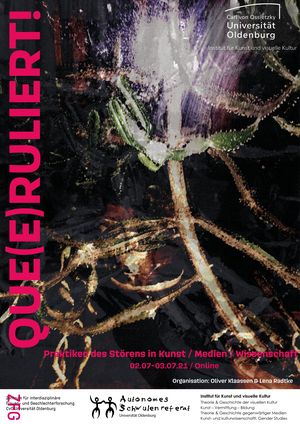
QUE(E)RULIERT! Practices of disruption in art / media / science
2 and 3 July 2021
The conference will take place via the Big Blue Button video conferencing system. Please register by 25.06.21 with a short email to
Further information can be found here.
Art Education Society. Historical reconstructions of a complex structure
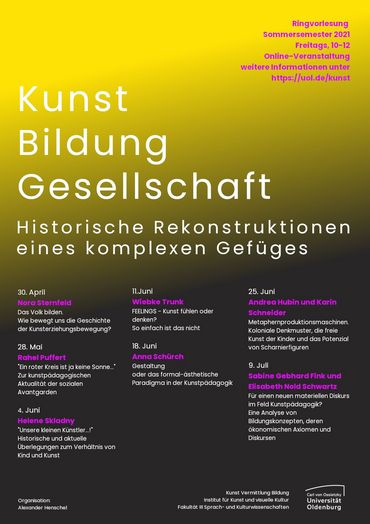
Series of lectures in the summer semester 2021
In German-speaking countries, the understanding of the history of art education is dominated by linear conceptions of history and narratives of continuous success. The contributions to the series of lectures counter this understanding with alternative narratives and historical approaches. These are narratives about art education that take socio-historical contexts into account, such as the history(ies) of colonialism, economics, gender and nationality – not least to present certain educational ideas, which are today unquestioningly accepted as successes, in a more nuanced light. And also to bring into focus certain positions that are no longer visible today or have been suppressed.
The series of lectures takes place online on Fridays from 10.15 am to 11.45 am and is open to the public on the dates specified. Guests are very welcome and can register by emailing:
Organised by: Alexander Henschel
Art education is nice, but it's a lot of work for the institution

"Art is beautiful, but it's a lot of work", as Karl Valentin, the great comedian and artist of language, once put it. The variation of the title for this year's series of lectures is based on the assumption that art education always takes place within a certain institutional order. And what's more: art mediation - at least when it is "beautiful" - means not only working within, but also working on the institution.
The institution that forms the respective starting point for the lectures can be called 'school', 'museum', 'education policy', 'the exhibition space', 'the university', 'art school', etc. The focus is on the question of how the relationship between art - mediation - institution can be described, discussed or mediated in other ways. After each lecture there will be sufficient time for discussion with the invited guests: artists, art teachers, curators, professors, educators, scientists. The event series consists of a series of lectures and appointments in which we reflect together on what we have heard.
The animal: discourses in art and media history
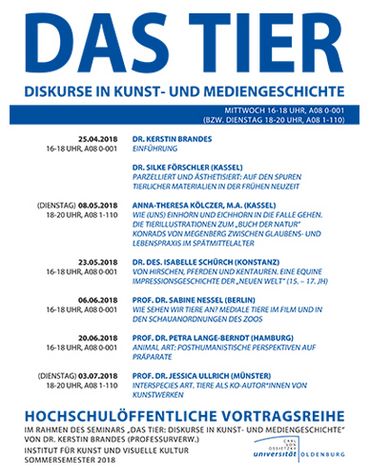
University lecture series as part of the seminar "The Animal: Discourses in Art and Media History", Dr Kerstin Brandes (Professor), Institute of Art and Visual Culture, summer semester 2018
Over the last 25 years, Human-Animal Studies (HAS) - or Animal Studies (AS) - has developed into an interdisciplinary field of research that aims to shift the usual anthropocentric perspective and look at the relationships between humans and animals in a new way. The lectures explore the question of how animals have been used and thematised in visual culture, in art and media history, in art and media studies discourses and to what extent this represents a challenge to human-animal studies.
Workshop for spatial issues and mediation #1

At the centre of the workshop for spatial issues and mediation # 1 rearrange focuses on approaching questions about educational institutional space in practice and theory. In 'small forms' such as a short lecture, excursion, short exhibition, reflection and guest lecture, we will deal with conscious changes in the conditions of educational spaces (university, school, ...). In doing so, scientific (reorganisation of knowledge), artistic (reorganisation of material and media arrangements) and pedagogical (transformation of social hierarchies) perspectives and attitudes will be adopted.
In the one-day research workshop reorganising the individual perspective on, in and towards space will be examined and the question asked as to how relationships and effects change when one walks through a space, walks around in it, moves something in it or leaves it. What becomes apparent when you start to rearrange things in the room? And can such effects and emotions be captured? Can this be achieved, for example, through images, language and observations?
WHY IT MUST BE: Current legitimisations of art education and art pedagogy

In view of a changing educational landscape and new socio-political and technological challenges, the question arises as to whether the existing concepts of aesthetic education are still relevant.
Whether taught at school or outside of school - how is the relevance of art and its teaching justified today? How does the subject respond to social challenges that are signalled by keywords such as 'inclusion' or 'migration'? How is aesthetic practice and theory changing in digitalised everyday life? Does art education in the museum and exhibition sector still need to fight for acceptance or has it long been accepted? And what significance does it have in relation to the expanding field of cultural education? To what extent is aesthetic education affected by a state-funded creative industry and the concepts of art and creativity that it disseminates? How can working contexts and discursive exchange be strengthened in this situation?
Art Education Inclusion
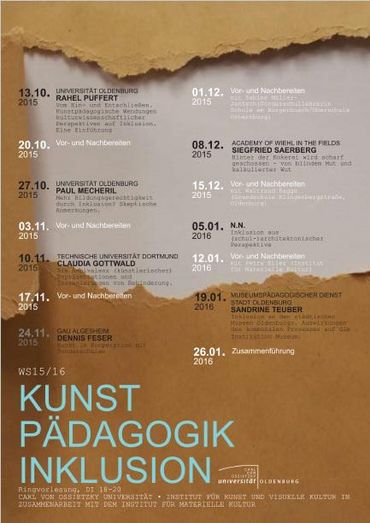
Inclusion is currently being discussed at the University of Oldenburg - and not only here - primarily with regard to teacher training.
The idea of this series of lectures is to scrutinise the discourse on inclusion and to undertake shifts: through a discourse-analytical perspective of disability studies and from the perspective of art and an "aesthetic education of difference" (Maset). One horizon here is art education in and out of school.
The call for diversity will be answered with a heterogeneous spectrum of speaker positions: artists, teachers, parents, architects, special educators, cultural scientists, people with disabilities and those with (supposedly) none, cultural scientists, blind and sighted people will be heard.
The event is organised in co-operation with Material Culture.
Fundamentals of art education
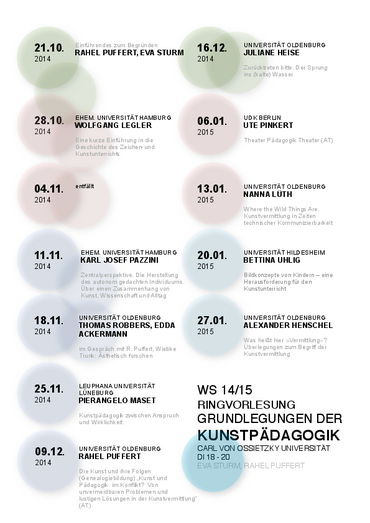
According to the dictionary,foundation means something that someone can build on, that someone can rely on, that is the starting point, the basis for something.
The word Grundlegungen now indicates that foundations are actively laid. So the question arises again and again: What must be said, clarified, assumed in order to be able to move in the quite contradictory field between art and education, in order to have a say, in order to achieve effects? What skills and knowledge must be acquired or already exist? What knowledge and thinking are indispensable? And who asserts these foundations/concepts? From which position, with which interest, in which discourse is it justified, a basis sought, a foundation laid?
Invited guests from Germany and staff from the art-mediation-education department in particular will address this question of grounding. The speakers come from different intellectual-real fields of practice and speak from different theoretical backgrounds.
"Queer as ... Questioning Representations of 'African' Sexualities"

This is the motto of a diverse programme of workshops, films and lectures in English offered by female academics from the University of Oldenburg in co-operation with Cine K in October and November. Organisers are lecturers from Gender Studies, the degree programme "European Master in Migration and Intercultural Relations (EMMIR)", the Institute of English and American Studies and the Institute of Art and Visual Culture.
Queer Studies and Intermediality: Art - Music - Media Culture
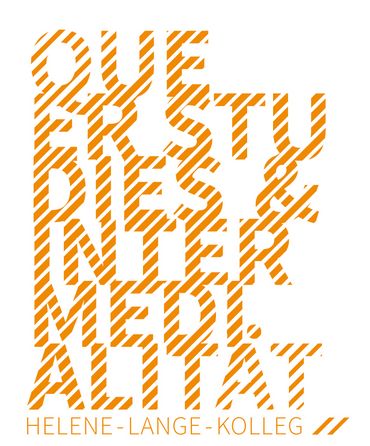
Under the motto "Queer Art, Talk and Media", the new Helene Lange Centre for Queer Studies and Intermediality: Art - Music - Media Culture invites you to its kick-off event: Thu, 4 July 2013, from 5pm, A8 0-001.
At the centre of the Helene Lange College "Queer Studies and Intermediality" are queer or queer-designated works from art, music and media culture - productions that combine different forms of artistic expression and formulate alternatives to heteronormative structures and arguments. The research programme asks questions about the interfaces between intermediality, queer performativities and aesthetic concepts as well as about interferences between everyday practices and juridical discourse. The extent to which queer artistic statements function as anti-normalisation politics will be analysed and discussed.
Ghosts of colonialism. Aesthetics Remembrance Resistance
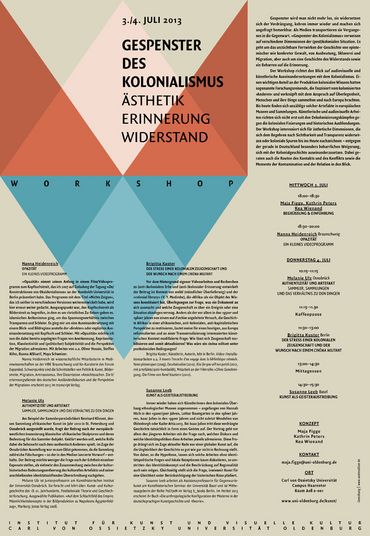
on 3-4 July, at the University of Oldenburg
You can't get rid of ghosts, they resist repression, return again and again and make themselves known without being asked. As media, they transport the past into the present. "Ghosts of Colonialism" refers to various dimensions of the (post)colonial situation. It is about the invisible/visible continuation of the history of epistemic and concrete violence, of exploitation, slavery and migration, but also about a history of resistance and an insistence on memory. The workshop focuses on audiovisual and artistic approaches to colonialism.
Primer, film, affective image. Media of education
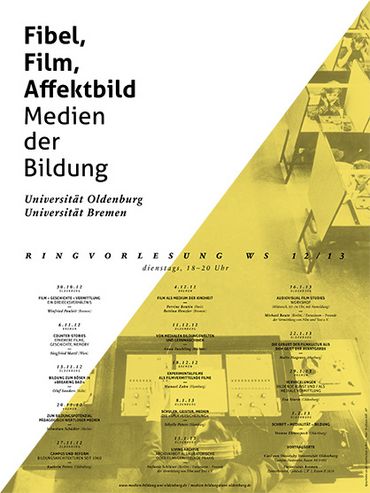
Series of lectures, winter semester 2012/2013
The relationship between educational processes and media can be considered from various angles: on the one hand, there is the question of how technical media are utilised in educational contexts and, above all, what impacts and effects this has. This, in turn, draws attention to the fact that education has always been shaped by media. One could say that the transmission of cultural techniques is linked to media technology – be it literacy through the primer, or independent learning through e-learning. Furthermore, one might ask how our understanding of education shifts and how teaching changes when film, rather than the book, comes into play as an educational medium.
Hikes

2nd Annual Conference of the Gender Studies Association, 3-4 February 2012, University of Oldenburg
Art - Education - Migration

Series of lectures, winter semester 2011/2012
This series of lectures aims to explore the interrelationships between the three concepts of art, education and migration. We do not view these concepts as abstract constructs that merely describe social reality, but rather as linguistic and social practices in their own right; as contested frameworks that help to shape social reality.
Un/verblümt. Queer aesthetics

Lecture series at the University of the Arts Bremen and the Institute of Cultural Studies at the Carl von Ossietzky University of Oldenburg
Winter semester 2011/12,
Thursdays 6-8 pm, fortnightly in Bremen or Oldenburg.
Workshops: Fridays/Saturdays at the HfK Bremen
Concept and organisation: Josch Hoenes, M.A. (HfK Bremen),
Prof. Dr. Barbara Paul (Institute of Cultural Studies at the CvO University of Oldenburg)
Art in mediation. Reports from the field
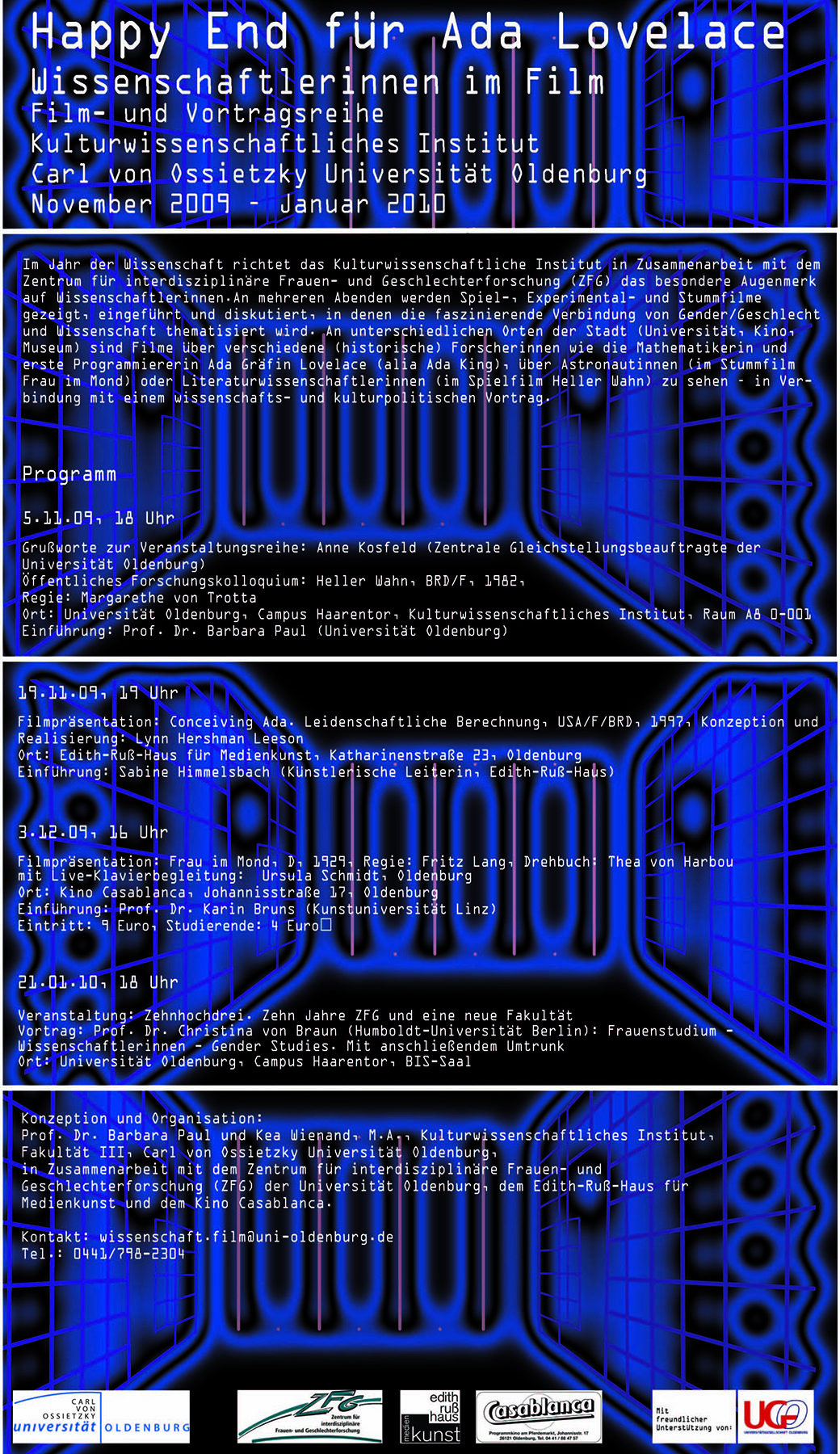
Series of lectures, winter semester 2009/2010
What does art have to do with education, with creative practice, and with school? How does it manifest itself, what does it do, what impact can it have – when conceived and realised in concrete terms? In a series of lectures, practitioners will have their say; they are currently carrying out exciting, unusual ‘art-related educational work’ in various contexts.
> more
Art educational positions
Series of lectures, winter semester 2009/2010
To this day, the history of art education can be recounted as a coexistence, succession, opposition and interplay of individual positions and movements that influence, permeate, exclude, take up, complement and, in one way or another, repeat one another. This series of lectures aims to explore and highlight such trends.
> more