

Through an exchange programme with a school in Nepal, Stephan Baur from Geretsried inspires his pupils to take an interest in science. He has now been awarded the 2024 Klaus von Klitzing Prize in recognition of his outstanding commitment.
A partner school situated at an altitude of around 3,500 metres in a remote valley in Nepal – very few schools in Germany are likely to have one. Geretsried Grammar School, south of Munich, is one of them: for the past 15 years, the Bavarians have maintained an intensive exchange programme with Lophelling Boarding School, situated high up in the Annapurna region. The fact that 60 pupils from Geretsried have already had the opportunity to get to know the school during exchange trips, and that some of them spent several months after their Abitur assisting the local teachers with science lessons, is largely thanks to Stephan Baur: After completing his teaching training, the maths, Computing Science and physics teacher spent half a year teaching at various schools in Nepal and took the lead in organising the co-operation when he subsequently became a teacher at Geretsried Grammar School.
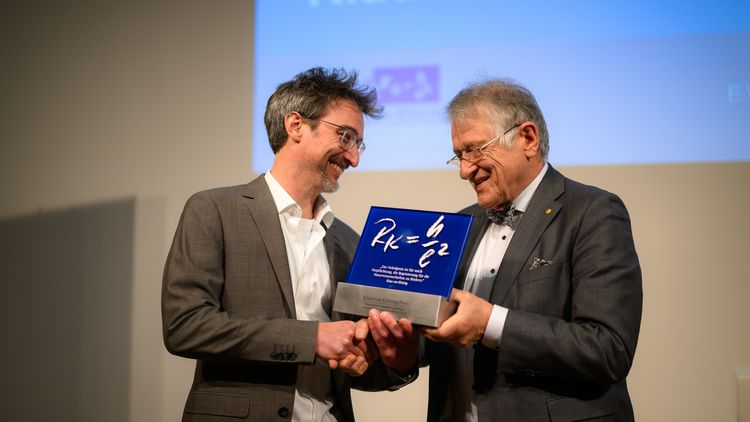
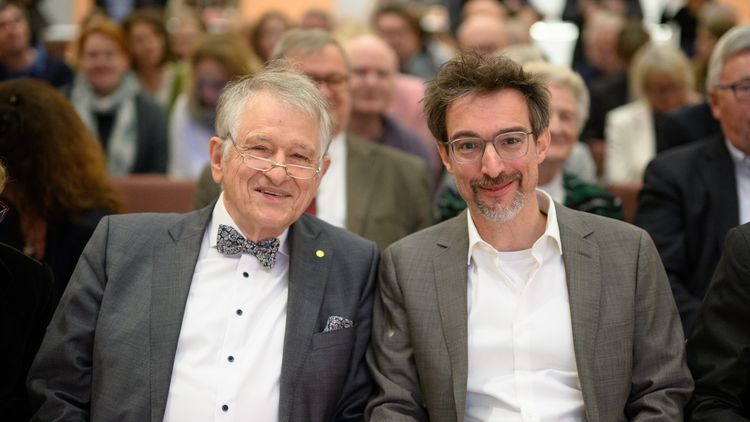
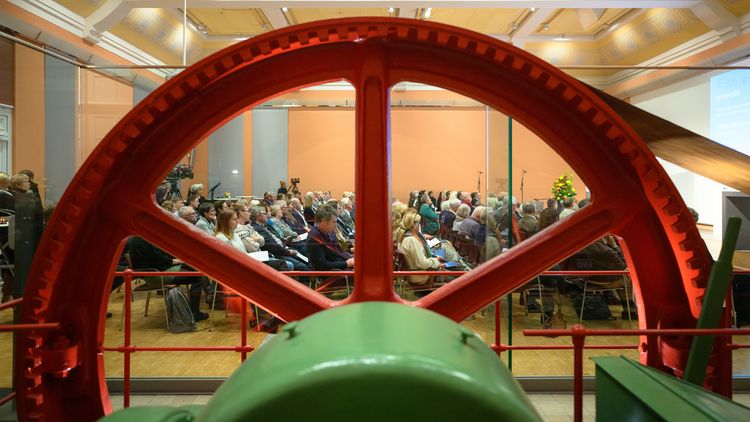
The teacher has now been awarded the 2024 Klaus von Klitzing Prize at the EWE Forum Alte Fleiwa in Oldenburg. Stephan Baur successfully beat 56 other nominees from across Germany. The Klaus von Klitzing Prize, worth 15,000 euros, has been jointly awarded by the University of Oldenburg and the EWE Foundation since 2005. The prize recognises outstanding commitment to the subjects of mathematics, Computing Science, natural sciences and technology (MINT). The jury comprises Nobel Laureate in Physics Prof. Dr Klaus von Klitzing, alongside representatives from the University of Oldenburg, the Oldenburg Chamber of Industry and Commerce, the EWE Foundation, the Wesermarsch Economic Development Agency and the new headteacher of the Graf-Anton-Günther School, Nicole Voigtländer-Kunze. At a ceremony in the assembly hall of the Graf-Anton-Günther School, Baur received the award from the school’s namesake in person.
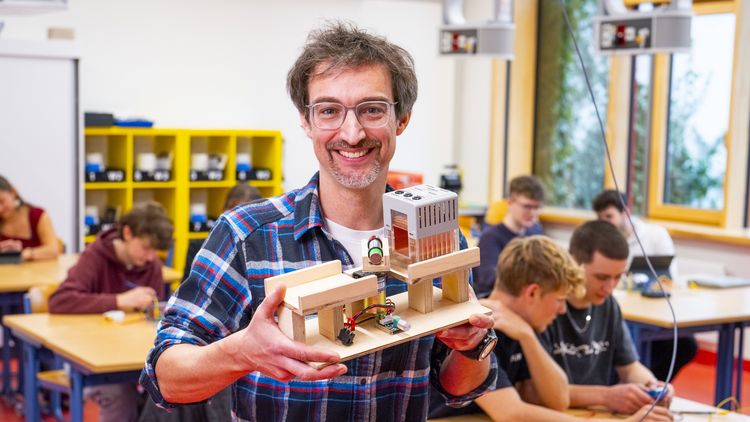
The jury was particularly impressed by Baur’s voluntary work, for example with the Nepal Initiative Schongau association. The keen mountaineer is also committed to promoting science education and sustainable development in other countries: for example, Baur has helped develop the curriculum for a Bachelor’s degree programme in electrical engineering at the Burkina Faso Institute of Technology, which focuses on renewable energy. He also maintains contact with other educational institutions in Burkina Faso, Nepal, Zimbabwe, Ghana, Togo and Ukraine. He runs workshops for teachers, develops teaching concepts and devises ideas for experiments that can be carried out using simple and inexpensive resources. His aim is to support teachers in these countries in making lessons in STEM subjects more interesting and practical – and, in particular, to incorporate exciting experiments that are relevant to everyday life.
How can remote regions be supplied with energy cost-effectively?
Pupils in Geretsried also benefit from his international work. “I start by testing experiments here at school and try to pass these on to schools in developing countries,” explains Baur. Renewable energy sources often feature in his lessons, such as solar energy, hydropower or heat supply. The 44-year-old is also exploring these topics in his PhD at the Technical University of Munich (TUM), which he is pursuing alongside his work as a teacher. His doctoral thesis focuses on a cost-effective and simple energy supply, for example for families in remote regions of Nepal.
By linking physics topics in the classroom to real-world projects across the globe, Baur creates a special sense of credibility, emphasises his colleague Robert Weisser, head of the physics department at Geretsried Grammar School: “He involves the pupils; they travel with him to Nepal and see the impact he’s making there.” Among other things, Baur initiated the construction of a photovoltaic system and a hot-water collector at Lophelling Boarding School. Former pupils regularly spend several months at the Nepalese school after completing their Abitur, assisting with lessons, helping with renovations and ensuring on the ground that the projects they have initiated continue. “What I find particularly special here is that everyone is incredibly happy and radiates a strong zest for life, despite their simple way of life,” says Elin Ott, who is currently completing a voluntary placement at the Lophelling Boarding School.
Commitment to sustainability and intercultural understanding
With his wide-ranging commitment, Baur is a role model both professionally and personally, explained Prof. Dr Andrea Strübind, Vice-President for Studies and Teaching at the University of Oldenburg, at the award ceremony. “Stephan Baur knows how to inspire enthusiasm for STEM subjects through his dedicated and practical teaching. He is a teacher who encourages young people all over the world to surpass their own limits and to champion sustainability and intercultural understanding. As a university, we attach the utmost importance to fostering precisely these outstanding skills in our trainee teachers at an early stage and in a lasting way.”
Klaus von Klitzing, who spent the early years of his school education in Oldenburg, is, amongst other things, Director of the Max Planck Institute for Solid State Research in Stuttgart and a member of the International Solvay Institute. He is also a member of the jury for the Wittgenstein Prize, awarded by the Austrian Research Council. In 1980, he discovered a new quantum effect and was awarded the Nobel Prize in Physics in 1985 for this achievement. The Von Klitzing constant, named after him, has had a significant influence on modern semiconductor development and precision measurement technology. In 2006, he was awarded an honorary doctorate by the University of Oldenburg, which is celebrating its 50th anniversary this year.