

Whether it's about dormice, the school garden or intelligence tests for dogs: Sandra Grösser-Pütz from Maintal knows how to inspire her pupils. This year, she was awarded the Klaus von Klitzing Prize.
Always friendly and positive, easy-going and sensitive at the same time: this is how pupils and teachers from Albert-Einstein-Gymnasium in Maintal describe Sandra Grösser-Pütz, a biology and geography teacher. "The most important quality - and Sandra has this in particular - is that she has never forgotten that she was once a pupil herself," says Jons Bauer, Head of Sixth Form at the grammar school in Hesse. With this approach, his colleague succeeds particularly well in gaining access to the children.
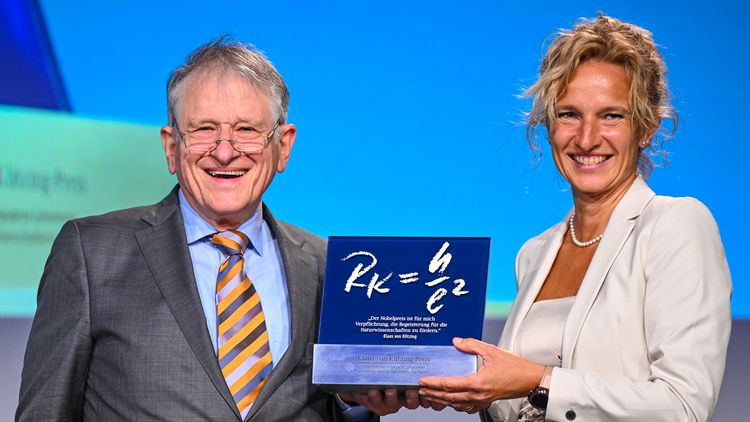
Grösser-Pütz has now been honoured for her commitment with the Klaus von Klitzing Prize, which has been awarded jointly by the University of Oldenburg and the EWE Foundation since 2005. The prize recognises outstanding commitment in the subjects of Mathematics, Computing Science, Natural Sciences and Technology, the so-called MINT subjects. Grösser-Pütz, who beat 47 competitors from all over Germany, received the 15,000 euro award at a ceremony in the auditorium of the Graf Anton Günther School in Oldenburg.
The 50-year-old is a real multi-talent and knows how to motivate and inspire her pupils, many of whom have a migration background and come from economically disadvantaged families, to take up STEM subjects, the jury said, explaining its decision. In addition to the namesake and Nobel Prize winner in physics, Prof Dr Klaus von Klitzing, the committee includes representatives from the University of Oldenburg, the EWE Foundation, the Oldenburg Chamber of Industry and Commerce, the Wesermarsch Economic Development Agency as well as the headmaster and a former pupil of the Graf Anton Günther School.
Arousing interest in nature and the environment
"What Sandra Grösser-Pütz does right is that she listens to the students and at the same time encourages and challenges them," says Saskia Heber, subject head for STEM subjects at Albert Einstein Gymnasium. In order to awaken young people's interest in nature and the environment beyond the classroom, the teacher has initiated several extracurricular co-operations - including with the German Nature and Biodiversity Conservation Union (NABU). For example, the children and young people regularly count sparrows, great tits and blackbirds for NABU's "Hour of the Garden Birds" campaign. In the "Nut Hunt" project, they examined nuts for traces of hazel dormice and thus helped to find out how widespread these shy rodents still are.
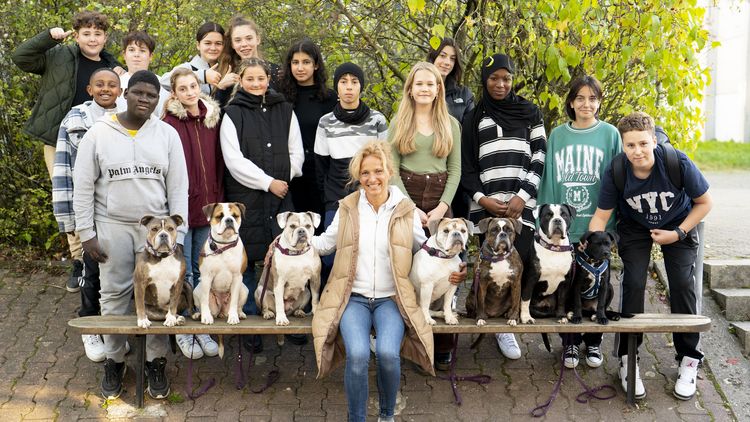
Grösser-Pütz motivates other pupils to help organise the school garden, take part in competitions such as "Jugend forscht" or visit the student laboratories at nearby universities. She has also established a collaboration between her secondary school and a dog school. Through contact with the animals, the children and young people should reduce their fears, develop trust and at the same time learn how to teach and lead dogs. "I enjoy it when the pupils suddenly start to be passionate about a subject," says the teacher. The mother of five is also a liaison teacher and is committed to educational equality.
University President Dr Ralph Bruder was impressed by the teacher's commitment. "Sandra Grösser-Pütz gives her pupils confidence in their own abilities in extracurricular projects. She encourages them to engage with scientific topics and gives them the opportunity to broaden their perspective on life and grow beyond themselves," said Bruder. It is precisely these skills that the university emphasises when training future teachers, explained Bruder.
Klaus von Klitzing, who spent his early school years in Oldenburg, is, among other things, Director at the Max Planck Institute for Solid State Research in Stuttgart and a member of the International Solvay Institute. He is also a jury member of the Wittgenstein Prize, which is awarded by the Austrian Research Foundation. In 1980, he discovered a new quantum effect and was awarded the Nobel Prize for Physics in 1985. The Von Klitzing constant named after him had a significant influence on modern semiconductor development and precision measurement technology. In 2006, he received an honorary doctorate from the University of Oldenburg.