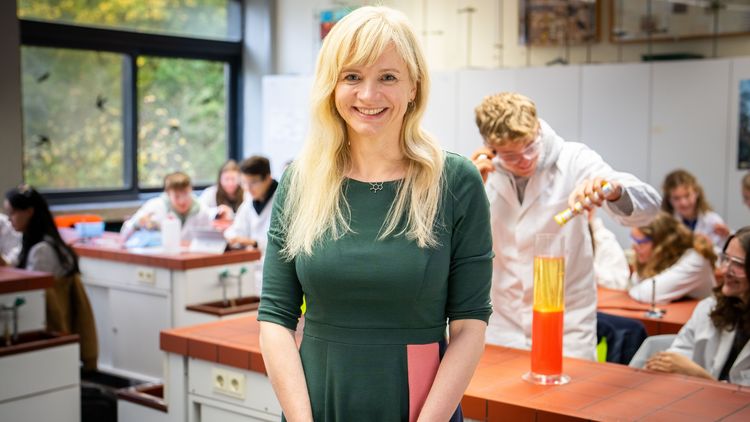


From experiment kits to escape games: Petra Lehner from Burglengenfeld comes up with lots of ideas to get her pupils interested in science. She has now been awarded the Klaus von Klitzing Prize 2023.
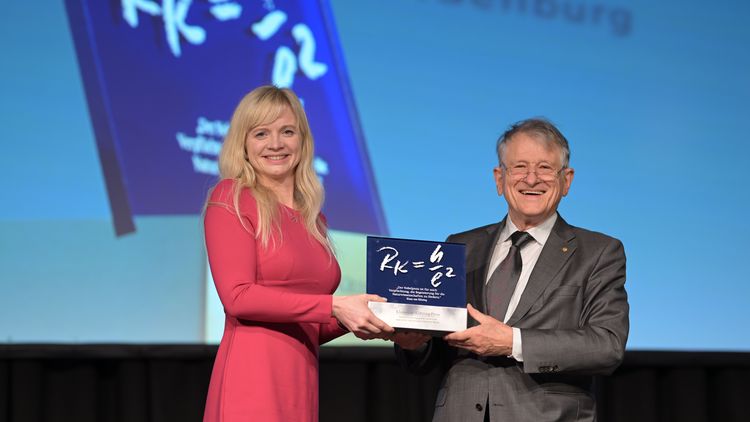
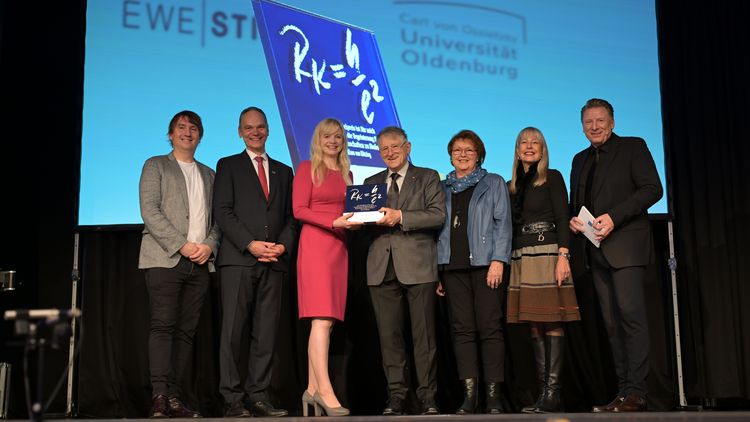
Her colleagues describe her as a spirited and positive personality with outstanding commitment and enjoyment of her work; she regularly inspires and motivates pupils with her ideas: Petra Lehner is a passionate teacher. At Johann-Michael-Fischer-Gymnasium Burglengenfeld in Bavaria, she teaches the subjects of Computing Science, Biology, Chemistry and Nature and Technology. She has now been honoured for this with a special award in Oldenburg: At a ceremony in the auditorium of the Graf Anton Günther School, she received the Klaus von Klitzing Prize 2023 from the namesake himself, Nobel Prize winner Prof Dr Klaus von Klitzing.
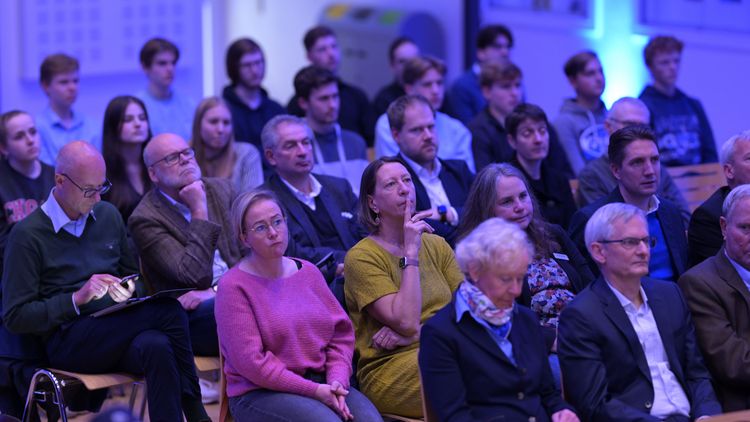
The Klaus von Klitzing Prize, which is endowed with 15,000 euros, has been awarded jointly by the University of Oldenburg and the EWE Foundation since 2005. The prize honours outstanding commitment in the subjects of Mathematics, Computing Science, Natural Sciences and Technology (STEM). In addition to Nobel Prize winner in physics Prof Dr Klaus von Klitzing, the jury includes representatives from the University and the Oldenburg Chamber of Industry and Commerce, the EWE Foundation, the Wesermarsch Economic Development Agency, the headmaster of Graf-Anton-Günther-Schule, Wolfgang Schoedel, and a student juror. Petra Lehner was successful against 41 competitors from all over Germany. At the award ceremony, student Amelie Hans-Eder and student Korbinian Kirschneck from JMF-Gymnasium Burglengenfeld gave the laudatory speech. They recognised the fact that Lehner encourages students to take the initiative and inspires others with her enthusiasm. She also manages to transfer her own enthusiasm for science to the pupils and give them a real sense of achievement.
Innovative STEM projects
Lehner has, for example, launched the project "MINTerpol - natural science secrets on the trail", which reaches several thousand pupils and numerous primary school teachers across all schools every year. As part of the project, Petra Lehner's pupils have developed a science experiment kit. It contains a brochure with instructions for experiments that primary school pupils can carry out. The kit was developed during the corona lockdown; the experiments contained in the brochure can also be carried out at home with chemicals that are available in almost every household. In addition to the brochure, the case contains around 2,000 other individual items such as chemicals and laboratory equipment that can be used in the experiments. The project has gained considerable publicity thanks to numerous awards at state and national level as well as reports in TV and newspapers.
The "mINTO THE WILD" escape hike, developed by Lehner and her pupils and free of charge for all participants, also inspires people of all ages to take an interest in the natural sciences: Equipped with a rucksack full of scientific puzzles, interested families and groups can get closer to the solutions step by step on the grounds of an outdoor pool and in the forest, immersing themselves in exciting stories, searching for hidden clues and cracking codes. They have to solve numerous tasks in a given time to unravel the mystery of "Bulbo the Bearded" or "Erill the World Wanderer".
A role model for student teachers
"Petra Lehner knows how to inspire enthusiasm for STEM subjects with her lively and motivating lessons. She is a teacher who is a role model both professionally and personally - for young people, whom she encourages to tackle even supposedly difficult scientific questions. But also for adults, to whom she opens up the fascinating world of science and wins them over to environmental and climate protection. As a university, we attach great importance to promoting precisely these kinds of outstanding skills in our student teachers at an early stage and in the long term," explained University President Prof Dr Ralph Bruder.
Klaus von Klitzing, who spent his early school years in Oldenburg, is, among other things, Director at the Max Planck Institute for Solid State Research in Stuttgart and a member of the International Solvay Institute. He is also a jury member of the Wittgenstein Prize, which is awarded by the Austrian Research Foundation. In 1980, he discovered a new quantum effect and was awarded the Nobel Prize for Physics in 1985. The Von Klitzing constant named after him had a significant influence on modern semiconductor development and precision measurement technology. In 2006, he received an honorary doctorate from the University of Oldenburg.