
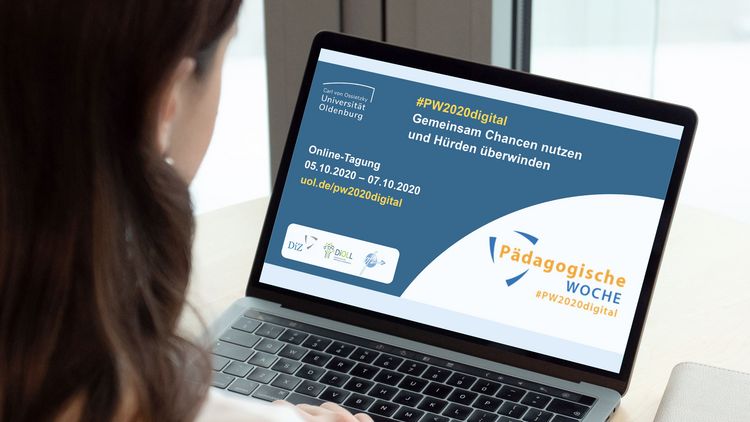


What does everyday life as a digital teacher look like, or even a mobile school? Digital teaching and learning are increasingly characterising everyday school life - and consequently also the form and content of this year's Pedagogical Week at the university.
How can learning material be taught well using video? How do I teach with a learning management system? How can children as young as primary school age learn to programme? And how can pupils recognise reputable sources of information and expose fake news? These are just some of the questions to which interested parties will receive answers from experts from universities, schools and media education during #pw2020digital from 5 to 7 October. The first online edition of the teachers' conference offers a good 50 online events on all aspects of digital teaching.
Participants can learn about virtual reality or blended learning, data protection or useful online tools for the first time or deepen their knowledge. In this way, the Education Week team aims to support teachers at various levels. Concrete examples illustrate how digital media can be used in creative teaching-learning processes.
"The event is a short-term response to demand - and just as much an experiment for us as digital teaching is for many teachers," says Dr Verena Niesel from the organisation team. Normally, a year and a half of planning and preparation goes into the Pedagogical Week, but for this year's 34th edition, the team put the programme together within three months instead of simply cancelling it due to the pandemic.
The list of speakers includes well-known bloggers with keynote speeches. For example, blogging secondary school teacher Nina Toller from Duisburg, who teaches with self-produced explanatory videos and screencasts based on the flipped classroom concept, will give an insight into her "everyday life as a digital teacher based on the MacGyver principle". And Jan Vedder, teacher at the Berenbostel secondary school, seminar leader and blogger, discusses why change is necessary in schools. The deputy head of Waldschule Hatten, Sarah Schellmann, will report on her school's journey to becoming a mobile school.
Niesel believes that one goal has already been achieved before the event begins: "For example, we receive emails from teachers asking for tips on how to get started as they have no experience of digital teaching." The #pw2020digital team believes it is particularly important to address those teachers "who are still unfamiliar with digital teaching".
This is also where the university project "Digitalisation of Oldenburg Teacher Training" (DiOLL) comes in, funded by the federal and state governments as part of the "Teacher Training Quality Initiative". The team, under the scientific leadership of computer science didactics expert Prof Dr Ira Diethelm, is helping to shape #pw2020digital. It is the first time that a project has been incorporated on this scale, says organiser Niesel: around one and a half dozen events, some with specially developed self-learning modules for the participants, came directly from the project. "We said to ourselves together: 'If not us, then who? "Without the DiOLL project team led by Ira Diethelm, it wouldn't have worked."
The participants of this year's Pedagogical Week were welcomed by Lower Saxony's Minister of Education Grant Hendrik Tonne with a video message. The online conference is recognised by the state education authority as further training, meaning that teachers from Lower Saxony can apply for special leave to attend. The event is organised by the Centre for Teacher Training - Didactic Centre (DiZ) in co-operation with the Oldenburg Training Centre (OFZ). This year, the Lower Saxony State Institute for School Quality Development (NLQ) is also closely involved with its experts from the field of media education.