Events / Archive
Prof. Dr. Mario Dunkel
Institute of Music (» Postal address)
Prof. Dr. Lars Oberhaus
Institute of Music (» Postal address)
Contact
Prof. Dr. Lars Oberhaus
Phone: +49 (0) 441 - 798 2080
E-Mail:
Events / Archive
Guest lecture by Ádám Havas (KWI Essen)
10 December 2024, 18:00-19:30 Room: A08 1-102
Semi-peripheral Whiteness, Micro-Utopias and (Free)Improvisation: Free Jazz Genealogies behind the "Nylon Curtain"
The talk problematises the role of ethno-racial and geocultural distinctions in the creation of cultural meanings, aesthetic forms, and political stakes of improvised music, drawing on lesser-known East-Central European avant-garde jazz histories as well as broader international trends. To challenge simplistic views of the counter-cultural functions of jazz within the Eastern Bloc, it begins by providing an overview of how different strategies of nationalising jazz during the Cold War Era contributed to the creation of autonomous urban jazz scenes. This is followed by an examination of the social conditions that shaped the Hungarian jazz field, leading to its division into rival camps of post-WWII modern jazz (bebop) and Bartók-oriented avant-garde. Focusing on the cultural critique of György Szabados, the founding father of Hungarian free improvised music, the lecture offers a critical reinterpretation of George Lewis' influential "Eurological" and "Afrological" distinction, arguing for a differentiated view of "Europe," often (re)presented as a signifier for "Western Europe" and consequently lacking experiences of semi-peripheral whiteness as well as Romani/"Gypsy," Jewish, or Balkan Otherness. The case studies contrast local experiences with canonical models to demonstrate the heuristic potential of combining ethnographic nuance with a global perspective on the diasporic reinventions of (free) jazz. The talk concludes with an exploration of the concept of "micro-utopias," considering the (lack of) countercultural potential of improvised music through examples from East-Central Europe (Budapest, Hungary) and Southern Europe (Barcelona, Spain).
Dr Ádám Havas is a sociologist and International Fellow at the Institute for Advanced Study in the Humanities Essen (KWI), where he researches the links between popular music, globalisation and migration. As a Marie Curie Postdoctoral Fellow at the University of Barcelona, School of Sociology (2022-2024), he analysed the cultural politics of musical diasporas in Europe, with a particular focus on musicians from Afro-Latin American, Black British and Sinti/Roma backgrounds.
Before joining CECUPS, he was Head of the Department of Social Sciences at Milestone Institute, a College for Advanced Studies in Budapest. From 2018 to 2020, he was Chair of IASPM-Hungary and is currently a member of IASPM-AL, the editorial board of the Jazz Research Journal (Equinox) and the social science quarterly Replika. Together with Bruce Johnson, he edited a special issue of Popular Music and Society on global jazz diasporas and co-edited (with Johnson and David Horn) the Routledge Companion to Diasporic Jazz Studies.
His book The Genesis and Structure of the Hungarian Jazz Diaspora was published by Routledge in 2022. His work has appeared in Popular Music, Jazz Research Journal and Jazz Research News, among others. He has given guest lectures at various universities and research centres, including The New School of Social Research, Rutgers University, the University of Music and Performing Arts Graz, the Franz Liszt Academy, the University of Barcelona, the Complutense University of Madrid and Birmingham City University. In 2019, he was awarded the Ferenc Erdei Prize for the most outstanding young sociologist of the year in Hungary.
Doing Music Difference?
Workshop at Schauspiel Dortmund
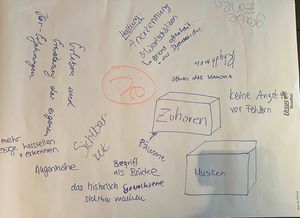
As part of the expert discussion, Discrimination-critical perspectives in the curricula at the interface of education and art! Two-day expert discussion at Schauspiel Dortmund from 16/06/2023 to 17/06/2023, Shanti Suki Osman held the workshop Doing Music Difference? with students, music and art educators and research assistants and professors from the fields of music education and musicology. The workshop focussed on the problems and possibilities of so-called transcultural music and music projects.
For further information, please contact
Intersectionality - Invitation to lecture and workshop
Advisor: Dr Kathrin Ganz

Cordial invitation...
... to the lecture as part of the series of lectures on intersectional sensitivity by Dr Kathrin Ganz:
"Intersectionality and capitalism: subject-oriented research with the intersectional multi-level approach" (04.10.2023, BIS-Saal, 16:00)
...to the workshop for doctoral students "Intersectional multi-level approach in empirical research" (05.10.2023)
Dr Kathrin Ganz is a social scientist with a focus on digitalisation, intersectionality and open access publishing. Publications: "Intersectionale Sozialforschung" (together with Jette Hausotter, transcropt, 2020), "Die Netzbewegung" (Budrich, 2018).
Further information on both events Oldenburg School 2023
Network meeting 2023
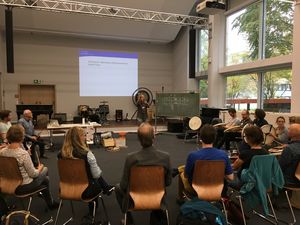
The music education team cordially invites you to this year's networking meeting on Friday, 22 September 2023 from 3.30 - 6.30 pm in the Chamber Music Hall of the University of Oldenburg/.
With this meeting, we would like to open up a space in which the university (Institute of Music) and school (music teaching) with their different perspectives on teaching and music education can enter into dialogue and develop common perspectives. Teachers from all types of schools in the Oldenburg area as well as lecturers and students from the University of Oldenburg will take part.
This time, a workshop on the production of electronic music for young people will be offered. Tash Todd, music producer and workshop leader from Berlin, will give a keynote speech on the topic of "DJ basics. Producing electronic music at school".
The music producer, DJ and workshop mentor Tash Todd works in the music industry and runs workshops and working groups for electronic music. She is a regular mentor for the workshop programme "Error Music: don't delete", which introduces young female and non-binary students to the art of error culture, building synthesizers and theramines and performing live in clubs. She has led workshops for the Mini Booth Festival, THF Radio and Refuge Worldwide and runs weekly workshops in schools focussing on music production, DJing and multimedia art.
Interested parties are cordially invited to register with by 03 August 2023 . We will then be happy to send you further information.
Interview on Diversity Day 2023
How do conservatoires become more diverse? Musicologist Shanti Suki Osman is investigating this question. In an interview with BR-KLASSIK on the occasion of Diversity Day 2023, she answers questions about the issue and talks about her research findings. BR comes to the conclusion that there is no one way. But there are many things that could be tried out.
Composing - being in dialogue
Lecture and discussion event with the composer Tobias Klich
24 April 2023, 12.15 p.m., KMS
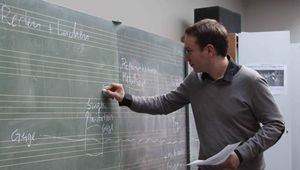
As part of the seminar "Composing with Pupils" (Alban Peters), we are looking forward to the composer, guitarist, music filmmaker and visual artist Tobias Klich, who will give an insight into his composition workshop and various music education projects. Other topics include working with pupils and students, the role of contemporary music in musical life in general, in schools and in composition projects, and the organisation and implementation of composition and music education projects from the perspective of a full-time composer, performer and concert organiser.
The Bremen composer and guitarist Tobias Klich has already been honoured with numerous prizes and scholarships, including from the German Orchestra Foundation and the German Music Council, and from May 2023 he will take up a residency scholarship at the Cité Interationale des Arts Paris. As a composer and performer, he can be heard regularly in concerts, with recent recordings released by WERGO and KAIROS. He has also been helping to shape contemporary musical life as Chair of the tritonus association since 2018. Tobias Klich has already realised several composition projects with pupils and students, including in co-operation with the HMTMH, the Hanover State Opera, Musik21 Niedersachsen and the Hannah-Arendt-Gymnasium Barsinghausen(https://tobiasklich.com/category/kachel/komposition/).
The event is open to the public - cordial invitation!
Monday, 24.04.2023
12.15-13-45
Chamber Music Hall