MuBiKi (completed)
Prof. Dr. Mario Dunkel
Institute of Music (» Postal address)
Prof. Dr. Lars Oberhaus
Institute of Music (» Postal address)
Contact
Prof. Dr. Lars Oberhaus
Phone: +49 (0) 441 - 798 2080
E-Mail:
MuBiKi (completed)

The project has been completed and the results of this project and the"ViMuBi" project have been published in the publication"Musik in der Kita - inklusiv und kooperativ".
The MuBiKi project comprises the conception, implementation and evaluation of a professional qualification for musicians and educators for music programmes at daycare centres (in cooperation with Klaus Bredl (State Association of Music Schools in Lower Saxony), Prof. Dr Ulrike-Marie Krause (Professor of Educational Sciences, University of Oldenburg); BMBF project.
Duration: 1.9.2014 - 31.10.2017
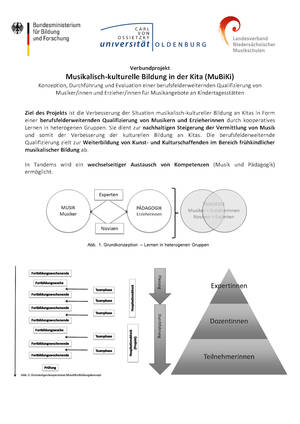
You can also download the poster and the following descriptions in our download area.
Information on the qualification programme
From early summer 2015, the Lower Saxony Association of Music Schools will be training up to 40 elementary music teachers as part of a professional development programme designed to broaden their career prospects.
As numerous practical examples demonstrate, the cultural educational role of our childcare centres is becoming increasingly important. Consequently, the demand for qualified teaching staff in the field of elementary music education is rising. Building on this trend and drawing on the success of Lower Saxony’s music education programme ‘Wir machen die Musik!’ the Lower Saxony Association of Music Schools is running a part-time, career-expanding qualification programme for musicians and early years educators between spring 2015 and summer 2017, aimed at delivering elementary music programmes in childcare centres. The scientific evaluation of the project is being carried out by the University of Oldenburg (Prof. Dr Lars Oberhaus and Prof. Dr Ulrike Krause). The collaborative project ‘Musical and Cultural Education in Day-Care Centres’ (MuBiKi) is funded by the Federal Ministry of Education and Research and comprises two training courses, each lasting approximately 1.5 years, which are to be based, where possible, in the eastern part of Lower Saxony (Wolfenbüttel or similar) and in a region in the west (the Oldenburg/Emsland area), and which can each accommodate up to 20 participants.
The target group for this further education programme comprises artists, cultural practitioners and early years educators. Through individual, tandem and team-based phases, participants acquire fundamental knowledge, skills and methods in elementary music education. The course content covers areas such as early childhood education, music and movement, listening, singing and speaking, as well as basic instrumental playing.
A distinctive feature of the courses is that a diverse group of participants, comprising artists and cultural practitioners (musicians, dancers, etc.) and early years educators with different specialist skills, are to be trained together. The formation of learning tandems is intended to facilitate a continuous, reciprocal exchange of experiences and the acquisition of skills amongst the participants. Each course will comprise several weekend blocks and teaching weeks, as well as ongoing practical and observation phases.
In accordance with the BMBF’s funding guidelines, participation in the training courses is free of charge. Only any accommodation and meal costs incurred need to be paid. For participants from the arts and culture sector, it is likely that these costs will also be covered.
A prerequisite for participation is that participants already possess basic musical knowledge and skills. Further information can be found in our leaflet:
Further information is available from the Lower Saxony Association of Music Schools.
Contact: Rhea Richter
Project coordination
“Musical and Cultural Education in Nursery Schools”
0511 - 270 640 53
Information on the accompanying scientific research
CONCEPT AND OBJECTIVE
The aim of the project is to develop, trial and conduct evaluation of a professional development programme for artists, cultural practitioners and early years educators, which involves collaborative learning in mixed-ability groups. The centre is on effective collaboration between artists and cultural practitioners with musical experience and educational professionals (nursery teachers) with an interest in music. During the training programme, participants will receive further training from experts on issues relating to music education; in addition, tandems – each consisting of one arts and culture professional and one early years educator – will facilitate a mutual exchange of knowledge and experience. The piloting and evaluation of the programme are intended, amongst other things, to provide insights into effective music education training programmes and thus contribute to high-quality musical provision in nursery schools and to the strengthening of early years education. The subject of music generally plays almost no role in nursery teachers’ training. For this reason, singing and making music are rarely practised in the day-to-day running of many nurseries. There is therefore a great need for qualified staff to deliver support programmes in the field of elementary music education (EMP) in nurseries. Demand is rising due to increasing co-operation between music schools and nursery schools as part of Lower Saxony’s music education programme ‘Wir machen die Musik!’. The collaborative programmes, currently running in around 500 childcare centres, are delivered by music school teachers who hold the relevant EMP qualification (a university degree or a vocational further education qualification). However, much of the feedback from music schools indicates that the existing teaching staff are unable to meet the high demand. Competent teachers are urgently needed nationwide. This project therefore aims to deliver professional development training in the field of early childhood music education, aimed at arts and culture professionals from various sectors who already possess musical qualifications (e.g. instrumental teachers, dance teachers, school and church musicians, and orchestral musicians) and early years educators. The participants’ diverse experiences will be utilised by having musicians and early years educators work in tandem throughout the training period, learning from one another. Through individual, tandem and team-based phases, participants acquire fundamental skills in the field of elementary music education and cooperative learning.
RESEARCH OBJECTIVES OF THE PROJECT
The accompanying evaluation will explicitly take into account the participants’ individual experiences, drawing on their specific artistic, cultural, educational and professional backgrounds . The following research objectives are pursued:
- To gain insights into the effectiveness of the professional development programme and the cooperative teaching and learning methods implemented, into music education teaching and learning processes, and into the relevance of certain participant profiles for the development of competences,
- To develop tools for assessing competences within the framework of music education qualifications,
- To reconstruct the relationship between the participants’ biographical and musical-cultural experiences and the skills and competences acquired during the qualification programme.
ON THE DESIGN OF THE CONTINUING PROFESSIONAL DEVELOPMENT PROGRAMME
The further training programme lasts a total of 18 months. As a pilot, the project will initially be trialled in two cohorts in both urban and rural areas. In line with the programme’s practical focus, participants will work closely with regional nursery schools and music schools. Approximately 20 people will take part per round and location. Accordingly, 10 tandems will be formed in each case, each comprising one arts or culture professional and one early years educator. Potential participants will be made aware of the training programme via a call for applications.
Prior to the call for applications, five renowned experts from various fields of musical and cultural early childhood education will come together to develop a competence-based, module-based training programme. Suitable trainers are then selected; they are briefed on the training programme concept during a one-day meeting and will subsequently deliver the training.
Following the nationwide call for applications, interested artists, cultural practitioners and early years educators are invited to an assessment centre, which serves for the selection of participants for the training programme. There, they will complete various group exercises, supervised by a panel (comprising musicians, early years practitioners, a psychologist and a coach). This is not an entrance examination primarily designed to test musical abilities and skills, but rather a criteria-based process which, above all, takes into account the participants’ willingness to collaborate in the field of elementary music education.
The training programme is led by two people (an educator and a music teacher). A coach plays a special role, guiding the group through various supervision sessions, offering advice and, above all, taking the group dynamics into account. The qualification comprises various learning phases. These include tandem phases, in which pairs plan, carry out and reflect on a practical session in a nursery. In addition, there are weekend blocks and training weeks during which the team is supported by professional tutors. These are (music) educators selected by the project team with experience in further training, who lead the workshops and put the concept developed by the experts into practice. In addition to self-study phases, there is also a work shadowing phase, during which participants are supported by so-called mentors (qualified early years (music) education specialists (EMP)) who are already working in existing co-operations. As part of these work shadowing placements, practical projects are carried out, which are also documented and reflected upon. The assessment component consists of a portfolio and musical presentations.
The implementation and evaluation at the two locations are staggered in time, so that lessons learnt from the first run and interim evaluation results can be used to optimise the programme for the second run. Two research assistants will be employed for the project.
An initial interim report on the quantitative survey can be downloaded here.
Persons
Project leader:
Prof. Dr Lars Oberhaus Professor of Music Education Carl von Ossietzky University of Oldenburg, School III - School of Educational and Cultural Sciences, Institute of Music Prof. Dr Ulrike-Marie Krause Professor of Educational Sciences Carl von Ossietzky University of Oldenburg, School I - School of Educational and Social Sciences, Institute of Educational Sciences Research assistants
Christiane Leder Carl von Ossietzky University of Oldenburg, Faculty I - School of Educational and Social Sciences, Institute of Educational Sciences (quantitative evaluation) Zoë Schempp-Hilbert Carl von Ossietzky University of Oldenburg, Faculty III - School of Educational and Cultural Sciences, Institute of Music (qualitative evaluation) Cooperation partners Klaus Bredl Managing Director of the Landesverband niedersächsischer Musikschulen Landesverband niedersächsischer Musikschulen e.V. Rhea Richter Project coordination Landesverband niedersächsischer Musikschulen e.V.
