
Stahmer
Stahmer
Stahmer, Klaus Hinrich

Whether a piece of music is worth composing, performing and listening to is not determined by any modern or interesting-looking style of writing, but by its message to the players and listeners.
In reverse gear into the future
Probably the greatest misjudgement of the last century was the overvaluation of dodecaphony. Used as a spearhead by progress ideologues since the new beginning in 1945, this led to a way of thinking that focussed on the technology of arranging sounds and turned the process of performing music into an act of adhering to and observing rules. A standard was established that was determined by the supremacy of the Western world, which is no longer justifiable today.
By intensively experiencing the music of non-European cultures and by studying the physiological processes of hearing, I have found a liberating way out of this mainstream thinking and, in close co-operation with players of instruments from the Near and Far East, have gradually developed a generally understandable tonal language and composed music that corresponds to my personal need to communicate. I have also developed a new relationship with the traditional music of my own culture.
For me, composing now means listening - listening - listening: Firstly in my imagination, and then to experience in real life how the sounds are created under the fingers of the players and unfold in the room. The listener should be given the gift of being completely involved in this role of listening and, in a way, "understand" what I want to "say" to them with my music.
Curriculum vitae in tabular form
| 1941 | Born in Stettin; experiences of war and flight |
| 1947 - 60 | School years in Lüneburg; instrumental lessons (piano, cello) |
| 1960 - 68 | Studied music in Dartington (England), Hamburg and Kiel (school music, musicology, music theory); first publications of his own compositions |
| 1969 - 2004 | Teaching (professorship since 1977) at the Würzburg University of Music; part-time work as a music journalist for radio and music magazines; various book publications; guest lecturer in South Africa and the USA; founder and director of the "Tage der Neuen Musik" (Würzburg); several times president of the German section of the IGNM and director of the "Tage der Neuen Musik" (Würzburg). President of the German section of the IGNM and director of the "World Music Days" (1987); cultural policy work in committees of the German Music Council (among others) and in the Bavarian Musicians' Association; composition prizes (including Tokyo 1984, Handel Prize Halle 2001, Taipei 2006, Oldenburg 2017) and awards (including the Würzburg Culture Prize 1994, Federal Cross of Merit) |
| Since 2004 | Active as a composer and author of radio programmes (focus: world music); occasional guest lectures (e.g. Shanghai) |
WORKS (SELECTION)
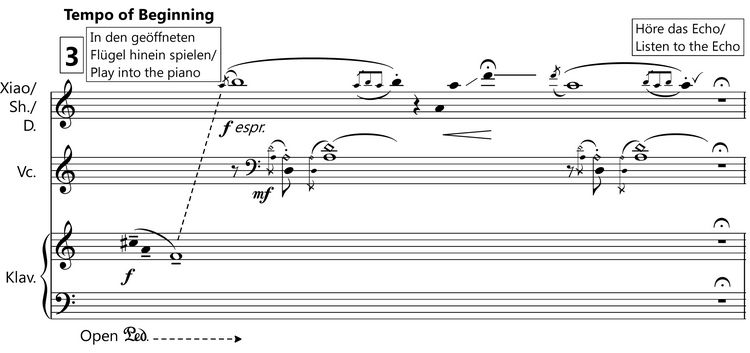
Ting Yin for xiao, cello and piano (2018)
Épitaphe for 8-part mixed choir (2017)
Inschrift der Vergänglichkeit for piano solo (2016)
Ming for sheng, accordion & cello (2015)
Aschenglut for Arabic frame drum and piano (2013)
Gerettete Blätter for violin solo (2013)
Taqasim for qanun, violin and cello (2011)
Wu for sheng, clarinet and violoncello (or viola) (2010)
Ning Shi for sheng and accordion (2007)
Pulip Sori for violoncello, kayagum and changgo (2006)
There is no return for flute, 2 percussionists and piano (2005)
Silence is the only Music for sheng and guzheng (2004)
Tchaka for four African drums (2003)
All compositions published by VERLAG NEUE MUSIK (Berlin); see also www.klaushinrichstahmer.de