

A team of Computing Science students has developed a system for monitoring dykes – one that is cost-effective, self-sufficient and flexible. The ‘Diek un dat’ project group has just presented its findings.
Early January 2024: Half of Lower Saxony is flooded, and in Oldenburg too, emergency services are battling the floodwaters. Dykes are in danger of breaching and must be reinforced with sandbags.
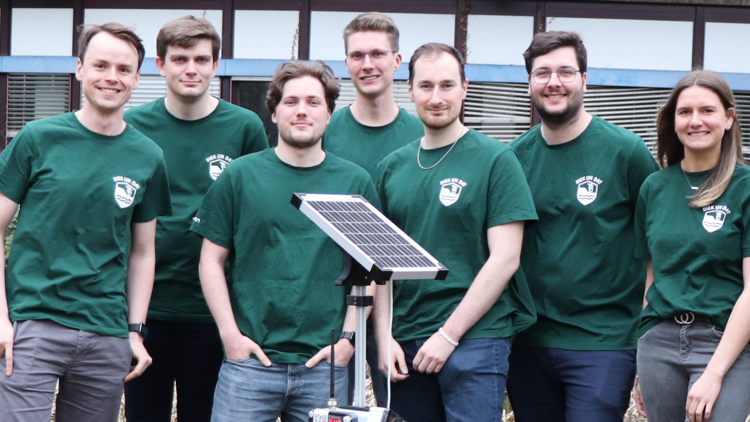
“Back then, dozens of dyke wardens had to patrol the dykes regularly to check whether they were holding up; in total, more than 200 people were on duty,” explains Imke Korte. Together with seven fellow students, the Business Informatics student has developed a system as part of the “Diek un dat” project group that could save dyke patrols several kilometres during future floods – a measuring device that automatically monitors the stability of dykes. The eight Master’s students in Computing Science and Business Informatics recently presented their system at a final presentation.
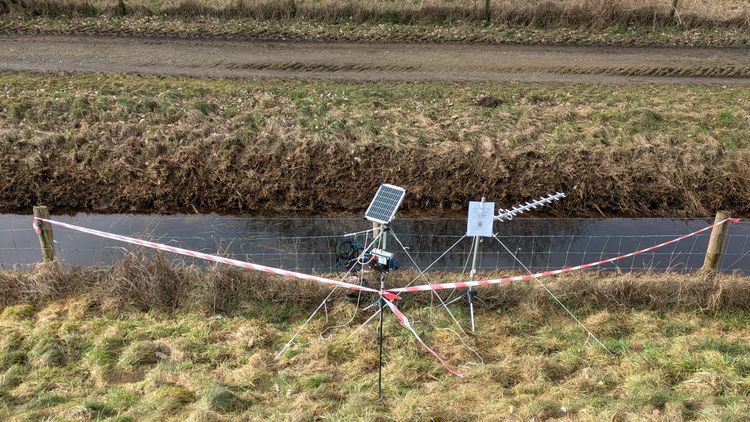
The result of the year-long study project is a digital, self-sufficient measurement system for dyke monitoring, consisting of a central sensor box (GBox) with an integrated power supply, data processing and communication capabilities, as well as flexible sensor technology and a platform for analysing and visualising the measurement data. “This device allows continuous measurement of seepage through the dyke during a flood,” explains team member Paul Tepe, who is also studying Business Informatics. The data is transmitted via radio every 15 minutes and clearly presented on a specially developed web platform – for example, in the form of graphs and status updates. “This allows the fire service, for instance, to see at a glance whether the condition of the dyke is critical,” says Tepe.
To familiarise themselves with the subject, the project team first met with experts from the Lower Saxony State Office for Fire and Disaster Protection (NLBK), the fire service, the Federal Agency for Technical Relief (THW) and NLWKN, the Lower Saxony State Agency for Water Management, Coastal Protection and Nature Conservation. “First of all, we had to build up a lot of basic knowledge about dykes,” says Tepe.
The seepage line can be used to determine whether a dyke is stable
The team learnt that the so-called seepage line – the boundary between dry and water-saturated material within the dyke – plays a key role in dyke stability. Its course within the dyke determines whether the structure is still stable or not. During high water, water seeps out at the foot of the dyke on the landward side at the level of the seepage line, much like a spring. “The dyke wardens can feel this by hand; the soil is slightly spongy there,” explains Korte. The team therefore developed ideas on how to monitor the course of the seepage line both inside the dyke and on the outside.
To this end, the students relied on two different methods. One method involved locating the seepage line using several moisture sensors, which look like small swords and are inserted horizontally into the dyke.
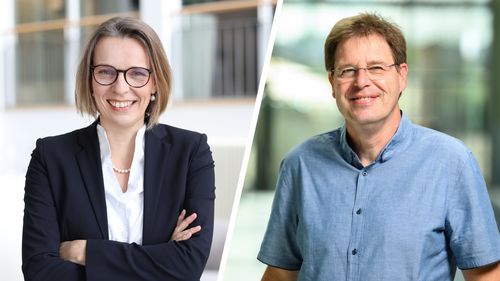
With the second method, the group can track the course of the seepage line within a dyke using water level sensors, such as those also used for groundwater monitoring. However, installing such water level sensors requires drilling into the dyke, which is not necessarily conducive to its stability, particularly during a flood. The method may therefore be less suitable for mobile systems deployed in the event of a disaster, and more suited to fixed stations. “Essentially, such a measurement system would have to be factored in right from the start when constructing a dyke,” says Computing Science professor Prof. Dr Andreas Winter, who supervised the project group together with his colleague Prof. Dr Oliver Theel.
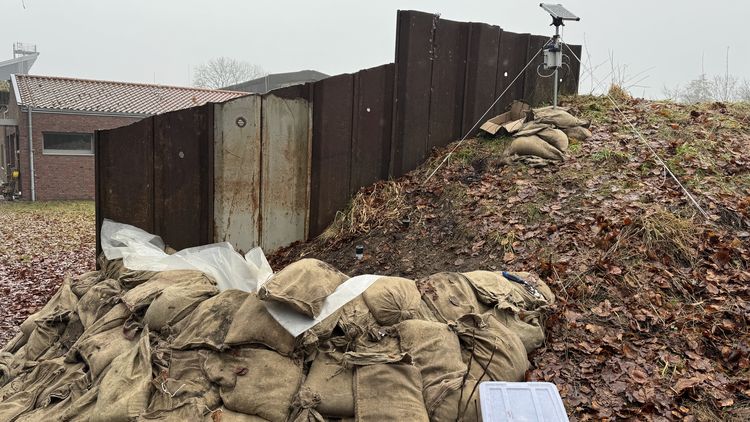
The students found the various field tests particularly exciting, such as those carried out on the Osternburg Canal and on the River Hunte in Tungeln. On the grounds of the NLBK fire service training centre in Loy, Rastede, they were even able to test their system during a simulated flood: NLBK staff flooded a dry dyke there, which is available for civil protection exercises. The conclusion from the trials: the technology works – the location of the seepage line can be determined using the tested sensors. Automatic monitoring does not render dyke guards redundant, but can support emergency services in an emergency, for example by continuously monitoring known weak points in a dyke.
Appearance at Interschutz 2026 in Hanover
Not only the students but also experts from the fields of water management and disaster control were satisfied with the result: the ‘Diek un dat’ team has been invited to present the system in June at Interschutz 2026 in Hanover, the world’s leading trade fair for emergency services, fire safety and disaster control. “It’s quite a remarkable achievement to get a monitoring system like this up and running within a year,” emphasises Andreas Winter.
The team was able to build on the work of previous project groups: in recent years, Computing Science students had developed various measuring stations to monitor environmental data – such as particulate matter levels in the air or water levels in rivers. As a result, there was already existing knowledge on how best to transmit and process the collected data, and which microprocessors were suitable for processing it. Furthermore, the ‘Guerilla Sensing’ online platform, developed by earlier project groups, provided a system through which the data could be retrieved and visualised.
“A core idea behind ‘Guerilla Sensing’ is to develop monitoring stations that are inexpensive and can be assembled by anyone with a basic understanding of technology,” explains Paul Tepe. The components of the dyke monitoring system, for example, are available for well under 1,000 euros in total. In principle, such stations could be used, for example, in citizen science projects – such as measurement campaigns organised by interested members of the public. Imke Korte would be keen to get involved straight away: “If there were to be a flood, I’d love to set up our boxes and support the emergency response teams,” she says.
The project group covers many aspects of future professional practice that are difficult to teach explicitly.
Andreas Winter, Professor of Software Engineering
For her and Paul Tepe, the project was one of the highlights of their degree – offering many new challenges beyond the usual seminars, written exams and exams. “We’ve really achieved something,” says Tepe. For supervisor Andreas Winter, the added value lies in the wide range of experiences the students gain during the one-year project phase. “The project group teaches many aspects of future professional practice that are difficult to teach explicitly,” he says. He has repeatedly observed that, after a few months, the students “make the project their own” and throw themselves enthusiastically into the various tasks, which range from soldering circuit boards to planning meetings with external project partners.
The theme of the next project group is once again related to water: in the coming summer semester, Theel and Winter’s students will be tasked with monitoring water quality, for example in the Moorhauser Polder. As Guerilla Sensing focuses on scalable environmental sensor technology, further experiments will centre on the digital detection of invasive species such as the Asian hornet.