

The new building of the Centre for Marine Sensors is all about measuring devices for the marine environment. The extension at the Wilhelmshaven site was officially opened today.
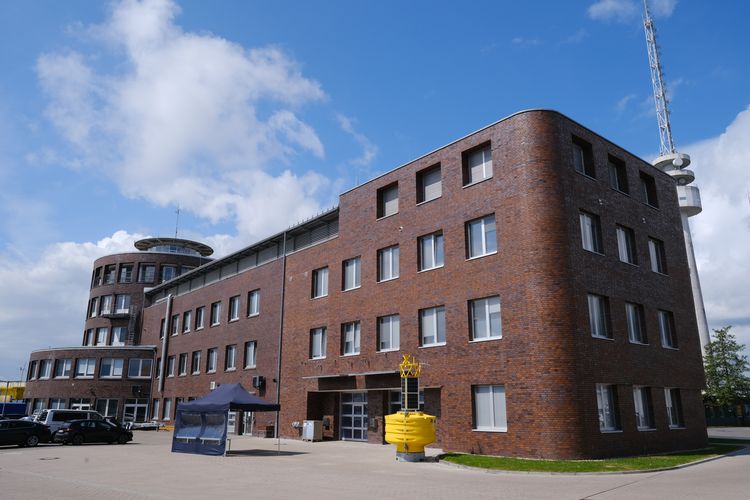
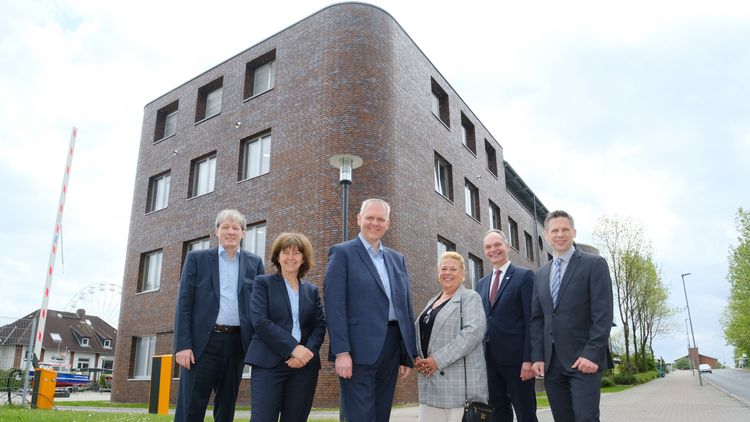
Around 600 square metres of space for test areas, laboratories, workshops, offices and a state-of-the-art situation centre: the research building of the Centre for Marine Sensors (ZfMarS) at the University of Oldenburg was officially opened today in Wilhelmshaven in the presence of Lower Saxony's Science Minister Björn Thümler. The research building, which was completed at the end of 2020, is part of the Institute of Chemistry and Biology of the Marine Environment (ICBM) and is an extension to the ICBM headquarters in Wilhelmshaven on Schleusenstraße. Due to the pandemic, the official inauguration ceremony has only just taken place.
"Whether in the field of renewable energies or environmental and coastal protection - sensors are key digital technologies in modern marine technology," emphasised Lower Saxony's Science Minister Björn Thümler in his welcoming address. "The expansion of the research infrastructure in this area strengthens Oldenburg-Wilhelmshaven and Elsfleth as a science location, which is well on its way to becoming an internationally important centre for marine and climate research."
Oldenburg's marine researchers are active on all the world's oceans and their interdisciplinary research is highly recognised both nationally and internationally, explained University President Prof. Dr Ralph Bruder at the inauguration. "The technological developments in marine sensor technology are of great importance. With our research building, we are once again strengthening this future-oriented focus - an important step for the ICBM and the entire university," said the President.
Robust sensors and smart measuring devices
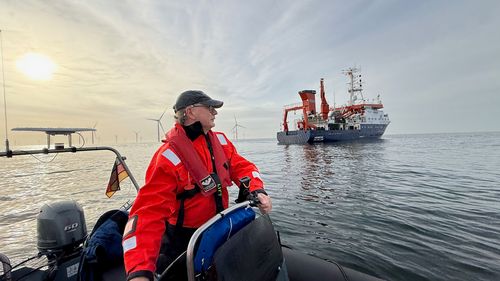
In the ZfMarS, which was founded in 2017, ICBM researchers are developing particularly robust marine sensors and are researching, for example, how autonomous systems can be more effectively protected against the effects of fouling. They are also working on smart measuring devices, for example to monitor plastic or oil pollution remotely. The centre works closely with Jade University of Applied Sciences, the OFFIS Computing Science Institute, the German Research Centre for Artificial Intelligence (DFKI), the German Aerospace Center (DLR) and regional industry. The scientific management of the centre is in the hands of Prof. Dr Oliver Zielinski, with Prof. Dr Oliver Wurl as deputy.
"With innovative sensors and intelligent data processing, we are creating the basis for new scientific findings and informed decisions," Zielinski is convinced. "Our aim is to develop tools that help society to better understand and protect the highly complex marine ecosystem."
Data from all over the world arrives at the situation centre
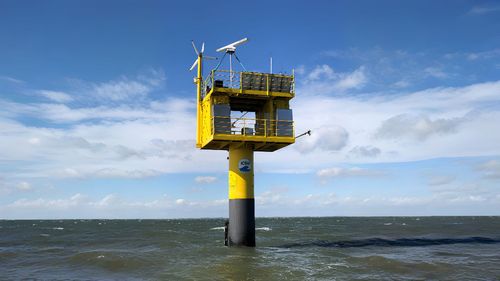
The new research building offers a flexible environment for a wide variety of experimental set-ups. The basement and ground floor house a large hangar, workshops and laboratories. The first floor houses offices and meeting rooms as well as a situation centre. This is where data from various research platforms comes together - for example from the research vessel SONNE, the permanent measuring station of the Spiekeroog coastal observatory, the ICBM research catamaran and several measuring buoys deployed around the world. On the top floor of the building, researchers can test new marine sensors under near-natural conditions in open-air water tanks. Around 20 ICBM employees moved into the new premises in spring 2021.
To mark the inauguration ceremony, the ZfMarS also organised a workshop on the future of digitalisation in water management and a panel discussion. The focus was on the question of what research infrastructure science needs. Prof Dr Monika Sester, Senator of the Helmholtz Association for the research field "Earth and Environment", the honorary mayor of the city of Wilhelmshaven Astrid Zaage and University President Bruder took part in the discussion with Zielinski.
Construction work on the ZfMarS began in March 2019; the costs, totalling around five million euros, were financed in equal parts by the university and the European Regional Development Fund (ERDF). At the end of 2020, the State Construction Management Ems-Weser handed over the new building designed by kbg Architekten to the university as planned.