

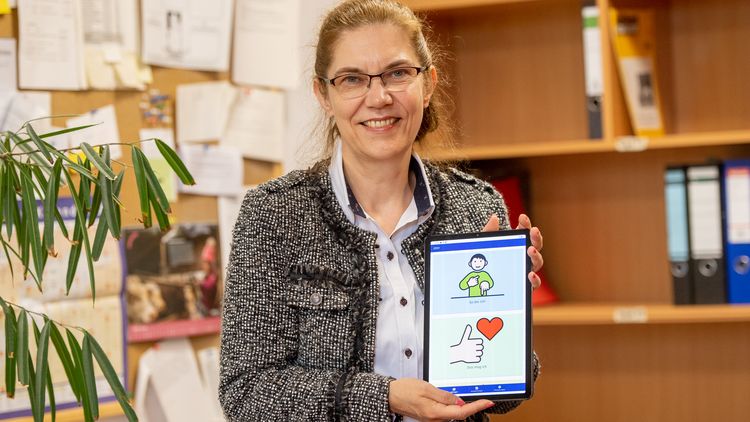


Signs, pictograms or speech computers - there are many alternatives for people who cannot or can barely speak. A tool developed by a team led by special needs teacher Andrea Erdélyi can be used to determine which is suitable for whom.
A child with Down's syndrome who only speaks a few words attends an inclusive daycare centre. A resident of a care home has a stroke and is unable to speak clearly and has limited mobility. In a special school, teachers feel that they cannot reach a child with autism spectrum disorder. As different as these three cases are, they have one thing in common: the better the affected person and their environment are able to communicate in ways other than spoken language, the more effortlessly they can make contact with each other. There are many possibilities, from sign language to picture boards and speech computers. In special education, they are summarised under the term "augmentative and alternative communication".
Closing knowledge gaps on augmentative and alternative communication
Prof Dr Andrea Erdélyi is a university lecturer in Education and Didactics for People with Intellectual Disabilities at the Institute of Special Needs Education and Rehabilitation. She has also run a counselling centre for augmentative and alternative communication there since 2008. "In counselling sessions, but also in scientific studies, I have repeatedly found that many people who work in schools, daycare centres or therapy lack knowledge and experience of AAC," she says. Together with four colleagues, she has therefore developed the "Oldenburg Inventory for Augmentative and Alternative Communication", or "OLI for AAC" for short, for this target group.
This is a collection of materials consisting of questionnaires and conversation guidelines, supplemented by a handout from the authors. The inventory is intended to enable people from the environment of a person with disabilities to determine their communication options and find suitable forms of AAC for them. After all, it is not always obvious to those around a person with an impairment what expressive possibilities they have.
Involving the whole environment in the diagnosis
"How a person communicates has a lot to do with their environment," explains Erdélyi. For example, some children appear very withdrawn at school, whereas they can express themselves more fully to their parents. In Erdélyi's view, it is therefore important that people from different contexts, such as parents, educational and therapeutic professionals, make a joint diagnosis in this regard. Questionnaires for such processes already existed before "OLI for UK", for example by the Cologne special needs teacher Prof Dr Jens Boenisch. "However, they are primarily suitable for working with physically impaired people and are not sufficient for people with intellectual impairments," says Erdélyi. She therefore expanded Boenisch's questionnaire for the inventory. Together with her colleagues and students, she used the revised version in practice and evaluated it on an ongoing basis.
From Erdélyi's point of view, it is important to set a common goal at the beginning. In some cases, the "OLI for UK" can be used to gain an initial impression of a person and their skills. "But it can also be used if a person is already working with AAC," says Erdélyi. It can then be used to evaluate whether the previous forms of communication still suit the person and their current level of development.
Support from establishing contact to evaluation
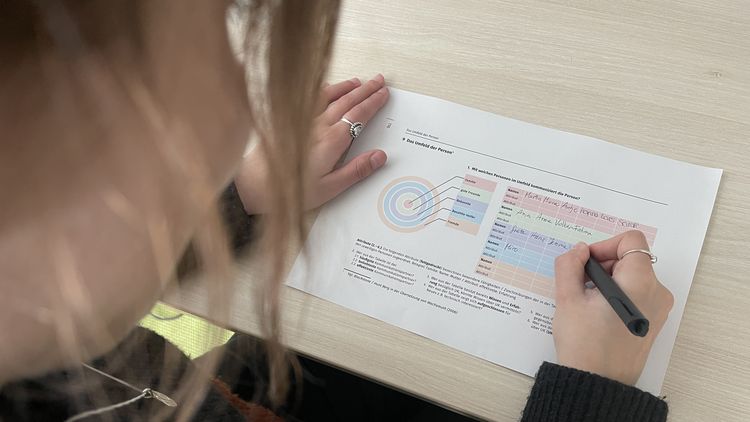
Erdélyi and her team have developed a comprehensive questionnaire for the diagnostic interview itself, which people from the person's environment fill out together. Depending on time, interest and possibilities, the person with impairments can also take part. The questionnaire begins with questions about communication options that are generally available to the person with an impairment. These range from pointing and signing to communication using a speech computer. The next step is to determine the purpose for which the person can use their abilities. For example, can they select one of at least two objects, answer yes-no questions or make jokes? As Erdélyi and her team pay particular attention to mental impairments, they also ask about elementary cognitive abilities - for example, whether a person responds to their name or can show a matching picture to a spoken word.
The findings on various areas such as speech comprehension, gross and fine motor skills, perception or cognition can then be summarised in an evaluation form and recommendations for possible types of AAC can be developed. "In the best case scenario, everyone sits down again for an evaluation meeting after around six months," says Erdélyi. The inventory also provides a guideline for this. "Our aim was to provide educational and therapeutic professionals with materials for the entire diagnostic and counselling process that they can use as a guide," explains Erdélyi. This is another way in which the "OLI for UK" differs from comparable inventories and guidelines.
Patchwork of counselling options
In her work with people with disabilities, Erdélyi has repeatedly found that those around her underestimate their abilities. "Many people jump to conclusions about a person's cognitive abilities based on their communication skills," she says. She would like to remedy this with the AAC inventory. In her view, there are also structural reasons why people with disabilities find it difficult to access alternative forms of communication.
"In Germany, there is a patchwork of counselling options for AAC," says Erdélyi. The AAC advice centre at the University of Oldenburg is the only one in the north-west. Erdélyi and her team can only respond to a fraction of the counselling requests, many of the staff work on a voluntary basis. In some Federal States, private organisations provide the counselling. In others, such as Bavaria, there is a comprehensive publicly funded service, particularly for teachers at special schools - which Erdélyi believes is the ideal situation. "It is my heartfelt wish that this model becomes the norm and that everyone can access counselling easily and simply," she says.
This article was first published in the blog "ForschungsNotizen Jade-Oldenburg" of the project "Innovative University Jade-Oldenburg!" (IHJO) PROJECT.