
Students of special and rehabilitation education offer individualised therapy to children from the city of Oldenburg who need support. The ELMO outpatient learning centre focuses on much more than flawless reading, writing and arithmetic.
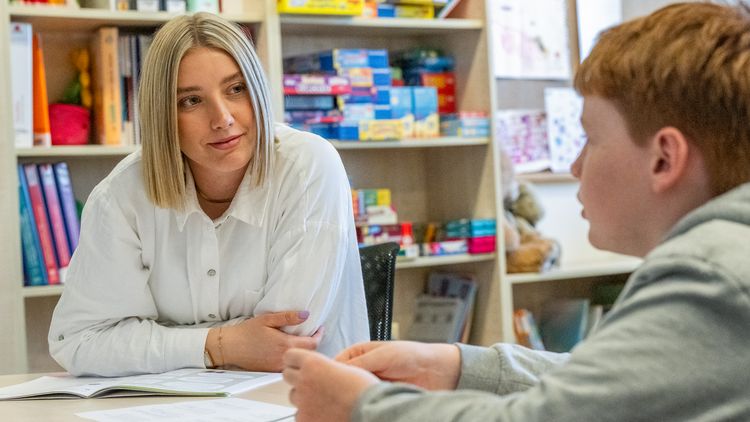
Jonas* (name changed) bends over his learning sheet. This lesson revolves around word building blocks - word stem, prefix, suffix. "Is everything clear?" asks Laura Erbes. "You can do it, I'm sure of it." The student, a third-semester student on the "Rehabilitation Education" degree programme, knows how to motivate the pupil. Jonas* has a diagnosed spelling disorder. In regular school lessons, he finds it much more difficult to write than other children in year five.
Erbes has been supporting the eleven-year-old for several months, liaising closely with his parents and teachers at the school. They meet every week for three quarters of an hour for learning therapy on the Haarentor campus. The aim is to achieve progress in writing in the short term and to break down learning barriers in the long term so that Jonas can successfully and happily return to everyday school life. The learning therapy is specifically tailored to his needs. Jonas learns at his own pace, without pressure and with playful support.
ELMO outpatient learning centre: for children in Oldenburg
The individualised learning support for Jonas is linked to the university learning outpatient clinic ELMO: Development, Learning, Motivation. If there is a suspicion of dyslexia or dyscalculia, parents can register their children from the Oldenburg area for free learning therapy - with a minimum of ten sessions. The children are accompanied by students in the final year of their Master's degree programme in "Special Education" and "Rehabilitation Education".
The ELMO outpatient learning clinic is part of the Inclusive Centre of Excellence for joint, holistic developmental support in childhood, adolescence and adulthood, KoggE for short. This centre is cooperatively supported and developed by all disciplines of the Institute of Special Needs Education and Rehabilitation. As a central institution, it combines applied research, practical teaching and networking in the region.
Studies show that more and more children and young people are having problems acquiring the basic skills of reading, maths and writing.
Prof Dr Clemens Hillenbrand; Institute of Special Needs Education and Rehabilitation
"There is a great need for such services," says special education teacher Prof Dr Clemens Hillenbrand, whose department "Pedagogy and Didactics for Learning Impairments" at the Institute of Special Needs Education and Rehabilitation is home to the learning outpatient clinic. Anyone who contacts them should expect a waiting period of around six months. "Studies show that more and more children and young people are having problems acquiring the basic skills of reading, arithmetic and writing". One of the factors that greatly impairs learning success is that children today are under significantly more psychological stress overall - for example due to crises such as coronavirus, climate change and wars.
One-to-one support as the key
"In training courses that we give at schools, we realise that What is offered as learning support is very committed, but often lacks an evidence-based, scientific orientation," reports Hillenbrand. "Our outpatient learning centre can make a small contribution to meeting the increasing needs in the Oldenburg area." In principle, educational institutions across Germany need more resources for personalised learning therapies and also more professional quality.
"We know that one-to-one support is particularly important," adds Alissa Schüürmann, ELMO coordinator and research assistant at the Institute of Special Needs Education and Rehabilitation. "However, this is often not feasible in the regular school day." The learning therapy offered through ELMO can provide additional help for children with support needs.
This is more than just tutoring: it is also about making fewer mistakes in writing, reading and maths. However, the students also help to motivate the children to learn again. According to Schüürmann, the individualised design of the tutoring session is key, as is an emotional and motivating connection between the child and the tutor. Children and young people's motivation can also often be increased with personalised materials, such as board games and educational games, tiptoi material, LÜK boxes and picture books. Digital tools such as "Reading games with Elfe and Mathis" are also used to promote individualised reading. "Milestones are, for example, when children tell us after a while that they have read a whole book out of interest. Or having the courage to say something in class."
Students with lots of practical knowledge
The students also benefit from their experiences in the outpatient learning centre. "Many of them use their experiences from learning therapy for research and final theses," emphasises Hillenbrand. "The close integration of theoretical knowledge and practical experience means that they are very well prepared for professional life as prospective teaching and support staff."
A total of 85 special and rehabilitation education students have supported 67 children since ELMO was founded in 2023. Supporting children over several sessions is a compulsory elective module in the final year of their Master's degree programme. Beforehand, they receive in-depth training on a scientific basis in the areas of diagnostics, support, didactics and individual case support.
The students also accompany the multi-stage diagnostic process that a child goes through before the support sessions begin: With the help of established tests, they work with the child and adolescent psychotherapists cooperating with the outpatient clinic to determine where exactly problems and difficulties exist. Language, processing speed, concentration and logical thinking are tested. The child's interests are also assessed.
"Stable and trusting connection"
Laura Erbes has already had ten sessions with Jonas, with ten more to come. A test to assess writing skills has demonstrated that he is now within the normal range in the areas in which he scored below average before therapy. "We're making really good progress," says Erbes.
The meetings with him have shown her in concrete terms what was already taught in theory in the university seminars: Support involves much more than just learning school material. "If we can build a stable and trusting relationship with each other during our meetings, Jonas' fear of making mistakes decreases," says the student. She is convinced: "When children feel safe and accepted, they are more open to learning processes."


