
Quantum Theory Group Prof. Dr Christopher Gies


Quantum Theory Group Prof. Dr Christopher Gies
Welcome to the website of Prof. Dr Christopher Gies’s Quantum Theory Group
We conduct research into the development of new quantum technologies. The underlying hardware platforms are generally semiconductor nanostructures, whose properties we calculate and predict based on fundamental physical processes. In doing so, we work closely with experimental partners to jointly discover and understand new phenomena.
We work at the interface between quantum mechanics, solid-state physics and information theory. We are interested in how the microscopic properties of quantum materials – such as coherence, correlations and dissipation – can be translated into information-theoretical quantities, and how these can be harnessed in a targeted manner.
Information processing with dissipative quantum systems. One of our group’s main areas of focus is quantum reservoir computing (see animation): A network of coupled qubits processes time-dependent input signals; only the linear superposition of quantum mechanical expectation values, obtained through measurements on individual qubits, is trained. In this context, dissipation is not merely a disturbance but a tool – without forgetting, there can be no learning. We demonstrate that the performance of such reservoirs is based on a balance between memory and non-linear response. This topic is embedded in the broader context of quantum machine learning. Here, the focus is on parameterised quantum circuits that are evaluated on real quantum computers.
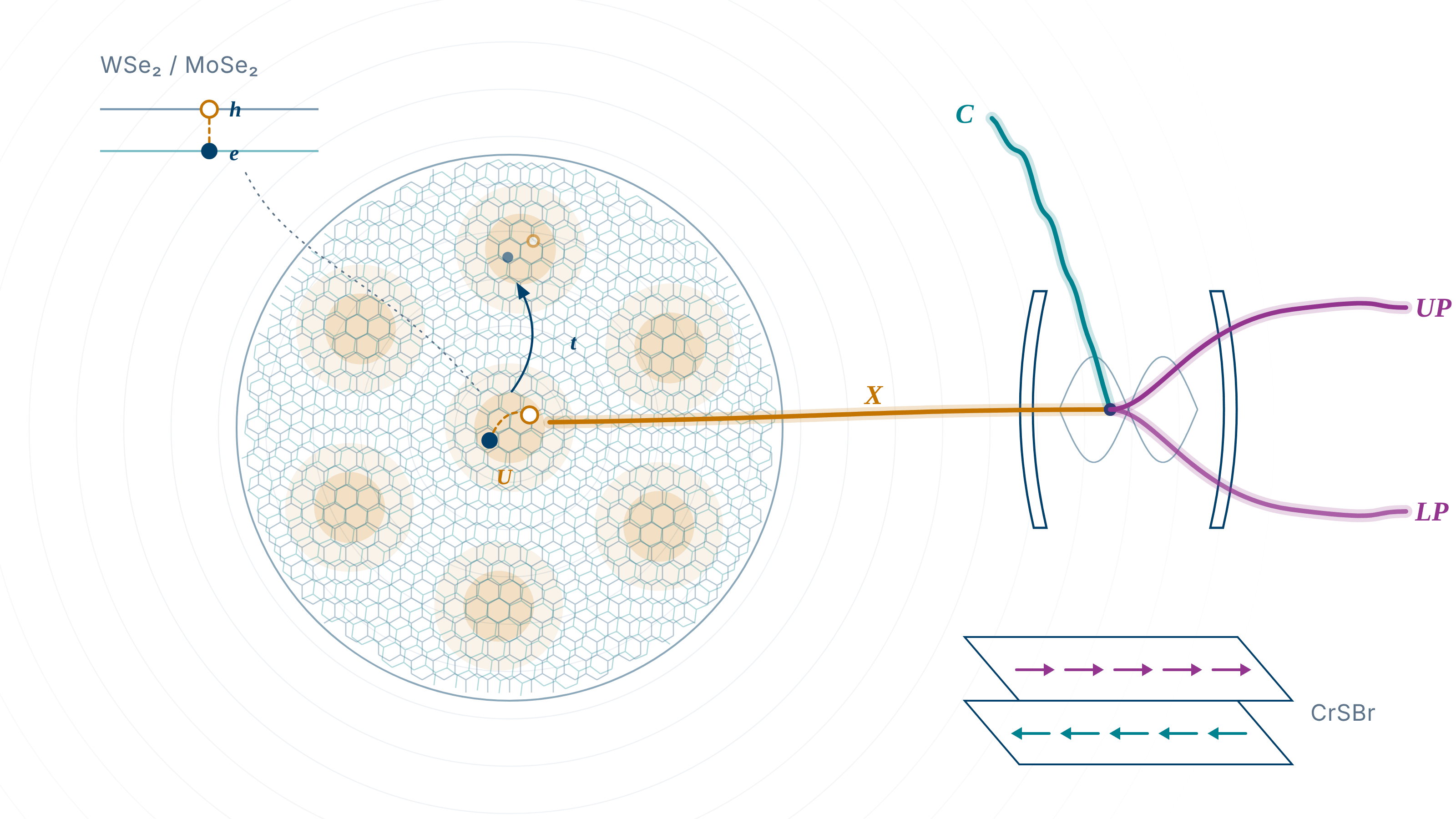
Excitonics and many-body effects in 2D semiconductors. Atomically thin semiconductors such as transition-metal dichalcogenides (TMDs) are ideal model systems for understanding and harnessing Coulomb interaction effects at room temperature, as excitons and higher-order carrier complexes are stable here even at room temperature. Using many-particle methods, we describe exciton formation, carrier scattering, band gap renormalisation and photoluminescence, and investigate how these properties can be specifically tuned via the dielectric environment. A future area of focus will be the behaviour of excitons at atomically thin interfaces: in van der Waals heterostructures, charge-transfer excitons form, the optical and transport properties of which remain partly unexplored. In moiré structures of multilayer TMDs, we study Bose–Hubbard physics and quantum phase transitions. When excitons are strongly coupled to light in optical resonators, exciton-polaritons are formed, the properties of which can be tuned by controlling the light field. We are also increasingly interested in 2D magnets such as CrSBr, in which magnetic order and excitons are closely linked.

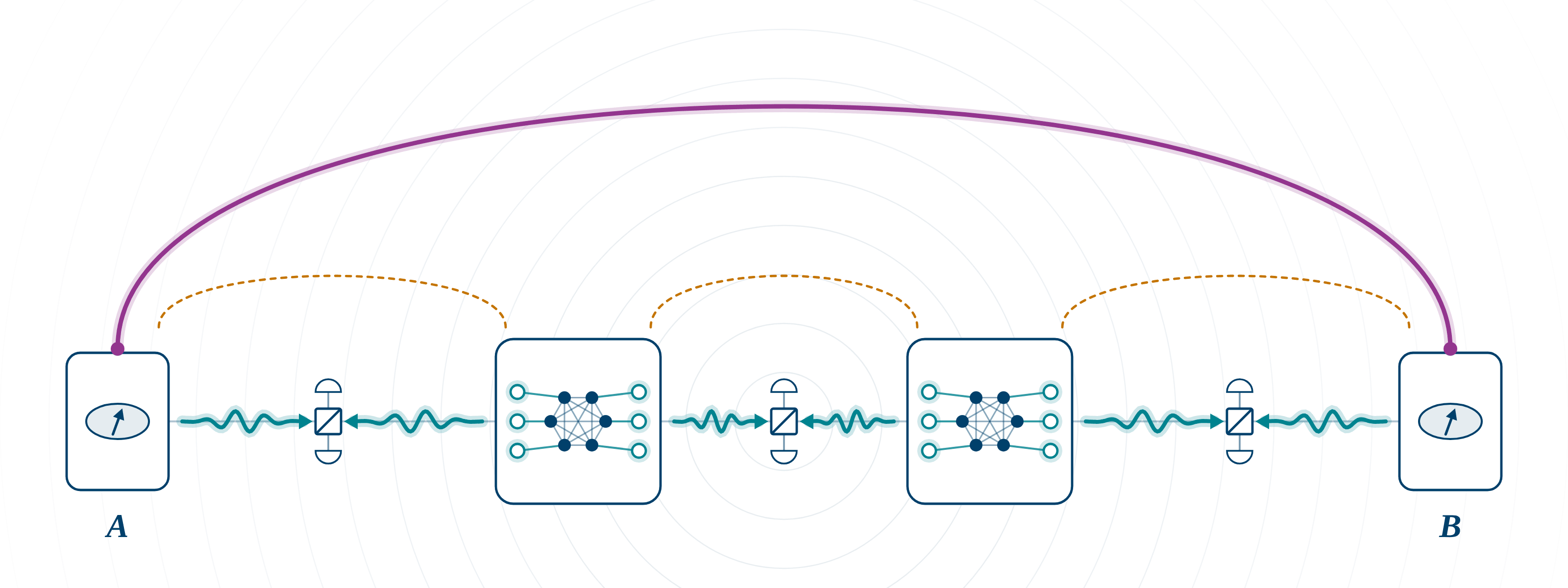
Quantum materials for quantum communication. Quantum repeaters are intended to propagate entanglement over long distances, thereby exceeding the fundamental rate limit of direct fibre-optic connections. To this end, we are focusing in particular on quantum-dot molecules as nodes and sources of entangled photons. We simulate the individual steps of repeater protocols using quantum mechanical methods. This enables us to assess which material parameters and protocol variants promise the greatest benefits and could potentially become components of future quantum hardware.

Coherence and entanglement. Finally, we investigate how coherence, collective effects and entanglement arise in many-particle systems such as quantum light sources and nanolasers, and how they can be quantified, for example using entanglement probes based on electronic pair correlations. We treat these quantities as resources in the sense of quantum information theory.
Quantum Natural Language Processing (QNLP). We apply concepts from large language models to quantum circuits. The quantum context-sensitive embedding (QCSE) developed by our group generates word representations that change dynamically with the context. Building on this, we are developing a quantum encoder-decoder transformer whose self- and cross-attention is realised via state overlap and which can generate tokens, texts and other data types.


