Review TdLL 2022


Review TdLL 2022
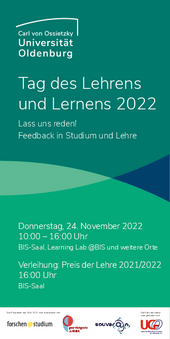
Let's talk!
Feedback in studying and teaching
At this year's Teaching and Learning Day, we would like to invite you - teachers, students and anyone else who is interested - to talk to us about the topic of feedback and explore the following questions:
- What is feedback actually?
- What constitutes good feedback?
- What role does feedback play within learning contexts?
- Is there such a thing as a feedback culture and how can this be promoted?
- Who can give feedback to whom and how do you actually deal with feedback?

Programme
Note: Please register for the workshops using the links provided, but spontaneous participants are also welcome!
-
10:00-10:15: Welcome
Prof. Dr Karsten Speck, Vice President for Studies, Teaching and International Affairs
Bibliothekssaal(BIS Saal)
10:15-11:00 Feedback - evaluation - re-registering students - critique dialogue: All one and the same? - Attempts at differentiation
Dr Jochen Spielmann, Centre of Excellence University Didactics for Lower Saxony, TU Braunschweig
"Re-registering students" is constantly given at universities: as reviews of planned publications and research proposals, in the form of expert opinions and grades for final theses, as critique discussions, e.g. in the case of unsatisfactory performance, as a component of annual appraisals; in teaching, both formatively during the course and summatively at the end. If it primarily serves the purpose of comparability, it is called "evaluation"; if it serves more as re-registering students, it is called "feedback". Sometimes re-registering students is requested, often not.
There is probably no commonly discussed and supported understanding at universities of what is meant by these different formats of re-registration, and certainly not how they can be differentiated and used in a targeted manner so that an improvement, however defined, can be achieved.
The input attempts to make such a differentiation for teaching - in the area of tension between requested re-registration on very specific concerns, "ordered" debriefings on the basis of completed examinations and jointly agreed consultations.
11:00-11:45 Three perspectives on the feedback culture at the University of Oldenburg
Dr Beate Curdes, Department for Study Affairs, University Didactics
Prof. Dr Katrin Kleinschmidt-Schinke, School III, Institute for German Studies
Wilfried Schumann, Psychological Counselling Service of the Studentenwerk and the University of Oldenburg
Feedback depends on the right feedback culture! But what is behind this buzzword? In a panel discussion with Prof Dr Katrin Kleinschmidt-Schinke, Dr Beate Curdes and Wilfried Schumann, three different perspectives on the feedback culture at our university will be presented. Wilfried Schumann will take a look at the importance and necessity of feedback in terms of learning psychology and how you as students can organise, demand and make use of feedback opportunities. Katrin Kleinschmidt-Schinke explains the role that development-sensitive feedback plays in the academic writing process. Beate Curdes shows that feedback processes are also influenced by stereotypes, how these colour the behaviour of the feedback provider and how feedback affects students as a result. Based on three short impulses on these perspectives, a joint dialogue and discussion with the participants will follow.
12:00-14:00
Poster session, lectures and workshops
12:00-13:00
Poster presentations of student research projects
Independent research by students - both inside and outside of courses - characterises studying at the University of Oldenburg. Supported by the "Forschendes Lernen" programme, five student research groups have explored different facets of the topic of "Aufbruch" this year and will be presenting their findings at the poster session.
Funded student projects
Max Schewe and Friederike Ulses (School I)
Between Protest and Utopia: Rap Music as a Medium of Awakening? An explorative study of the political didactic potential of socially critical German rap based on song and music video analyses.
Robin Forstenhäusler and Kolja Witt (School IV)
Krise des Aufbruchsbewusstseins. Cultural representations of a post-corona society.
Jasmin Behnke and Lara Yasmin Disselhoff (School V)
The flies are off! Towards a more sustainable future with the black soldier fly - Black Soldier Fly larvae as a substitute product for fish oil & meal in aquaculture.
Raxide Andrade Leon, Oliver Bruton and Sumbul Jafri (School VI)
AI meets MD: Combining machine learning algorithms and medical experts' diagnosis (MD) for new beginnings in the prediction of Alzheimer's disease progression.
Funda Yilmaz and Trupthi Karanth Ramadeva (School VI)
Exploring the New Normal: The effect of personality differences, risk perception and emotion regulation on moral judgements regarding everyday behaviour during the COVID-19 pandemic.

12:15-13:45
Feedback: Fuel for your own growth
Wilfried Schumann, Psychological Counselling Service of the Studentenwerk and the University of Oldenburg
Feedback is essential for us if we want to develop personally or professionally. The view from the outside broadens our perception and opens up perspectives that we could not recognise on our own. The workshop will focus on how we can organise feedback for ourselves in a variety of ways and use it constructively. On the other hand, we will also look at how we can protect ourselves where feedback is hurtful or could have a negative impact on us.
12:15-13:45
Peer feedback in courses: Miracle method or unnecessary effort? Experiences and examples
Sophie Berg, School II, Department of Business, Economics and Law
Priv.-Doz. Dr Sylvia Jahnke-Klein, Faculty I, Institute of Educational Sciences
Niklas Reinken, Faculty III, Institute for German Studies
Dr Hendrik Wolter, Faculty II, Department of Business, Economics and Law
The workshop "Peer feedback in courses: Miracle method or unnecessary effort?" is primarily aimed at lecturers from all Schools. The use of peer feedback in courses offers a number of advantages for students - from more intensive engagement with learning content to increasing reflection skills and ultimately taking on a more active role in the learning process. Teachers also benefit directly from peer feedback and are relieved of some of the burden, e.g. by delegating the giving of feedback to the students. In this workshop, we will take a closer look at the advantages, possible applications and challenges of peer feedback. Teachers from different Schools will present examples and experiences with their students and we will discuss together to what extent elements of peer feedback can be integrated into the participants' courses. Finally, we will work together to develop conditions for successful peer feedback.
12:00-13:00
Implications for future (digitally supported) university teaching - results of two surveys from the SOUVER@N project
Patricia Dammann, University of Vechta, School I, Department of Educational Psychology
Hannah Naundorf, University of Veterinary Medicine Hannover Foundation, Centre for E-Learning, Didactics and Educational Research (ZELDA)
The aim of the SOUVER@N project("Souver@nes digitales Lehren und Lernen in Niedersachsen") is to promote sovereign digital teaching and learning. In order to implement this project, a survey was conducted among teachers and employees in service and support facilities at the project locations. Selected results of the surveys and the resulting implications for future (digitally supported) university teaching will be presented. Further possible implications and participants' assessments can then be discussed.
12:15-13:45
Feedback in the school
Sarah Huck, School IV, Institute of Philosophy
Taalke Hanna Joosten, Oberschule Ganderkesee
The workshop focuses on different forms of feedback in schools. The focus will be on teacher feedback, student feedback and peer feedback. The different forms of feedback will first be explained based on theory and discussed together. Different feedback methods will then be tested in an action-orientated way and reflected on together. Overall, the workshop aims to provide practical tips on how to use feedback tools consistently and profitably.
12:15-13:45
Selected SOUVER@N topic areas: Basic qualifications, e-tutor training, audience response systems
Dr Norbert Kleinefeld, Department for Study Affairs, SOUVER@N project
During this event, the joint project "SOUVER@N" (Souver@nes digitales Lehren und Lernen in Niedersachsen) will introduce itself and present three selected fields of work. (1) With the help of a comprehensive OER package, prospective primary school teachers are to be supported in acquiring basic qualifications for non-subject teaching in the main subjects. The focus is on teaching the essential learning content of the individual main subjects using digital learning environments. (2) University teaching, which is increasingly conducted online, is often supported by student tutors. The newly developed asynchronous self-study programme "Digital Teaching Skills for eTutors", based on ILIAS, teaches the media-didactic basics of digital teaching. (3) The programme also takes a look at current feedback technologies. Audience response systems give teachers the opportunity to receive immediate feedback during the course!
The event is aimed at students and lecturers.
14:00-16:00 Workshop and lecture
14:15-15:45
CANCELLED Accompaniment of written (final) papers
Dr Jochen Spielmann, Centre of Excellence University Didactics for Lower Saxony, TU Braunschweig
There are two major phases in the process of supervising theses and projects: supervision and assessment. At some point in this process, we lecturers have to stop supervising in order not to end up evaluating our counselling services. Shaping this role change is a new challenge for every piece of work and every project: when is the right time? What is the appropriate approach: a gradual change or a clear cut? What preparation is needed for the change?
Based on the experiences of the participants and the speaker, these questions will be reflected upon and an attempt will be made to develop different courses of action.
14:00-15:00
Feedback on courses - quantitative and qualitative instruments
Dr Nicola Albrecht, Department for Study Affairs, Internal Evaluation
Lisa Preller, Department for Study Affairs, Internal Evaluation
Dr Simone Schipper, Department for Study Affairs, University Didactics
How can lecturers receive feedback from their students and what is the best way to deal with this feedback? Two feedback tools for courses are at the centre of the presentation: the course evaluation (LVE) and the Teaching Analysis Poll. These are carried out by the Internal Evaluation Department (the TAP in co-operation with the University Didactics Department). After a presentation of both procedures, the main focus will be on how lecturers can use these instruments in their courses to further improve the quality of their teaching with the help of re-registering students.
12:00-16:00 participate@UOL
12:00-16:00
Open Space in the Learning Lab
Petra Janssen, Lars Seehausen, Peter England
Fancy a round of virtual air hockey or flying through space in a rocket? The multi-touch table in the Learning Lab makes it possible!
And in future, you will be able to develop your study projects interactively and collaboratively on smart screens.
Come to the Learning Lab on Teaching and Learning Day! You will find us on intermediate level 4 in the library. A contemporary feel-good learning space is currently being created for you here! Do you have any ideas about how the perfect learning and working space should be designed and what other technology could support you in your learning and working?
Let's get talking!
12:00-16:00
Open Space hybrid teaching in School II
Halil Ege, Hardo Schencke
In the "Open Space Hybrid Teaching", School II and the participate@UOL project offer the opportunity to get to know various hybrid settings for combining face-to-face and online teaching.
Interested parties can take a look at equipment purchased for this purpose, such as a "Meeting Owl", a conference room system and various mobile settings for image and sound in operation and learn more about possible applications and framework conditions.
12:00-16:00
Participation café - drink coffee and chat or just listen
Esther Jahns, Judith Penning, Sarah Meier
Not heard or not heard enough about participate@UOL? Before, after and during the lectures and workshops, you can relax in the Learning Lab over coffee or tea, exchange ideas and find out more at
.
How much participation is needed at the university and what should it look like? Which language(s) are spoken at the university and which are not? What do language and digitalisation have to do with participation?
We want to talk to you about these and similar or completely different questions. Silence as a form of communication is also expressly permitted.
14:00-15:00
Workshop "OER concrete" - What is OER and how does it work?
Susanne Schorer, Dr Wolfgang Müskens
We want to use various short examples to show how Open Educational Resources (OER = free educational materials) can be used and created. We will explain what needs to be considered and what the finished result can look like. The focus is on answering questions about OER.
The workshop is aimed at students and teachers, no prior knowledge is required.

16:00-17:00
Award ceremony: Teaching Award 2021/22
In order to encourage teachers in their commitment to good university teaching, the University of Oldenburg awards the Teaching Prize. The award is under the patronage of the Vice President for Studies, Teaching and International Affairs.
This year, the Teaching Prize will be awarded in the following categories:
- Best event
- Research-based learning
- Best course evaluation (events with fewer than 40 participants)
- Best course evaluation (courses with 40 or more participants)
Further information can be found on the Teaching Prize website.
The Teaching Prize is sponsored by: