
Angelus Sala Prize of the Institute of Chemistry

Angelus Sala Prize of the Institute of Chemistry
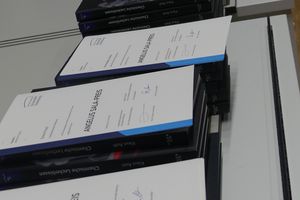
Every year, the Institute of Chemistry honours students from the North-West region who have achieved outstanding academic performance in the subject of chemistry in the 10th grade with the Angelus Sala Prize.
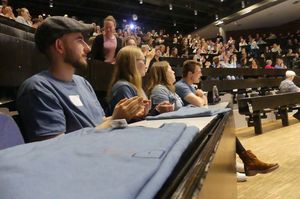
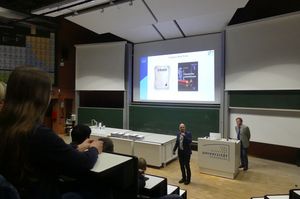
This year's Angelus Sala Prizes will be awarded on 19 June 2026 as part of the University Information Day at Carl von Ossietzky University. In addition to the award ceremony, information about studying chemistry at the University of Oldenburg will be presented.
- Information event on the subject Bachelor and 2-subject Bachelor of Chemistry degree programmes, 10.30 - 11.15 a.m. in W03 1-161
- Presentation of the Angelus Sala Prizes, 11.30 - 12.30 in W03 1-161
For teachers: online form to nominate for the Angelus Sala Prize
For teachers:
- Please nominate only one person from your school for the Angelus Sala Award.
- To make a nomination, please complete the online form here.
- All fields in the form are mandatory (and marked with *).
- At the end, click on the "Submit nomination" button.
- You will now receive a confirmation of your nomination in the mailbox of the email address you provided.
- Registration was possible until 10.05.2026.
Who was Angelus Sala?

Angelus Sala (1557-1625), an Italian clergyman, natural scientist and philosopher, taught as a member of a Jesuit order at several universities, including Padua, one of Europe's leading scientific centres in the 16th and 17th centuries. In his academic work, he advocated a synthetic view of nature that combined the old Aristotelian and Neoplatonic traditions with the new findings of experimental natural research. His scientific work was characterised by a deep interest in matter, its changes and the underlying principles - topics that were central to chemistry.
Particularly noteworthy is Sala's work De natura et causis corporum (On the nature and causes of bodies), in which he deals with the properties of substances, their interactions and the processes of transformation. He investigated phenomena such as combustion, weathering and metallurgical processes, thus helping to steer alchemical practice in a more systematic, scientifically based direction.
Sala was a proponent of the experimental method, although he did not regard it as the sole basis of knowledge. He emphasised the necessity of observation and experimentation, combined with philosophical reflection on nature. This attitude was an important step towards a scientific chemistry that moved away from purely speculative alchemy and focussed on the systematic investigation of substances and reactions.
Sala was also an advocate of the idea that nature is governed by rational laws - an idea that was later developed further by the pioneers of modern science such as Galileo and Newton. In this sense, he saw chemistry not as mere craftsmanship, but as a science that could contribute to the knowledge of divine order and promoted the idea that nature can be understood through careful observation and rational analysis.
Overall, Angelus Sala remains as a bridging figure between the alchemical tradition and the emerging modern chemistry. His work is an example of how the natural sciences in the Renaissance and Baroque era gained their foundations through the combination of philosophy, theology and experimental research.
[Author: Julia Wembacher, better than any AI*]
The University Information Day at the C.v.O. University of Oldenburg
Are you thinking about which degree programme is right for you?
Whether you're still at school, doing voluntary service, have been abroad, are already working or are simply undecided - hit is the right place for you! Come along on 19 June and find out!
- Students and lecturers from all Bachelor's and state examination degree programmes will be represented at hit. Just talk to them!
- Take a look at the wide range of study options offered by the University of Oldenburg in advance and talk to the Central Student and Career Counselling Service or the International Office.
- Get to know the campus and the city of Oldenburg - there are many opportunities to experience studying outside of lectures.
- Find out more about the Voluntary Scientific Year (FWJ) at the C.v.O. University of Oldenburg or about other (training) opportunities at the information stand of the Oldenburg-Wilhelmshaven Employment Agency.
You can find out more about the offers and the programme at the University Information Day here: https: //uol.de/hit
By the way:
Here you can find a letter from the central study and career counselling service of the University of Oldenburg, which you can submit to your school to get time off to attend the hit.
Past events
Angelus Sala Prize, 2024
Every year, the Institute of Chemistry honours students from the surrounding area with the Angelus Sala Prize for outstanding academic achievements in the subject of chemistry in the 10th grade.
In addition to the award ceremony, this event also provides all the information about studying chemistry today at the University of Oldenburg.