The Institute of Chemistry at the Discovery Days 2024


The Institute of Chemistry at the Discovery Days 2024
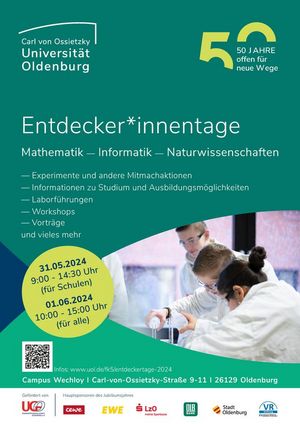
50 years of the University of Oldenburg - 50 years open to new paths. From the very beginning, the natural sciences and mathematics have played an important role in the development of Carl von Ossietzky University. Topics such as energy, sustainability, the use of raw materials and the question of what role science will play on our path through the transformations of the future have always been at the centre of our research. Over time, we have added specialisms in environmental and marine sciences, insurance and financial mathematics, Computing Science and many more. To this day, our researchers continue to set the tone and work on the major issues facing society in the future. Generations of teachers have been preparing to teach biology, chemistry, Computing Science, mathematics, physics and technology here - for over 40 years on our own campus in Wechloy. Today, the Institutes continue to research the challenging questions of our time with great commitment and a spirit of discovery: What materials, energies and raw materials will we live and work with in the future and how do we understand the world around us?
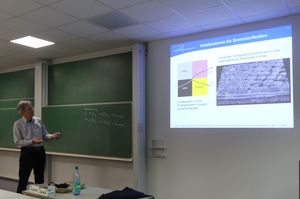
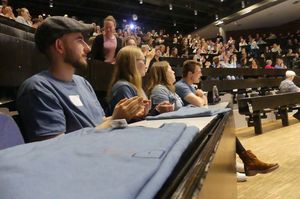
Staff and students of the Institute are delighted that so many young and old explorers took part in these two days, took part in the numerous activities and thus gained an insight into the subject as well as the work, research and teaching at the Institute of Chemistry:
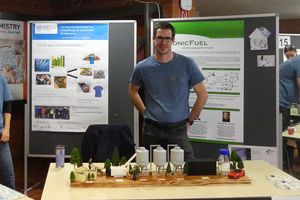
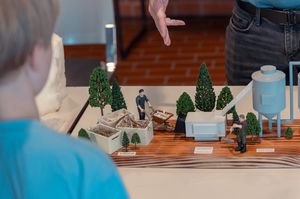
Biofuel with a negative CO2 balance from organic waste (exhibit)
We have developed a process to produce a 2nd generation biofuel from organic waste as a substitute for petrol with a negative CO₂ balance and energy surplus in production. The special feature here is the new purification technology as a platform technology for fermentation processes. We will show you exactly what this looks like at this stand with the help of a model!
(Offer of the AG Prof. Wark)
CATALIGHT (exhibit)
Our chemistry didactics sub-project aims to scientifically support the public and scientific outreach of the Collaborative Research Centre/Transregio "CataLight" and to promote the transfer of findings into chemistry teaching and society. The photocatalytic production of hydrogen by sunlight is used to reconstruct specialised didactic results on the central questions and objectives of CataLight. The developed working materials and (model) experiments are then arranged and disseminated for schools, student laboratories, teacher training and public events.
(Offer of the AG Didactics of Chemistry, Prof. Wilke)
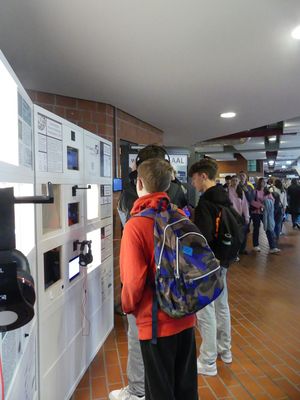
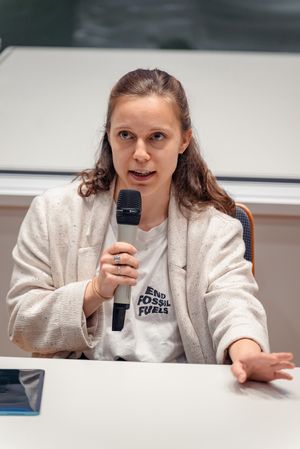
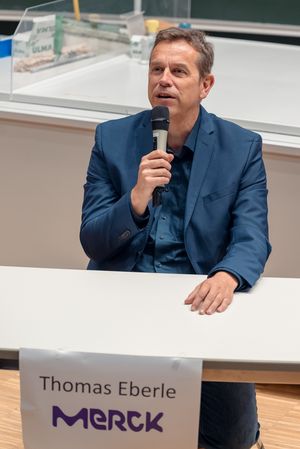
Chemistry in transition - I'm in! (Panel discussion)
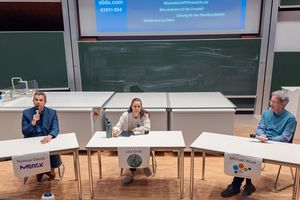
Species extinction, climate and energy crisis, microplastics - chemistry is also facing new challenges. We want to discuss the current issues facing the chemical industry and how research and innovation can advance the transformation of society. What challenges are we facing? How can chemistry contribute to solving them? What goals has the chemical industry set itself? And what does this mean for the skills profile of chemistry students?
We look forward to a round table discussion with:
- Thomas Eberle, Head of Educational Partnerships and Strategic Projects Corporate Responsibilty at Merck KGaA, Darmstadt
- Lisa Groß, Fridays for Future, Berlin
- Michael Wark, Institute of Chemistry
- Verena Wolf, Expert Plant Authorisation, Biodiversity, Nature Conservation, Verband der Chemischen Industrie Landesverband Nord e.V. (VCI North), Laatzen
Moderation:
- Jarl Ivar van der Vlugt, Institute of Chemistry


The Chemistry Quartet (card game)
This game contains 18 quartet cards. Each card represents a specific refrigerant with its specific properties such as flammability or global warming potential. The purpose of the game is to learn about and explore the properties of certain refrigerants in order to gain a better insight into the world of refrigerants and the background to the use or prohibition of the substances depicted. The game was developed and designed by chemistry degree programme students as part of the module "Physical Chemistry 1: Thermodynamics and Kinetics". Have fun playing and learning!
(Offer of the AG Prof Al-Shamery and B. Albach and R. Wichmann, students of the module "Physical Chemistry 1: Thermodynamics and Kinetics")
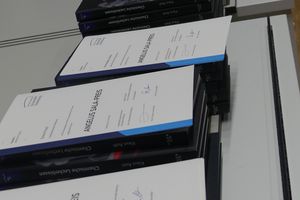
The study of chemistry today, including the presentation of the Angelus Sala awards
Every year, the Institute of Chemistry and the Oldenburg chapter of the German Chemical Society (GDCh) honours students from the surrounding area with the Angelus Sala Prize for outstanding academic achievements in the subject of chemistry in the 10th grade.
In addition to the award ceremony, this event also provides all the information about studying chemistry today at the Carl von Ossietzky University of Oldenburg.


On the trail of the counterfeiter's workshop: XPS analysis of "gold-plated" copper coins (lab tour)
Photoelectron spectroscopy is used to obtain information on the chemical composition and bonding states near the surface. In the Physical Chemistry laboratory, together with Prof Dr Gunther Wittstock 's team, we get to the bottom of the question: Is this gold coin really made of gold?

Discussion forum with graduates, lecturers and the Young Chemists' Forum
Studying chemistry and then what?
Former students and members of the Young Chemists Forum (JCF), who are now working in various functions and business sectors, will provide an insight into the world of chemistry:
- Dr Frank Meiners, KRAIBURG PuraSys GmbH & Co.
- Dr Thorben Sieling, VANEVO Oldenburg
- Dr Julia Witt, Federal Institute for Materials Research and Testing
- Dr Melanie Wallisch, TÜV NORD EnSys GmbH & Co KG, Hanover site
Moderated by:
- Jana Grüneberg, JCF Oldenburg
- Prof Dr Gunther Wittstock, Institute of Chemistry
(Offer of the AG Prof. Wittstock)
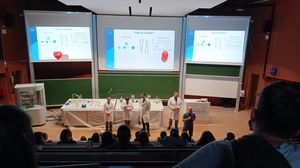
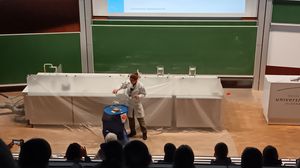
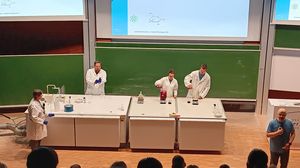
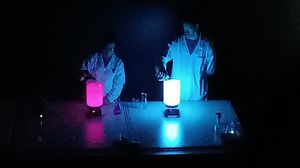
Experimental lecture: From big to small!
Chemistry is everywhere in our environment, in our everyday lives and in many areas of our lives. Chemical processes can take on huge dimensions (just look at processes in factories or the growth of entire fields) or they take place on a scale that is more tangible for individual people: Internal combustion engines, there's a super amount of chemistry going on in the kitchen. But it can be even smaller. Digestive processes take place in all of us. Even smaller? Gladly: electricity from batteries or experiments with individual drops. And it can be even smaller, much smaller. Come along and enjoy a show for young and old about small and big chemistry!
(Organised by staff and students of the Chemistry Department under the direction of Dr Michael Peetz and Dr Alexander Weiz)
Building dye-sensitised solar cells (hands-on experiment)
Black solar cells are used to generate electricity on many roofs in Oldenburg. But do solar cells always have to be black? No, other colours are also possible. Try out how simple solar cells can be produced with the help of fruit tea and a few other substances and test their function.
(Offer of the AG Prof. Wark)
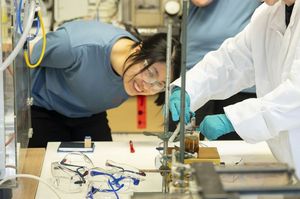


Ask the students: Exchange with students of the chemistry department (student body chemistry)
Find out everything you need to know about study opportunities and student life on our campus.
(Offer of the student body Chemistry)

Produce gels for cell printing (hands-on experiment)
In this hands-on experiment, participants can produce gels for cell printing (= production of biological tissue).
(Offer of the AG Prof. Wittstock)
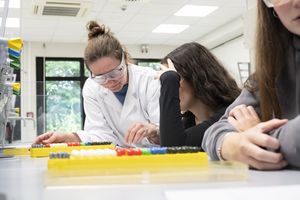

Production of simple electrocatalytic layers (demo or hands-on experiment)
In the future, electrocatalysis will not only be used to produce hydrogen from water, but will also revolutionise many processes in the chemical industry. See how electrocatalytically active layers are constructed, try to produce them in our laboratory and test their function.
(Offer of the AG Prof. Wark)
Hydrothermal carbonisation (exhibit)
Waste biomass, e.g. green waste, liquid manure or fermentation residue from biogas plants, is available in abundance in Oldenburg and the surrounding area. We show how this can be used to produce biochar in simple plants. The biochars can potentially replace peat in plant substrates in the garden and thus limit the further destruction of ecologically valuable moorland, but they can also filter pollutants out of the air or water or serve as a carrier for catalysts.
(Offer of the AG Wark)
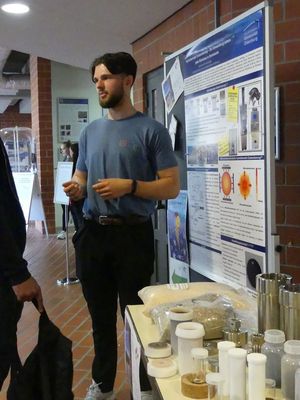
Small series of experiments in general chemistry (hands-on experiment)
Look, touch, join in! Not only do chemical reactions take place in our countless bodies at all times, we also use the chemical process unconsciously every day in our everyday lives. We invite you to our hands-on stand to actively experience excerpts from household and everyday chemistry.
(Offer under the direction of Dr Alexander Weiz)

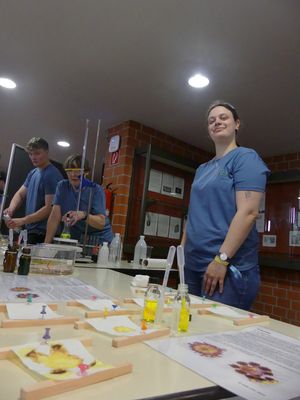


Left or right? That is the question! (Lecture)
A lecture on the importance of chirality in organic chemistry and pharmacy.
(Offer of the AG Prof. Christoffers)
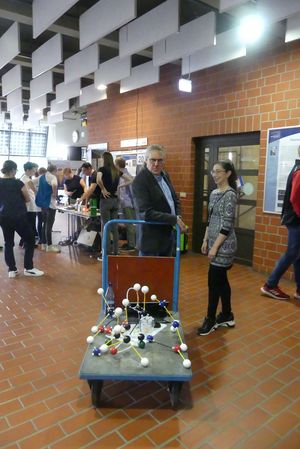
Marine bioeconomy (exhibit)
Everyone knows about fish farming. But how can algae and other aquatic organisms also be utilised as raw materials in order to create added value both ecologically and economically? This is the focus of the "Bioeconomy on Marine Sites" innovation area. In particular, we are supporting creative start-up companies in a project to develop innovative, sustainably obtained products and bring them to market. Product developments will be presented at this stand and the benefits and risks of the marine (blue) bioeconomy can be discussed.
(Offer of the AG Prof. Wark)
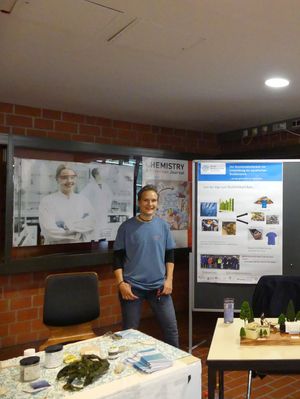
Micro 3D printing (demo experiment)
Here we present our new 3D printing technology for producing metallic structures with microscale resolution - up to 1000 times thinner than a human hair! We will show how different printing techniques work and demonstrate the growth of metals under the microscope.
(Offer of the junior research group Dr Momotenko)
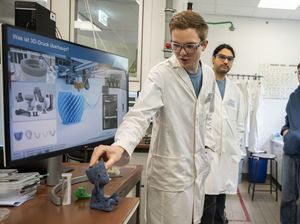

NMR spectroscopy (nuclear magnetic resonance spectroscopy) (lab tour)
NMR spectroscopy can be used to find out which molecular structure is present in a sample. During this lab tour, you can see what equipment is needed and how the whole process works!
(Offer of the AG Prof. Müller)
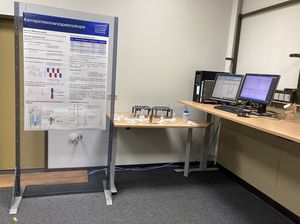
Paracetamol - from synthesis to pure substance (lab tour)
What do laboratories in which molecules are synthesised, i.e. produced, look like? What equipment is needed for this? This tour will show you what laboratories look like in which substances are produced, analysed and the samples are then tested for purity. On this tour, we will take a closer look at the process and visit three different laboratories where the individual steps are carried out.
Please note that for safety reasons, the laboratories of the limited-participation activities, especially in chemistry, may only be entered with closed shoes and long trousers (no leggings, preferably jeans or linen).
(Offer of the AG Prof. Müller)
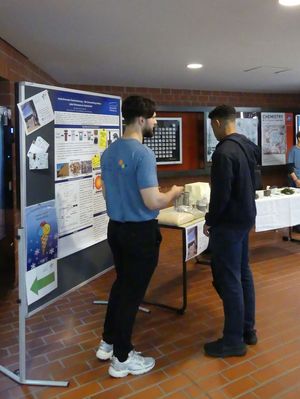
Poster gallery of the individual working groups
The work of the Institute of Chemistry briefly presented in poster form.


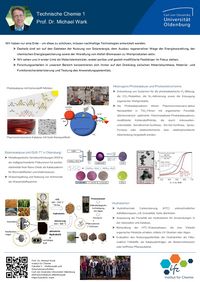

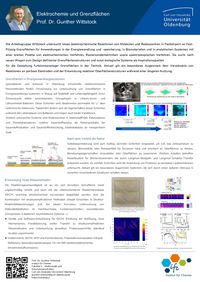

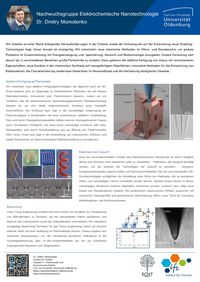
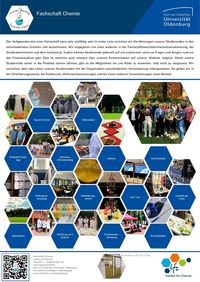
Photocatalysis (demo or hands-on experiment)
The sun supports chemistry. Test in a hands-on experiment how light and a solid - the photocatalyst - can be used to render dyes from the production of clothing (keyword: blue jeans) or other pollutants in water harmless.
(offered by Prof. Wark's working group)


Physical chemistry (lab tour)
Lithium-based batteries and accumulators have become indispensable as energy storage devices. Members of Prof Dr Gunther Wittstock's working group have developed a new method for observing processes on the surface of electrodes during operation. The aim is to develop innovative battery components and at the same time develop techniques for testing these components. The work is part of the co-operation project "Alternative Materials and Components for Lithium-Oxygen Batteries" (AMaLiS) funded by the Federal Ministry of Education and Research (BMBF).
In this laboratory tour, Prof Wittstock and his colleagues provide an insight into the AMaLiS project and answer the question of how a federal government research project works.
(Offer of the AG Prof. Wittstock)
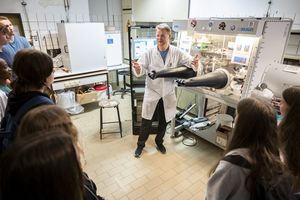
Demonstration experiments in organic chemistry
Prof. Hilt's working group from Organic Chemistry will be presenting exhibits on organic electrochemistry and reaction control in an inert gas atmosphere and will be demonstrating selected oscillating reactions (= reactions in which the solution periodically changes colour). As a hands-on activity, galvanised copper coins can be "gold-plated". The principle of gas chromatography and mass spectrometry is explained.
(Offer of the AG Prof. Hilt)

Speed dating in chemistry (hands-on experiments)
Chemistry didactics invites you to take part in experiments that allow you to experience chemistry with different senses. Come along on a trip through our laboratory street and get to know us and a few exciting experiments.
(Offer of the AG Didactics of Chemistry, Prof. Wilke)
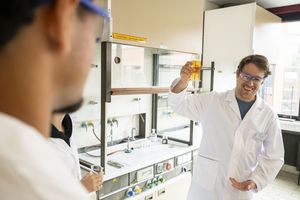

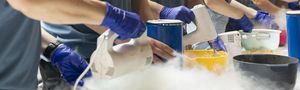
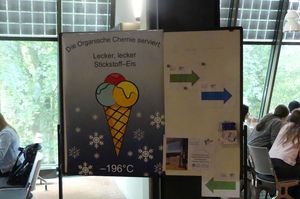
Nitrogen ice cream
Milk ice cream in a wide variety of flavours is produced at this station using liquid, cryogenic nitrogen. Come along and see the results for yourself!
(Offer of the AG Prof. Christoffers)

From everyday study to research: physical chemistry to watch (lab tour)
This lab tour presents experiments in the thermodynamics lab course. There will also be an insight into the large-scale research laboratory of AG Al-Shamery: Presentation of the apparatus and set-ups including ultra-high vacuum systems and large-scale equipment. Current research goals will be presented.
(Offer of the AG Prof. Al-Shamery)
Hydrogen - clean, emission-free fuel from water or waste biomass (lecture)
"Green" hydrogen is being discussed as the "energy carrier of the future". In reality, hydrogen is a colourless gas; the colours often mentioned refer to how and from what hydrogen is produced.
The lecture will report on how hydrogen can be produced from water or waste biomass with the help of sustainably generated electricity, light, temperature or microorganisms. The storage of the hydrogen produced is also important for large-scale applications; the possibilities for this will also be discussed.
(Offer of the AG Prof. Wark)