Prof Dr Michael Daxner
Prof Dr Michael Daxner
President of the University from 1986-1998
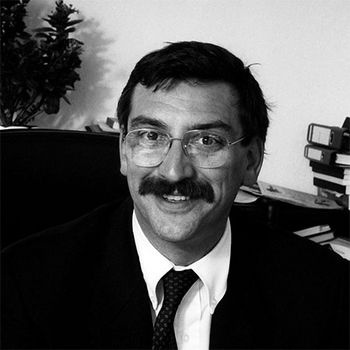
Prof Dr Michael Daxner, born and raised in Vienna in 1947, was appointed Professor of Higher Education Didactics at the University of Osnabrück at the age of 27 and became President of the University of Oldenburg at the age of 39. Before embarking on a career in higher education, he completed a doctorate in Vienna at the age of 25 after studying a broad range of humanities and social sciences and worked on higher education reform at the Austrian Ministry of Science. After twelve years as president, he took over a professorship for sociology in Oldenburg and remained an internationally sought-after higher education expert. He was active in Kosovo (Head of the UNMIK Department of Education and Science, among others) and Afghanistan in the reorganisation of universities and advised the Austrian government on higher education legislation, for example. He also headed the research project "Security and Development" and was a senior researcher at the Collaborative Research Centre "Governance" at the FU Berlin. He left the University of Oldenburg in 2011. Michael Daxner has received numerous awards and has been a member of numerous international committees. Towson State University (USA) and Novosibirsk State University (Russia) awarded him honorary doctorates, and in 1999 he received the Federal Cross of Merit First Class.
More pleasure than a burden
Thinking is public work.
Peter Brückner
The distance to my departure in 1998 is just as long as the duration of my presidency: twelve years. My memory is now covered by important years and experiences from more recent times: before my time in Oldenburg I was stable - 13 years in Osnabrück, before that four years in the Vienna Ministry - but after 1998 my life was constantly reorganised at short intervals - in fact it was , because I only reorganised it to a limited extent. We are not that free in our decisions. After Oldenburg, I travelled to Kosovo, Vienna, Afghanistan and Berlin.
Before Oldenburg, everything I touched was somehow connected to higher education and university policy: University didactics, examination research, sociology and history of science, exile research, legal commentary, BAföG, university socialisation. This prepared me for my presidency and at the same time distanced me further and further from education - probably more so than my prominent colleague Dieter Lenzen, who moved from Berlin to the University of Hamburg in 2010 to become the second successor to the former Oldenburg chancellor and almost-president of the University of Oldenburg, Jürgen Lüthje. This distance from pedagogy - Hilbert Meyer, probably one of Oldenburg's most famous luminaries and a very friendly colleague, had even detected an anti-pedagogical affect in me - was logical and important: I knew that I belonged to the social sciences, and the steps from university sociology to the sociology of science, from this to Jewish studies and political sociology, to conflict research and conflict anthropology and finally to the political sciences in Berlin were only logical. The presidency in Oldenburg contributed significantly to this.
I regularly and quite carefully wrote down all the stages of my adult life, not focussing on my sensitivities, but on what I did and the environment in which I acted. As President of the University of Oldenburg - which was called Carl von Ossietzky University long before it was renamed - I provided the Council and the Oldenburg public with long reports and reflections on the institution and my activities. Some felt annoyed, and yet the Council reports were a means of democratic communication that fell into oblivion after my term of office. In addition, there was no longer a council by law and the university felt it could do without this transparency.
I am putting this at the beginning because I want to make one thing clear: I will not only write about successes and developments, but also about setbacks and mistakes, including blunders and misjudgements that I blame on myself. But there is one thing that I have persevered with: I never left the university in the dark about my plans, views and positions. Everyone could hear and read what the President was doing. Not always what he was thinking.
I don't want to present a chronology of my time in office here. All the dates and stages of development are documented: by the press office (which one of the editors of this book, Gerhard Harms, headed before, with and after me), by the official announcements and finally by the press and media coverage, the political and cultural commentaries. As far as possible, I try to get by without my archive and my notes. What I wrest from my memory will provide information about me, but even more about the university and its social environment. The distance to the twelve years allows me to mention names and organisations without anger and zeal where appropriate. And it is clear anyway: I often say "I" when I mean "we", but only want to present myself as a specific actor, and I often say "we" when I was actually the driving force and author of a development - not out of modesty, but in the sense of how an action was conceived and planned.
Presidential levels
I became President in Oldenburg because I had failed in Kassel in 1979. I was elected there by 58 votes to 19 against Ernst Ulrich von Weizsäcker, despite questions from an angry female professor about my sex life (the colleague wanted to know because Weizsäcker had also been asked about it by students) and, of course, about my political views. The Hessian Minister of Science, from whom I was threatening to take away his candidate and "his" university, had not appointed me, and I realised that a withdrawal from the University of Kassel would benefit me more than a certainly profitable lawsuit at the administrative court. On the occasion of my election in Kassel, I was given a pair of dungarees (too small), symbolically in pink. After my election in Oldenburg in May 1986, I was the dungaree president for those who would rather not have had me here.
But I had used the time after my defeat in Kassel: I had made a lot of mistakes in my application and my programme, above all frightening off potential alliance partners by wanting to set the programme that the University of Kassel would have given itself. It was about opposing nuclear power and the DFG's procedures, which did not want to accept Kassel at the time. Years later, when I voted in favour of Kassel at the DFG, Oldenburg was already a member at the end of my first term of office. And Ernst-Ulrich von Weizsäcker, who would later head the Wuppertal Institute for Climate, Environment and Energy, as Uwe Schneidewind does today, had thanked me for helping to pave the way for an alternative career that he enjoyed.
I wasn't really that relaxed about it, but as a young professor and dean in Osnabrück, I had learnt under one of the best rectors and presidents a German university has ever had since 1945: Manfred Horstmann, Rector and President of the University of Osnabrück. He was a friend and teacher, and above all he was undivided in his loyalty to his university, which to him was more than just a collection of professorships, Institutes and disciplines. After 1986, I was able to work with him for a few more years as President of the neighbouring university, a co-operation that was certainly fruitful for Lower Saxony and both new foundations, but which was torn down by his early death.
A few days after the Chernobyl accident, I spoke to natural scientists in Wechloy during an application speech for the Oldenburg presidency. They were sceptical and not impressed by much of what I said, but my commitment to preserving the radiation measuring station was intended to build trust (this later contributed to our noble partnership with the Russian University of Novosibirsk, which was looking for a partner in the field of alternative energies and found many partners in Oldenburg). It was also important that I had a long-standing friend and advisor in the Department of Physics, Klaus Jaeckel, who died too soon, who worked for my candidacy like no other and often called me at 7 a.m. after my election to express his disapproval or approval of my actions. After my oral presentation to the council, I was exhausted. I had realised that Oldenburg was and would remain difficult, that the fault lines between politics and science, between recognition of achievements and personal destinies or networks, and also between the university and the city or the North German Plain, would be even more complex than elsewhere. The Oldenburg landscape, which has the task of promoting culture, science and nature conservation in the former state of Oldenburg, soon wanted to prescribe curricula for me.
But when I was elected in the fifth round of voting with a majority of one vote against the incumbent Horst Zillessen, many things became easier than expected: The minister had no problems with my appointment, even though a few particularly "democratic university lecturers" and a Vechta MP wanted to prevent this unlawfully. I was able to return my loyalty to Johann-Tönjes Cassens without ever getting any closer to him politically. Rainer Rheude also gave me a taste of critical, supportive and sensitive regional journalism just a few days after the election, when I was recovering from a minor operation that took place just at election time: I praise him in retrospect, although he sometimes pushed me to the limit. He led a small group of journalists who didn't attack me before I had done anything. For the others, the dungaree-clad Austrian was enough. I also heard the Hitler-Beethoven joke from the president of the government (Hitler was German and Beethoven was Austrian), clear words about my hostility to the economy from the managing director of the Chamber of Commerce, about the reserves of the professors who wanted to prevent me and those who wanted to take me in. It was a good thing that I was able to recover from the hospital and lay the foundations for long-term partnerships in the USA in the summer of 1986 before I took office - on a research trip with the Education and Science Trade Union. Before me and with me, some exciting projects and a veritable top-class member of the Bundestag, Thea Dückert, who now teaches at the university - in the Jean Monnet Centre - emerged from the cooperation office with the trade unions.
As I no longer had to commute to Oldenburg for personal reasons, I was able to move and remained loyal to the Dobbenstadt district for twelve years, initially also as a neighbour of one of the most important colleagues in the internal structure of this university, Christian Leszczinki from the Psychosocial Counselling Centre - another friend who died young. I can't spare this in my review: the names or memories of many friends and colleagues close to me, from whom I was separated by office and lifestyle more than was often good for friendship, but who were conversely more than just collegial companions. In addition to Klaus Jäckel, the actual initiator of my application, it was the physicist Ulrich Radek, the Head of the International Office Johannes Buchrucker and many others who died during my term of office and who also made this "close separation" of personal and public communication a task, not just a friendship enjoyed. This was most evident in the case of my friend and role model Manfred Horstmann. I also mention such names because the President's relationship with his academic appointments was subject to many and often inexplicable interpretations, which then became part of university politics and often took on a life of their own. In this context, it is important to mention my first Vice President Herbert Uppendahl, with whom I had little contact during his term of office, but who was to become a friend during his final illness.
The beginning of my term of office was objectively more difficult than I had admitted to myself for a long time. I blamed everything on the experiences I must have had and only gradually learnt about the special features of Oldenburg, which were perhaps not typical of all universities, not even of all newly founded ones. Where did it happen that the new president was warned by representatives of the mid-level faculty against publicly funded third-party research ("We don't do it that way here!"), while the same group tried to defend their research sabbaticals - because of the principle of equality with the professors. I found the first principle rather strange, the second not fundamentally wrong. However, I quickly had to suspend the sabbaticals (incidentally, many mid-level staff who were given the title of professor very quickly became professors).
The biggest problem was that the university had split into two camps, which were divided against each other with a wagon-castle mentality. Conflicts were fought out at the level of affairs. The spying affair, the right-wing radicalism affair, the feminist iconoclasm against Wunderlich's graphics in the senate hall ... all affairs that did not affect the work of most university members, but did disrupt it; and the external impact was not pleasant either. I had some highly prosaic fields to work on there. In Oldenburg, it was all about door-to-door canvassing and making contact with all groups in local society, although I realised that most of them overestimated their importance to the university and underestimated our importance to them. But psychology also played a major role here. I danced on the fine line of demanding regionality and avoiding provinciality, but of course Oldenburg was and is more provincial than is good for the city.
For those who don't like reading this, I would like to remind you of the years of endeavouring to create the science park in Wechloy or the two key experiences that made me finally put my money on the international rather than the local card. It was to be my first business coup: A first-class working group in biology was conducting research in the field of large mushroom cultivation. We searched for and found a suitable regional mushroom grower. But he didn't want to wait five years for his investment to pay off. Today, Hungary is one of the countries producing edible large mushrooms, and the Oldenburg entrepreneur has long since gone bankrupt. The other experience brought status gains for the university relatively quickly: the business community - employers, the IHK CEO, most local entrepreneurs - criticised our weakness in the training of locally desired professions and our generally unproductive character (sociologists and teachers cost money, bring nothing). I showed them how much consumer spending - from the housing market to catering - we were leaving in the city and surrounding area, and threatened that we would one day cover our needs in Bremen. The climate improved.
But there was also another side to the economy - two exceptional figures to whom I owe a great deal: Christopher Pleister and Peter Waskönig. Christopher Pleister, Director of Raiffeisenbank, who later ended up on the Board of DZ-Bank, became Chair of the University Society. He was young, too young for Oldenburg like me, artistic, cosmopolitan, funny. We wanted to promote a university that was getting ready to be good. I remember that we gave popular lectures (I: "Vom Zwerge" and "Vom Wesen") and music (he: Wagner, jazz, impromptus) in the café of the Casablanca cinema, a sideshow of course: but it was recognised that I was making an effort for the city (a few grumpy people at the university resented it: it wouldn't have been serious what we were doing). We were taken seriously when I arrived with the cheques for the University Guest House and we were able to build a magnificent piece of guest accommodation at the sports grounds in Wechloy (I was not allowed to build a hotel at the Uhlhornsweg junction later on, as there was competition from the city's hotel industry - a handicap for congresses for a long time).
Peter Waskönig, former president of the Oldenburg Chamber of Industry and Commerce, entrepreneur from Saterland and later honorary doctor of the university, to whom we owe the Oldenburg Technology Centre (TGO), among other things, was and is a friend, constant and with the long duration that Hannah Arendt demands for friendship. However, we had to learn to trust each other. But then we were a team that could stand up for both: Locality and cosmopolitanism. An entrepreneur naturally stands for the "economy". We first had to work out that the university's long-standing relationship with the DGB, the first cooperation centre to be established nationwide, also stands for the "economy", that social, economic and cultural interests must be equally close to and distanced from science in order to allow it criticism and co-operation. Without Peter Waskönig, we would have had a very difficult time. To this day, he is more than a generous patron and tireless advertiser for the university: he lives the business ethics that others only preach.
Successes, failures, routine
When is the president allowed to say "I", when is it "we", when is it "the university"? As I said, I don't want to garnish a chronology of successes during my two terms of office with a few self-critical dabs and failures to create a realistic picture. It was about more than that: after all, it was about a regional university with a lasting impact, about hundreds of jobs, about a contribution to university reform, about Lower Saxony state politics, and a little bit of world politics was also involved.
Biographically, my time as President has shaped me, moulded me a little, supported me a little. I enjoyed being president, I also considered the power associated with the office to be legitimate and sought it out, I felt powerlessness (often helpless against the harassment of bureaucratic tradition and the narrow-mindedness of politics). I have tried to keep a distance between my office and my private life, which I have never managed to do as well as with my accent. I enjoyed my re-election with a two-thirds majority and renounced my candidature at Humboldt University with a heavy heart out of loyalty to Oldenburg; I did not seek a third term and said so before false friends suggested it to me. Because as a university scientist I was able to observe my own work somewhat objectively, I was able to see myself as a test version of a new type of university leadership, as an experiment with a lot of need for correction and as a prototype whose model version still has an effect today, even if it was more the fate of the Wankel engine that my memory suffers. Enough about me, and in what I partially resemble Horst Zillessen's parting words: When he said: "I did it my way", I say: "We did it my way - partially."
Failures
Failures are not coincidences that upset a well-thought-out plan. They have something to do with wrong planning, a lack of allies or a lack of luck. Or they are the successes of others who try to thwart your own plans. Others often don't even realise how deeply they affect you. I am quite good at suppressing failures, but I still remember some of them to this day - and I get annoyed. I'll describe some of the failures that strongly characterise my memories of my time as President.
University structure: I didn't just set out to be president for the whole university, most of the time I was. So I didn't have a specific clientele, and the university is the wrong institution for a so-called house power. I wanted to move the "shop" forward and maintain its independent face without making it ineffective or boring. I had always been a supporter of the departmental system, and the fact that the university was increasingly splitting into Institutes and departments was counterproductive according to all the findings of higher education research. Well, I had to experiment, once with departmental officials, once without them; once with the attempt to promote strong deans, once with a more flat-hierarchical concept. To this day, the Presidential Board's freedom of action is inhibited because too many funds are budgeted decentrally and there are hardly any opportunities to provide massive support and direction from the centre. Incidentally, this has little to do with a lack of democracy; the President's pools are also subject to control.
We got far too fewnon-university Institutes, and again it was communication into a political space that Oldenburg simply thought it could ignore. That is one reason why I continued to hunt for Max Planck and other Institutes after OFFIS was founded, in order to compensate for the structural deficits - we were too fragmented for special research areas for a long time. I know that not only the Oldenburg stigma, but also a number of aversions in the large research institutions towards me, inhibited the already low chances of getting such Institutes - you can't be everyone's friend.
Oldenburg airfield: I would have loved to have acquired the Oldenburg airfield after the Bundeswehr no longer wanted it. An alliance of incomprehensible citizens - there would have been no aircraft noise - and a city administration that was completely ignorant on this point prevented the project, and when it was later offered to the university, it was too late. The point is not important in itself, but similar to the technology park in Wechloy, which was tackled far too late, there was a certain indifference to the economic and labour market factor of the university in Oldenburg on the part of the "unaffected" scientific areas.
I was deeply affected by some personnel decisions that still have an impact today. My part in this was that I ultimately made them and did not continue to resist and, in the case of a chancellor, allowed myself to be deceived. It's unforgivable, but it was also a great challenge to make up for it. The way in which the state government then promoted this person was an additional humiliation in that he pursued the same policies in his new position as in Oldenburg and failed. In hindsight, I realise how tenaciously I should have fought the decision once I had recognised the damage.
Of course, there were many more of these failures. But most of them had no lasting impact on the overall system at the University of Oldenburg. The institution forgave me more easily than some of my colleagues and sometimes myself. That should also be said in this context: Nowhere have I learnt to appreciate the friendship and loyalty of those who disagreed with me as much as at this university.
Of course, people like to talk about their successes. I also like to share them with the collective that this university has become, and often others than me have provided the impetus. But I insist that the most important results of my tenure fit into a concept that is now called leadership. The concept involved much more than expert knowledge of universities and science (which most university presidents do not have when they are elected), but required an elaborately cultivated network with social capital in a key position and first-class employees in important positions. It had to inspire confidence and thus fulfil well-founded expectations for the future. I leave out personal dispositions, my ability to deal with conflict, my rhetoric and other things because I don't want to be reduced to them. Of course, the recognition for my future considerations was good for me, but at the same time I was tired of the fact that I often received it much more from outside the university than from within it.
The low point for me was the election of a vice president as "institutionalised opposition" (a colleague called it that) shortly after my re-election. They wanted to put shackles on the "strong" president. That also remained an episode. But much of my bold impartiality towards the members of the university was destroyed at the time - not least by the aforementioned affairs. There were always university members who pounced on anything that offered itself as a principle of opposition - and there was little "corporate identity" on the right or left, professorial, student or service side, but often a lot of pettiness. The University of Oldenburg is certainly not unique in this respect (when my friend Dirk Grathoff once offered the fable of the stomach and limbs of Menenius Agrippa in the University Senate, he was heavily criticised). But sometimes I felt like the power centre of a centrifugal amorphous figure. It should slowly change. Today I am somewhat reassured about this. But before I get to the successes - I'm still hesitating, as readers will realise - two conflicts that were not affairs:
The naming, the dove and peace
The following intermezzo is a central part of my memory and work to this day. I have been working in Afghanistan and other conflict zones for some time. I have increasingly focussed my academic research and teaching on conflict transformation, continuing a constant of my policy that I had established long before Oldenburg1. Although the University of Oldenburg is not a peace university (what would that be?), it is committed to the pacifist programme of Carl von Ossietzky and has interpreted and politicised it accordingly. I still share the intention today, but the arguments and the schematic friend/foe discourse surrounding the naming are also still suspect to me - despite a personal friendship with the late Ossietzky's daughter Rosalinde von Ossietzky and her son, despite all conceivable support for the work edition, despite all gestures in favour of internal university enlightenment. The dispute was conducted by the opponents of the name with undignified, sometimes stupid vigour. But those who gave the name also made it too easy for these opponents and often knew little about Ossietzky himself in practice. By the time I arrived, the Ossietzky Days had degenerated into a little-attended ritual, the name had been instrumentalised for party political purposes and the fathers and mothers of the name were not always on the same page. At the Ossietzky Days in 1988, however, the tide turned: there were some excellent discussions, but of course also narrow-mindedness within the organisation. I was compensated for this by meeting Willy Brandt. The hour with him as a living example in my office was a highlight of my time in Oldenburg - an hour of great intensity. My friend Erich Fried as well as Robert Jungk, Ossip Flechtheim and Lew Kopelew were also present at these Ossietzky Days and not only supported the naming of the organisation, but also made it appear to us as a substantive perspective. The next three years were dedicated to the formal act of naming, which was, of course, linked to a change of government in Hanover. The Ossietzky edition and later the Tucholsky edition were to become trademarks of the Oldenburg edition history, which we intend to continue with Hannah Arendt's estate.
In 1991, the time had come: the government cleared the way for the naming and Minister President Gerhard Schröder himself came to the official naming ceremony: Carl von Ossietzky University of Oldenburg. The context of the naming is still a topical field of interpretation today, as the discussion surrounding Rainer Rheude's book "Krieg um Ossietzky" (War over Ossietzky) from 20092 shows. Of course, the release of the naming rights was the right thing to do and was intended to correct the local and national political opposition. The post-war period had come to an end and, after Willy Brandt's speech, was to move even more strongly into a new historical context. It wouldn't be Oldenburg if the joy at the naming hadn't also experienced its own small cloudiness: There were fierce intra-university disputes that escalated into two almost comical and embarrassing debates: on the one hand, my argument against the dove of peace on the tower was stylised into the verdict that this university did not deserve the name Carl von Ossietzky at all ... when even Oskar Lafontaine wore this unsuspicious sign of the peace movement on his lapel. I had argued against any allegorical logo, especially in the University Senate, that images and emblems can always be misused, and if you allowed one, you would be defenceless against others. I once had the pigeon removed. When it was back up the next day, I left it up and defended my passivity against the attacks of the political right with the principle of proportionality. They also took offence at the fact that the name appeared too small and the University of Oldenburg too large in the logo - such childishness was played up with big words until the next cause for outrage arose.
The Gulf War
The first Gulf War marked the end of the mass peace movement, which reached its peak in the 1980s with the protests against the neutron bomb and the deployment of missiles. Since then - and before that the Vietnam protests - there had been no such mobilisation. But it was difficult to formulate the exact motto of the protest. Because "No blood for oil" was obviously an afterthought, it was about something else. When a Vice President quite rightly asked in the University Senate whether it was right that a large state (Iraq) should be allowed to invade a small one (Kuwait) for whatever reason, the pacifist mood threatened to tip over once again. Hundreds had gathered on the floor of the sports centre to discuss the issue. Apart from three annoying side effects - anti-Israeli overtones, anti-Americanism and real socialist hypocrisy - it was impressive to see the second post-war generation sitting here and discussing war. These students had fully realised that the old slogans of 1968 could no longer be adopted uncritically (they had once had their greater validity and should not simply be consigned to the archive). But now it was about science and peace, about the university in an imagined threat of war. Since there were few student protest
forms that reached the population directly and spread a legitimate message or made it debatable, the fear and anger threatened to radicalise inwards - without an outcome. I was really impressed and helpless, because with every speech the mood threatened to prevail over the analysis of "what is". I was asked to make a statement. My speech wasn't particularly good because it was analytical and without too much emotion. Perhaps that was my mistake, I had to impose greater restraint than usual on Israel. If I hadn't said at the end that peace be with us - which was interpreted in religious terms, but actually meant that we shouldn't start with distant love and appeals to others - the protest would have remained an episode, despite daily peace meetings, resolutions and debates. But for me, the debate was to accelerate a development - which had already been in the offing for some time - towards the sociology of conflict and the problem of looking the other way in international conflicts.
This aspect of my work and interest intensified during the Yugoslavian wars after 1990. As I worked in the European Rectors' Conference and other international bodies, mainly on South-East Europe, and had been in Oldenburg since 1991, it should come as no surprise to anyone that I became involved in the Council of Europe from 1999 and later for the United Nations Interim Administration Mission in Kosovo and the Balkans (UNMIK).
Finally: Successes
Depending on the level of detail and self-attribution, the list may be long or short. Since I assume that the readers of this book are somehow familiar with Oldenburg, I'll throw up a few unexplained buzzwords, some of which I particularly like to remember, while other successes I chalk up to professional results.
In terms of university policy, it was important to carefully prepare for admission to the DFG, as the conditions in Oldenburg were poor - too small units, no outline of the research balance, little ability to overcome small-scale interests, etc. I had already experienced the debacle of the first DFG membership. I had the debacle of the first Kassel application in mind, which motivated my application in 1979. The inspection by the German Council of Science and Humanities, the founding of the Institute of Chemistry and Biology of the Marine Environment (ICBM) and my urgent plea to Hubert Markl, the then President of the DFG, played a role here, as did the attempt to brand myself as my university. "The University of Oldenburg is a medium-sized regional research university" was to appear at the beginning of our texts in the research landscape for many years. The research paradigm had finally taken its place alongside education - especially teacher training.
My first major Senate discussion was a controversial battle over the ICBM. The objections were manifold, but unspoken and characterised by the fear of a shift in power in favour of strong, not directly training-related activities - objectively correct objections to an unsuitable object. The ICBM's success story is not typical of classical natural sciences, because the social contexts of the focal points of this research are particularly relevant to the university's commitment to critical relevance: climate change, rising sea levels, man-made changes to the estuary, etc.
There was a similar discussion about the introduction of Computing Science, with some of the defence stance here being simply old-fashioned and anti-technology, while others were based on the sharp line between the humanities and technical sciences. The example of academic appointments to Computing Science professorships over three generations of appointments also made it clear how small our reserves were and to what extent we were dependent on help from Hannover. The fact that it was only the founding of OFFIS as an affiliated institute that made it possible to go beyond the subject boundaries in academia and make the subject attractive to top talent points to a problem in the German academic landscape: unlike in the USA, universities find it very difficult to affiliate their development and commercialisation institutes; instead, a virtual or real spin-off process takes place, to the detriment of legitimate income for the universities, which are the basis of usable services themselves.
This group of successes also includes the constant expansion in the field of renewable energy - the engagement with students from the Third World and the work on site publicly legitimised the university. The fact that other aspects of environmental policy and social criticism were incorporated into the natural sciences made it easier for me to represent the university to the outside world than to settle conflicts within the university. The example of acoustics and hearing research clearly shows how many aspects, disciplines, social and professional issues are affected, and I was also able to show that it took a first-class foundation, for example through Professor Mellert, to push through such new appointments, in this case Professor Kollmeier.
One of my greatest successes also lies in this socially relevant area of basic scientific research: the establishment, academic appointment and positioning of Hans-Joachim Schellnhuber in theoretical physics. He is now globally recognised, a national leader and has never denied his roots in Oldenburg, where he also completed his habilitation. But how you can take someone from A14 to C3 and C4 (full professor) in a short space of time and persuade them to remain loyal to their university with their working group for several years is also part of my success story. I don't need to go into this any further, but I already suspected quite strongly (and publicly) in the 1990s that Schellnhuber was significantly involved in the Nobel Prize for the United Nations ICCP.
The PIK (Potsdam Institute for Climate Impact Research) under Schellnhuber's leadership, his professorship at Oxford and his role as an advisor to the German government show the possibilities of completely non-elitist excellence: They have to start somewhere, in this case it was Oldenburg - and that is something to be more than proud of, beyond all the envy of colleagues, because at the top people tend to ask where someone comes from rather than where they are going. We have several cases that are not as spectacular as Hans-Joachim Schellnhuber. When I sometimes come across one of the top exports among my colleagues today, I am a little proud of our plants, which grew up under more difficult conditions than elsewhere (exchange of words with my colleague Kamp from the University of Göttingen when it came to savings in physics: He: "You can't compare physics in Oldenburg with physics in Göttingen". Me: "You're right; most of your Nobel Prize winners are in the cemetery, ours are just assistants.")
There would be more success stories here, but they follow the patterns described. One anecdote is extremely important to me. It made me grim. When the Institute of Technical and Applied Physics (ITAP) was founded as a limited company, I immediately acquired a private share in order to donate it to the university immediately so that the university could have acquired an inalienable co-determination share here. The university wanted this, but the Ministry of Finance made such an embarrassing - in my opinion ridiculous - fuss and wanted to incorporate the DM 2,500 share into its state participation concept that I capitulated and am still a shareholder in ITAP today.
After all, I had been elected to stand up strongly and proactively for the humanities and social sciences. This quickly seemed to take a back seat to the successes in the natural and technical sciences I mentioned earlier. I was also on the defensive until we set a clear public course towards a profile in the humanities and social sciences with the creation of Jewish Studies, the Hannah Arendt Estate and Centre and the Ossietzky and Tucholsky editions. On the one hand, I encouraged later successful social science research through personal intervention; on the other hand, I was unable to regulate the conflict between different factions in this area in particular - with fatal consequences. Today's social science no longer has anything to do with Oldenburg's once strong position in the subject; the new approaches are only partly a promise that we can hopefully have reason to trust. The fact that I have always been a loyal supporter of teacher training was ambivalent. After all, the high quality of teacher training, which was weakened by the state's sometimes mercilessly backward school policy, did not leave much room for other pedagogical developments - such as those later introduced and implemented by Anke Hanft with the part-time degree programme "Education and Science Management", among others.
The small successes that I can take credit for have often long since been woven into the fabric of the university - or have disappeared again. If you find campus radio at many universities today, this was not at all a given when it was introduced in Oldenburg. The concept that Gerhard Harms developed with me for Radio Bremen was viable and well-recognised - so well, in fact, that it led to a one-year media training programme funded by the Federal Employment Agency for university graduates who were not immediately accepted into working life, and gave many participants a very good media career. Although there was no other university that had its own magazine in a public broadcaster, in which the University of Bremen then also participated, my dream of having my own media station with TV and radio, which had been nurtured in the USA, could not be fulfilled. That was too ambitious by German standards.
Nevertheless, I still consider this function of universities to be essential today. The gradual development of press and information work from an information organ to an authority for marketing, foreign policy and internal university self-understanding also changed the university's relationship with the region's media landscape. The fact that I was also constantly acting as an "opening and event agent" for art exhibitions in the region was less unusual to me as a natural secondary function of a university president than it was to many members of the university, who misunderstood this as an ornament for self-promotion. Paradoxically, this brought me closer to the immediate region than many university policy achievements, because there can be little local understanding of many sciences.
One lasting success for me and the university was my appointment as Senator of the Lower Saxony Foundation. It has brought us a number of important projects such as the continued funding for the Jaspers lectures on contemporary issues initiated by Rudolf zur Lippe and - at the end of my term of office - the Hannah Arendt estate. My commitment to the Foundation has also sustainably promoted my networking in state politics and has shown me to be a representative of a concept - our university - beyond party politics. To this day, I am linked by a friendship with the noble Dominik von König, the long-serving Secretary General of the Foundation, who did great service not only to high art and culture but also to the regional connections associated with the university. My relationship with Ernst Albrecht, which had been strained during his time as Minister President, was repaired during their time together in the University Senate (he was President of the Foundation).
In retrospect, I consider the following areas, in addition to the DFG admission, to be so noteworthy that they are not simply included in the success story, but have contributed to the overall shape of the university:
Internationalisation: for me, the region or even the city in which people live, work and think is important. But I have always hated provincialism in its confinement to the structures that the local elites dictate. A university has to be internationally orientated or it is not. I think that I have achieved many goals here on which the further development of the university can build: The partnerships with good universities worldwide have also brought us recognition and research successes beyond the exchange. With Towson in the USA, we have acquired an "ambassador" named Armin Mruck, who has managed an extremely active collaboration for over twenty years - politics, music and administrative exchanges are the hallmarks here.
We tried to bring the American universities together in a consortium, which was only partially successful. The partnership with Novosibirsk State University, which was certainly politically motivated, has become a lively collaboration that has strengthened our reputation over the years and opened up new horizons. I had already taken over Toruń from my predecessors - the Polish university became particularly dear to me, also through my close contacts during the state of emergency in the 1980s. Overall, the university's international networking was successful, even if it often overstretched the administrative resources and commitment of many colleagues.
The fact that Oldenburg still has a good reputation in many parts of the academic world today is a result of that time, when the enthusiasm for reform and expansion was also passed on to our partners. Not only the Vice Presidents, but also the Centre for Advanced Scientific Training under Ina Grieb, were an invaluable help for this internationalisation.
Another aspect of external representation was my functions and honorary posts in international organisations: Council of Europe, European Rectors' Conference, international associations of universities and university researchers, etc. I admit that it took me - and the university - a lot of effort to establish viable logistics here. But the fruits were many. What was always underestimated was the recognition that the university received from the fact that its president was involved in these transnational scientific organisations - not a matter of course for German universities in particular, unlike our neighbours. Of course, it was exhausting, and my travelling often demanded patience from the university. But I think it was worth it.
Nordverbund: The Association of North German Universities was one of my most important projects right from the start: To this day, I believe that the autonomy of the individual university is just as valuable as the need to form organisational alliances and binding networks. What began with Bremen, Hamburg and Kiel, later expanded to include Rostock, was intended to coordinate our interests in the higher education landscape, which is still suffering today due to the fragmented regionalism of the German states. Jürgen Lüthje, who had in the meantime been elected President of the University of Hamburg, had the opportunity to provide us with particularly sustainable administrative support in Hamburg, and he had not forgotten his old university. Contacts with Bremen were close anyway, and today I can say without hesitation that the idea of a possible merger was very much on my mind during the last years of my presidency. After all, cooperation in research and teaching is now more intensive than in many places between neighbouring universities.
Hanse-Wissenschaftskolleg: The close co-operation and also personal friendship with Jürgen Timm, the long-serving Rector of Bremen, initially gave rise to an idea in which Jochen Luther and Thomas Blanke in Oldenburg and Ulrich K. Preuss in Bremen enthusiastically participated: we wanted to have our joint "Institute for Advanced Study". Little Princeton? Why not? - Our role models were the Wissenschaftskolleg in Berlin and the American centres of high-class discussion and research work that were removed from the hustle and bustle.
The idea was so brilliant that it quickly convinced Henning Scherf, the mayor of Bremen, and Helga Schuchardt, our minister in Hanover. She was the main driving force behind the foundation. With high-ranking advice, especially from Gerhard Neuweiler, we fought our way through prejudices and envy among colleagues. The location in Delmenhorst was not easy to find, but it was ideally situated halfway between the two university towns. In Gerhard Roth, we found a sustainable founding rector who actually lasted his term of office. Today, the college is an additional attractor for both universities that should not be underestimated.
Global budget: I have already said a lot about the administrative reform. In the 1990s, all educational reforms in Germany pretty much came to a standstill, the material wealth of our university system stagnated and, objectively speaking, our leading position in Europe was gone. One reason for this was certainly structures that may have made sense in the past, but were now outdated and inhibiting. One of these was certainly the way our economic management was governed by ministries, in which economic expertise is not part of the official duties, and by the cameralistic approach to accounting. The idea of the global budget - Lump Sum Budget - had been increasingly discussed in some circles of the Rectors' Conference since around 1985, but who wanted to try it out? The state governments appeased and wanted to give the universities "more autonomy" within the cameralistic system, i.e. more freedom to make cuts. But that was not the point at all. Switching from expenditure to cost accounting and responsible handling of public and private money entrusted to us, for which the state is now not directly responsible as part of its governance, seemed appropriate to us. It was Helga Schuchardt who, as Minister of Science under the red-green government, helped us, as so often, to become pioneers. The introduction had to contend with so many prejudices inside and outside the university that you could write a textbook about it alone. Now the global budget was to blame for all the shortcomings. But our shining example soon set a precedent, while our own state government had long since begun to dismantle the model. As a member of the Austrian Board of Trustees for Universities, I was proud to present this model; it gave some impetus to my home country's University Act of 2002.
German unification: We have contributed a little bit. I have already reported on the cooperation with Toruń and on the agreement with Novosibirsk, which took place during the Gorbachev era. It was clear to many people that this division would not last forever, and if it did, then not under the conditions of a wall. But nobody knew exactly when and how it would change ... (not even political scientists and the secret services). In any case, Oldenburg had long been a place of exchange with the East - and with the opposition movements there. Friedrich Wilhelm Busch was therefore to become the founding dean of education in Dresden, and Rostock joined the Northern Association. The centre of the republic had moved to the east and Oldenburg was once again on the fringes, which should not be overlooked. I myself probably had the most physically demanding phase of my presidency from 1991 to 1992, when I was Co-Chair of Humboldt University's Personnel Structure Commission. It wasn't just a matter of winding things up, it was initially about maintaining and "opening up" the capital city university, whose existence was not at all secure. I commuted and demanded a lot from my environment and myself. It was with a heavy heart that I resisted the temptation to transplant myself to Berlin; as I said, I had registered my renewed candidature in Oldenburg.
Hannah Arendt estate: My farewell was approaching. I had decided not to consider a third term in office. I wanted to tell the Council early on what this meant. My last "big" action was an emotionally and academically significant feat of strength, also for me, which was to struggle for a long time - after my term of office - to be properly recognised at the university. Since 1997, on the advice of Antonia Grunenberg, I had been pursuing the plan to bring Hannah Arendt's estate to Oldenburg - in the only "European" copy of around 80,000 documents held by the Library of Congress. The necessary money was not easy to find: The Körber Foundation and the Lower Saxony Foundation had generously agreed to provide the financing, an endowed professorship for Antonia Grunenberg was established - and then the Hannah Arendt Centre was created, from which an edition is to emerge alongside a great deal of research. The story is sober. But just as Jaspers was later to become a trademark, Hannah Arendt was not a "local possession" in Oldenburg, but in a certain sense a trustee for an entire political civilisation. You can imagine what I sometimes had to "suffer through", for example, when I was attacked by members of the student senate because "private" foundation money was being raised and spent here.
Success epilogue
A certain vanity would like to say: you have done much more. What about a detailed appreciation of OFFIS, the collaboration with Emden University of Applied Sciences in Engineering Physics, what about East German history, Jewish studies? No - you can't list everything that was successful, and even if you can take credit for it, you will tire yourself out. Yes, there were more successes, some were temporary, others were ultimately failures, and many things blossomed in secret, completely without my involvement. I am concerned with something else, something more important: I would like to mention many names and yet I won't, because then I would forget or suppress other important names, would be unfair in the success story and perhaps the same with the failures. Let's leave it at this: I was successful. The fact that I was successful was the work of many, and the fact that many antagonists were more or less convinced in the end is quite nice in retrospect.
Pride, happiness, resignation, new beginnings
I don't see myself as part of a continuous line of ancestors and feel very little like a link in a genealogy of rectors and presidents. In a way, my development after my presidency is typical of my attitude. I came to Oldenburg as a stranger, and after my term of office I changed my professional field, research area and affinity groups. Friendships have lasted over the years, collegial cooperation has given way to memories of good and less good constellations. Many at the university found the mixture of openness and distance inappropriate. What I am proud of in retrospect is that I never left the university in the dark about my plans and reflections on its state, its "constitution", that I imposed the Council reports, often derided as "Daxner's hour of prayer", in great detail as my contribution to this constitution and at the same time insisted on my claim to leadership. Oldenburg was and is a thick board.
I don't write anything today about my political and social activities, which of course always played a role in my personal actions during my presidency: the aftermath of 1968, the Greens, the Jewish community, the lifelines to Austria and the USA. All of this had to fit into an internal diary, beyond the official time economy. That's why I tried to protect my private life, which I may have succeeded in doing. Nevertheless, I am proud of an achievement that has benefited this university, that has made it a hallmark of a public culture that is open to society. I was not from Lower Saxony or Oldenburg. I always tried to be a cosmopolitan and a citizen of my university. There was also a lot in it for me. The honorary doctorates in Towson and Novosibirsk, the first-class Federal Cross of Merit, connections and networks in areas where recognition is important to me. The fact that my plan for a Federal Education Fund (BAFF) also caused a political furore, that my books - especially "Can the university still be saved?" - were a great success, that also contributed to my good fortune.
There was also good fortune: for example, it made me happy to lead a DFG research project on the history of a Jewish school in Berlin and later in the USA during my presidency. That was my side job, so to speak, but the good thing about it was being in science myself and not above it, alongside it and for it alone. Another fortunate thing was getting to know many colleagues, behind whose outer front completely different, unexpected qualities could be discovered. They were not simply "interesting", but beyond their function and their functioning, they were and became "important" to me. I was lucky when I walked to university very early in the morning and had this feeling in the morning light: "Mine".
It was also lucky that a sick student didn't kill me, as he had announced and his voices had told him, because of the rotten mores at the university. It was lucky that I was able to help solve really big problems in the human sphere - there is a lot of misfortune in universities - with many colleagues in solidarity. I was lucky to work with people who were not in the limelight at this university, but who made the university possible in their daily work. Not many colleagues have had the kind of presidential office and administration that I was privileged to lead.
The downside: a president who is not a megalomaniac must beware of resignation. Oh, those Senate meetings ... those insults, that lack of understanding (in the ministry, where they didn't want to understand what the university needed, in the subject, where petty egotism stifled any solidarity). The university scandals have also taken a toll on my self-confidence. Who likes to be bugged, sometimes called a German nationalist, sometimes a left-wing extremist, antisemitically insulted, etc., without leaving any traces? I was often close to resignation, but then I was able to overcome this through successes and happy encounters.
A portion of irony was also part of the defence against resignation: when the topic of "caravan parks" came to a boil in the community, living in one was discussed in academia as a new way of life. My comment was that at least the showers in Wechloy contributed to this. When the loss of culture under my leadership was lamented by conservative colleagues in the University Senate, Thomas Blanke and I began to speak Latin (a mistake we made, we called it Northern Latin). And when it was unbearable, I drew hundreds of session cartoons as spontaneous psychotherapeutic relief. I survived. But none of that was funny, any more than the suicides, criminal cases and accidents at university, which you always have to take some credit for. There was one misfortune that most people didn't understand and I let myself off the hook: I wanted to give the university a present for my 50th birthday. I had invited a colleague, Heinz Bauer from Giessen, and an excellent singer from Düsseldorf to perform Schubert's Winterreise. No speeches, none of the usual celebrations. Just Schubert. It was marvellous. Afterwards, however, I was very perplexed as to why I had chosen such a sad, resigned work ...
A new beginning. Take a deep breath. 1998 was supposed to be the end. I made a mistake that still haunts me to this day: I should have left the university immediately and permanently instead of occasionally showing up in the buildings like Hamlet's father ghost. But that's another story. I started to turn my attention to international conflict transformation from 1999 onwards - after reclassifying my position as a sociologist and carrying out a few research tasks - initially in the field of higher education. It's important to remember that I had put a straightforward academic career behind the presidency, and I couldn't make up for that. But I had to reconnect.
I should now take on the more important honorary posts, even the more complex ones. And after a few weeks working for the United Nations in Kosovo, Oldenburg began to sink into the biographical horizon, but it still pops up again and again today, is often very present, but I don't say to myself every morning: "I was once President there", but rather: "This has become a university that has developed very well despite the many irrationalisms and tunnel vision of many of its members." And that's why I look back fondly on my twelve-year term of office, which was more of a pleasure than a burden.
Postscript to the online publication
Today, in 2023, I would not change much in this text, perhaps emphasising those who have since died and taking a closer look at the problems of higher education legislation and management functions. What is more important, however, are the changes in the higher education landscape and the reality of a not uncontroversial academic system. So this retrospective is also a look back at an important period in my academic and personal life that does not already include the assessments of my successor. Except for one sentence, which is more important today than ever before: I am grateful for the insights into reality that government and academia have offered me over such a long period of time.