Prof Dr Hans-Dietrich Raapke
Prof Dr Hans-Dietrich Raapke
Acting President of the University from 1979-1980
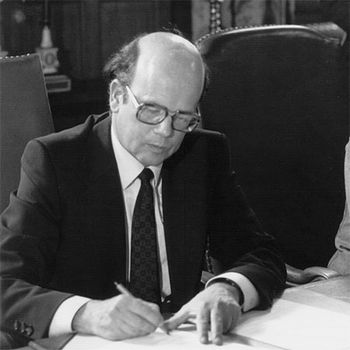
Prof Dr Hans-Dietrich Raapke, born in Hanover in 1929, initially completed an agricultural apprenticeship in the post-war years before enrolling at Göttingen University of Teacher Education in 1951. After his teacher's examination, he continued his studies at the university there, obtained his doctorate in 1957 and became head of the continuing education department ("Göttingen Seminar Courses"). In 1965, the educational scientist was appointed to the Oldenburg University of Education, which he headed from 1970 to 1972 before the university was founded. He made a name for himself nationwide as an advocate of scientific teacher training. After his provisional presidency (1979-1980), he was active in university politics as Vice President (1980-1982) and played a decisive role in the further development of teacher training in Oldenburg. Even after his retirement in 1997, Raapke continued to work as an educational scientist and advised schools on their planning, among other things. He died in 2016 after a long and serious illness.
The first state commissioner
It is rare for a State Commissioner to be appointed to head a university. The University of Oldenburg has now had two State Commissioners; I was the first. Dr Heide Ahrens, Vice-President for Administration, recently became the second commissioner. This is evidence of lively and, at times, heated debates with the Ministry of Science, the state government and within the university itself.
In 1978, the Lower Saxony Higher Education Act (NHG) came into force alongside the new presidential constitution. The university’s first president was due to be elected in the summer semester of 1979. But as early as June, the UNI-INFO reported that the election that term was ‘at risk’, as the Minister for Science had excluded the promising candidate, Dr Jürgen Weißbach, from the election. As head of the Contact Centre for Advanced Scientific Training (KWW), Weißbach did not meet the formal requirements for the office of president.
By the end of the summer semester, the university’s rector, Prof. Dr Rainer Krüger, and his deputy, Prof. Dr Friedrich W. Busch, had declared themselves unable to continue in their posts in view of this situation. They resigned on 1 August – without a farewell and without thanks. They saw no possibility of a president being elected in the near future. Jürgen Weißbach had taken his case to the Administrative Court, and the Ministry subsequently appealed to the Higher Administrative Court. This resulted in considerable delays. The appointment of a ‘representative to carry out the duties of the President of the University of Oldenburg’ had thus become unavoidable.
Formal criteria were to apply to the selection of the representative, such as having previously been elected to a senior management post at the university. As I had been Dean of the Oldenburg branch of the Lower Saxony University of Education from 1970 to 1972, I saw no justifiable reason to decline the Minister’s request. It was not foreseeable that I would be required to carry out the duties of the office for a whole year.
I found myself facing this new task alone – together with the Chancellor, Jürgen Lüthje, who later became President of the University of Hamburg – as no vice-presidents were to be appointed. An additional post for an assistant was not approved, although the Oldenburg Members of the State Parliament, Josef Dierkes and Dr Heinrich Niewerth (both CDU), had also lobbied for this. I received varied and reliable support from press spokesman Gerhard Harms. At the outset, I was helped and encouraged by Gerhard Wachsmann, a retired senior civil servant, former president of the Oldenburg Chamber of Industry and Commerce, and chairman of the University Society (UGO). He was in every respect a key supporter of the university, to whom the UGO rightly dedicated its Science Prize for Young Researchers following his death in 1980. I also received support from the trade unions in Oldenburg and, of course, from my colleagues Hermann Helmers, Jost von Maydell and Wolfgang Schulenberg.
Expansion - the dominant theme
The initially dominant topic was the difficult planning and realisation of the expansion of the university. Supplements and alternatives had to be developed for the range of subjects at the university, which had emerged from the teacher training college and Diplom teacher training programmes, in order to expand the range of courses on offer for first-year students. On the other hand, Science Minister Professor Pestel feared a decline in the number of students, which demonstrably did not apply to the north-west region. The German Council of Science and Humanities had addressed a number of sceptical questions to the university, particularly regarding the expansion of the natural sciences. The response from Rector Rainer Krüger with well-founded materials, the now revised position of the Minister of Science in Hanover and the energetic intervention of Gerhard Wachsmann seem to have convinced the German Council of Science and Humanities, as on 16 November 1979 it issued a recommendation for the further expansion of the natural sciences, including mathematics and sports facilities. This was received with relief at the university, not least by the newly appointed professors. At the turn of the year, Chancellor Jürgen Lüthje and I drew up a far-reaching plan for the next steps to expand the range of subjects.
The recommendation of the German Council of Science and Humanities seemed to be a favourable signal for the expansion to a "full-scale university" - as it was often called at the time
. But shortly afterwards, in January 1980, the Ministry of Science's fourth cutback plan alarmed the university once again. Among other things, the physics degree programme was to be discontinued and the Law degree programme, which the minister had promised several times, was not to be established after all. All organisations, associations and groups in Oldenburg, who had just welcomed the positive signals, were outraged or stunned: "A resounding slap in the face for the region" was one of the statements (UNI-INFO 1/80). On 28 December 1979, State Secretary Möller had publicly declared in Oldenburg that the state government wanted to expand the natural sciences in accordance with the recommendations of the German Council of Science and Humanities. But in February, a different signal was sent: according to Minister Pestel, the physics degree programme was no longer in question and there was "no question" of cancelling it. Protests had been organised from the region and a demonstration (with snowball throwing) had apparently also had an effect. Packaging artist Christo served as a model for the students to wrap the AVZ (now A1-A4) in plastic foil in a giant parcel with the following address: "To the MWK, attn. Minister Pestel: Returned due to incomplete delivery!"
With regard to Law, the state government decided to form a commission. It was to examine the establishment of a law faculty. It met in July 1980 under the Chair of the renowned jurist Prof. Friedrich Merzbacher from the University of Würzburg and its recommendation was positive in March 1981 - albeit against the votes of the representatives of the ministries. This recommendation was welcomed almost without exception by all important institutions in the region, including the parties in the state parliament. However, in February 1984, a Law faculty for Oldenburg was finally rejected by a majority of only two votes in the state parliament (see also the article by Horst Zillessen).
The above-mentioned recommendation of the German Council of Science and Humanities for the expansion of the natural sciences in particular concerned not only staffing but also the necessary buildings. But that was not the last hurdle. Towards the end of 1979, the federal government, as the funder of university construction, ordered a funding freeze for all buildings that were to be started after 1980. However, it was impossible to realise the construction of the large natural sciences complex so quickly. That is why we - in particular Chancellor Jürgen Lüthje and the university's construction department - managed to bring forward the construction of the energy laboratory in December within two weeks. This meant that construction had begun and the entire natural sciences building project was saved. The energy laboratory had been designed under the direction of the physicist Prof Luther and was to supply itself with energy from solar and wind power as well as heat pumps - a unique building in Germany up to that point.
In the meantime, in May 1980, during my year in office, the construction of the central area with library, canteen and sports facilities had begun with a ground-breaking ceremony by Minister Pestel. It was completed in 1982.
Discussion about medicine
At times, the establishment of the subject of medicine was also under discussion. In addition to the university, Oldenburg doctors also had an understandable interest in this. One of the reasons given was that the state of Lower Saxony already had sufficient training capacity. However, after lengthy negotiations - particularly with the Medical School at the University of Göttingen - it was agreed that the large Oldenburg clinics would become teaching hospitals of the University of Göttingen. This had advantages for the habilitated doctors and for the clinics as a whole. To compensate for the loss of medicine, the less costly field of dentistry was discussed for a while, the German Council of Science and Humanities proposed pharmacy, and an agricultural science department specialising in animal husbandry was also discussed for a short time. But none of this made any waves.
Overall, the development of the university was discontinuous, as the university policy of the
state government had no continuity. Some members of the state parliament, such as the always helpful Horst Milde, Johann Bruns and Inge Wettig-Danielmeyer (all SPD), criticised this as "a strange style of government". The Oldenburg CDU MPs Josef Dierkes and Dr Heinrich Niewerth were also almost always on the side of the university, as was the FDP MP Erich Küpker and his party colleague Walter Hirche in Hanover, who noted a clear deterioration in the relationship between the Ministry of Science and the university. I would also like to note, however, that State Secretary Rolf Möller was always a reliable and, within the limits set for him, accommodating dialogue partner in the Ministry.
The discontinuity was evident in the allocation of funds and also in the constant juggling with the number of study places. In 1974, the state was still planning a comprehensive university (university with a university of applied sciences) with 14,300 study places; in 1976, 8,600, then 5,800 study places were planned for the university; for my term of office in 1979, the figure was 6,800. This policy met with virtually no understanding from the public, and there was a rapid succession of irritations at the university.
A reform model dies
Another difficult issue was how the Ministry of Education and Cultural Affairs and the Ministry of Science dealt with single-phase teacher training. As early as 1972, the Lower Saxony Minister of Education had applied to the Federal Minister of Education and Science for a pilot scheme of single-phase integrated teacher training. The integration of teachers from all school types - and instead - training by school level was soon cancelled for political reasons. However, after inevitable initial difficulties, the single-phase teacher training programme (ELAB) gradually improved. It was only in the practical training of teachers for upper secondary level that there was permanent resistance. In addition to daily practice, the "school-university dialogue group", which was formed early on for cooperation between the university and schools or school administrations with its own procedural regulations, also proved its worth. However, as in other areas, there was constant confusion in the relationship with the Ministry of Education and Cultural Affairs due to back-and-forth proposals from the university and the ministry as well as multiple changes to the training and examination regulations for single-phase teacher training. The delays in creating a legal basis put a strain on the pilot programme. In addition, most grammar schools in the university's catchment area refused to allow contact teachers to participate in the practical training programme. Opposition to the ELAB came mainly from the Philologists' Association - and mostly in alliance with the CDU. In essence, just like today - in 2010 - it was about maintaining the status of the grammar school unchanged. In a long public campaign, the end of the pilot scheme was demanded and finally, in a press conference, the "coup de grace for single-phase teacher training" (NWZ 6 February 1979) was called for (with grace, after all). On 15 September 1980, the Ministry of Education and Cultural Affairs ended the model experiment for upper secondary level, and in 1981 it finally came to an end.
Minister of Education Werner Remmers then commissioned expert reports from the renowned educational scientist Prof. Dr Carl-Ludwig Furck, the Ltd. government school director Kurt Ewert and former senior school director Dr Werner Ohaus. The German Institute of Educational Sciences in Frankfurt (Peter Döbrich, Christoph Kodron, Prof Wolfgang Mitter) had already prepared an expert report beforehand. Both reports differ in details, but not in their overall assessment, which was far more favourable than even many at the university had expected. All reports emphasised - albeit with different emphases - that the ELAB pilot project was the most far-reaching reform attempt in teacher training in recent decades. However, this model had obviously overstretched the tolerance of some
politically influential groups.
Even Minister Remmers conceded that the pilot scheme had been worthwhile, but he did not resist the pressure exerted on him. The critics also remained unimpressed by the consistently positive response to the single-phase teacher training programme from abroad. The 5th annual conference of the "Association for Teacher Education in Europe" (ATEE), which took place at the university in September 1980, brought it home to them, so to speak. One of the most energetic advocates of the ELAB, Prof Dr Friedrich W. Busch, was elected President of the ATEE in Oldenburg, not without symbolic significance.
The establishment of Institutes and Seminars as envisaged by the NHG led to a fierce dispute at the university. Until then, Oldenburg only had one level below the president, the departmental councils, in which the co-determination of academic staff, "service providers" and students was regulated. This co-determination was to be abolished at the new level below in the Institutes and seminars. The protest of those affected was understandable. The faculty councils were against it, and the University Senate also voted against Institutes by a narrow majority. Four professors from the "Democratic University" list, however, submitted a minority vote in favour of introducing the institutes and seminars. After lengthy discussions, the university then submitted its own organisational plan, for which the minister granted partial approval in October 1980, but at the same time announced an octroi for the establishment of institutes and seminars (see also the article by Horst Zillessen).
The keyword "octroi" also sheds light on the political behaviour of the time. For example, the university was banned from using the word "Berufsverbot", and the student body was repeatedly stripped of its political mandate. I also had to "remonstrate" several times against politically relevant ministerial decrees as the appointed president. Because I had refused to have the "Carl von Ossietzky" lettering removed from the tower at the request of a student from the right-wing camp, I was hit with a supervisory complaint and summoned to the ministry, where, however, the matter was declared closed.
From the outside, some people seem to have found the university scary. At one of the many receptions that come with the office, a magazine publisher - as others often do - regretted that working at the university was difficult and unpleasant, and certainly dangerous at times. I invited him to one of my seminars, but he didn't turn up. When the new commanding general of the division stationed in Oldenburg at the time wanted to make his inaugural visit to the university, the secretary called every half hour or so before the agreed appointment to check whether the general's safety could really be guaranteed. He came to me unmolested and relieved, and we had a good chat.
The dispute over the name "Carl von Ossietzky" for the university was a long story - also for my predecessor and my successors. The disputes had begun in 1972 in the founding committee - during my term of office from autumn 1979 onwards, they initially took place in the state parliament. The SPD members of parliament Carl Ewen, Walter Polkehn and others called on their party's parliamentary group to support the university in the naming issue. However, a corresponding SPD resolution was rejected. At the beginning of 1980, the naming of the university was brought before the Oldenburg Administrative Court at the university's proposal, with the question of whether the university was allowed to give itself a name. The university lost the case, but by no means gave up on its decision that the university should bear the name of the Nobel Peace Prize winner Carl von Ossietzky, who died after being imprisoned in the Esterwegen concentration camp. Gerhard Harms was particularly committed to this, and the name Carl von Ossietzky University thus became part of our university's identity even without official confirmation.
First co-operation partner - the University of Groningen
The conclusion of the cooperation agreement with the Rijksuniversiteit Groningen on 17 April 1980 in Groningen was a pleasing highlight for the university and therefore also for myself.
In 1975, a small group of Oldenburg academics had made a kind of "inaugural visit" to their new neighbour across the border in Groningen. An increasingly intensive exchange of information ensued. In 1979, the Groningen Institute for Advanced Scientific Training surprised everyone by organising a large-scale symposium on regional development between the two universities. The contacts began to become more official. After the ceremonial signing of the agreement in the morning, the planned symposium took place and was the prelude to numerous other contacts. Around eighty scientists and students from Oldenburg took part in the symposium, as did representatives from the regional administrations. The main topics were "Innovation", "Future", "Ecology" and "Planology/Regional Planning".
For Oldenburg, it was - and still is - of considerable importance that such a large and traditional university in the Netherlands wanted to co-operate with the newly founded Oldenburg university. In addition to the scientific aspects, the Groningen university expressed particular interest in the experiences of the Oldenburg university in its cooperation with the trade unions and hoped to receive suggestions for its own socio-political opening of the university. The training and further education of teachers was an important aspect, as was regional planning on both sides of the border and, last but not least, the broad field of coastal research. When the agreement was signed, both universities committed to providing at least 50,000 guilders or Deutschmarks annually for the co-operation.
It was important for me to say this on the occasion of the signing of the agreement: "We are grateful to the University of Groningen for taking in German emigrants during the Nazi era and enabling them to continue their academic work. I will only mention the name of the philosopher and sociologist Helmuth Plessner, who reminded us again and again after his return to seek a connection to Groningen."
The first election of a president
On 4 June 1980, Dr Horst Zillessen was elected President with a narrow lead over Jürgen Lüthje. Prof Dr Peter Köll and I became Vice Presidents.
On 6 October 1980, the first elected President of Oldenburg University was ceremoniously inaugurated by State Secretary Möller - not by the Minister as usual. As I had endeavoured to maintain many and good contacts with the public during my year in office, I had invited many guests, including representatives of the German Armed Forces, which was unusual at the university. This earned me criticism from colleagues. After the report I had to give, the State Secretary introduced the President in a balanced mixture of exhortation and wishes for luck and success. In a clever speech, AStA spokesperson Edith Goldmann said everything that the students - and with them many at the university - had to complain about and addressed the new president with the sentence: "We fear that luck alone is not enough."