

InTech Cup 2016
InTech Cup 2016
Archive: InTech Cup 2016
The InTech Cup is a co-operation project between the Department of Computing Science Education at the University of Oldenburg and schools in the region. The robotics competition takes place at the end of the school year at different school locations. Interested schools are welcome to take part at any time.
The InTech Cup 2016 took place on 18 June 2016 at Teletta-Groß-Gymnasium in Leer.
The tasks and rules
The rules document for the InTech Cup 2016 can be downloaded here. Please also note the FAQ on this page.
FAQ - Questions about the rules and rule precisions
General information
Question: What does "one basic construction" and "various attachments" mean?
Answer: Teams taking part in several disciplines may not compete with several robots. However, the exchange of different attachments between the disciplines is permitted. These attachments may also contain motors or sensors. It must be recognisable that the same basic construction is used in all disciplines in addition to the EV3 brick itself. A corresponding check will take place during the competition.
About the Amoeboter discipline
Question: Can the robot lift the amoeba panelling?
Answer: All corners of the amoeba cladding must be in contact with the ground at all times.
Question: What happens if the amoeba cladding comes apart or is damaged in any way?
Answer: The robot must not damage the panelling. If it does, the team will be awarded 0 points in 3 minutes for this scoring round. The robot must handle the panelling gently. You cannot assume that the cladding at the competition venue is as robust as your own.
Question: Does the amoeba cladding have a crevice like normal copy paper boxes?
Answer: The amoeba panelling is closed all the way round. It is more comparable to a board game box, but significantly higher. Please also note that it is heavier than a copy paper box. Pieces of felt are glued to the corners, creating small horizontal gaps on the floor at the side edges. The prototype of the amoeba panelling can be seen in the two pictures. 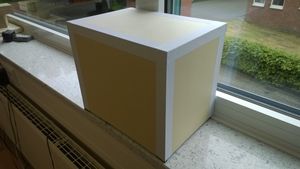
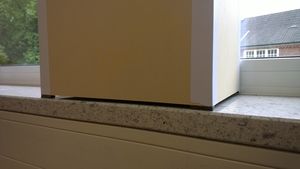
Question: If there are small horizontal gaps at the side edges, how is the covering of the bacteria decided?
Answer: The decisive factor for covering the bacteria is the view from above.
Question: Are the bacteria also directly next to the wall and can they interfere with the turning manoeuvre?
Answer: The bacteria are at least 40 cm away from the wall.
Question: Does the robot actually have to turn at the wall or is it allowed to drive backwards from the wall?
Answer: The rules refer to turning, the robot should turn round in a way that is recognisable from the outside.
Question: Does the robot have to touch the wall?
Answer: The turning wall is the turning point. This is only reached when the turning point or the turning wall is touched.
Question: Do the covered bacteria count a second time on the way back?
Answer: Yes. Amoebae that manage the return journey after the outward journey and the correct turn can "eat" the bacteria again, i.e. cover them up. A maximum of 24 points can therefore be scored.
About the ball pushing discipline
Question: How is the score awarded if the robot has to be picked up for the third time (e.g. because it threatens to fall down)?
Answer: The robot may not be put back again, the points scored are counted and the time is counted as 121 seconds. If a robot threatens to fall off the plate, it must always be reset.
Duel discipline The seesaw
Question: Does a duel end immediately if a team is disqualified?
Answer: No, the other team plays the duel to the end. (Reason: See next question.)
Question: How is the order determined after the preliminary round?
Answer: Each duel won is awarded one point. The number of points is decisive for the order. The average number of stones on your side of the seesaw at the end of a duel is used as a secondary criterion. If this is also the same, the direct duel decides.
Note: There will probably be 6 preliminary round groups. The first team from each preliminary round group will qualify for a mini-intermediate round. The first two teams there will play in the final, while the second two teams will compete for third place. The other places in the overall ranking will be determined by the points scored and the lower-ranking criterion described above. If necessary, places are awarded twice.
Question: What happens if the seesaw ends up on the scales?
Answer: In the unlikely event of this happening, the referees will decide on the scoring for this duel.