Event archive
"Music history on the stage"
Past events organised by the Emmy Noether junior research group "Music History on Stage" can be found here.
Event archive
2020
Open-topic workshop of the Women's and Gender Studies Section of the Society for Music Research
Organised by the Women’s and Gender Studies Section of the GfM and University of Oldenburg
Date and venue: 5–7 June 2020, online
The workshop is intended to offer all academics working in the field of musicological gender studies, or those interested in the subject, the opportunity to present and discuss their research projects and findings, with early-career researchers (doctoral candidates and postgraduate students) are just as welcome as established colleagues – the aim is not to organise a conference exclusively for early-career researchers, but rather a discussion forum bringing together people of different genders and generations. Participants do not need to be members of the specialist group.
The specialist group’s open-topic workshop offers the opportunity, within a relatively small yet diverse and experienced circle, to bring new topics, methods or fresh ideas up for debate, and furthermore to exchange views on current trends and positions within gender studies in musicology.
Contributions on topics and/or methods from all areas of musicology are welcome.
Dr Cornelia Bartsch (University of Oldenburg): and
PD Dr Katharina Hottmann (University of Hamburg): katharina.hottmann@baumgart-hottmann.de
2016-2019
Strandrecht, opera after Ethel Smyth, at the Lichthoftheater in Hamburg Bahrenfeld
Scientific support: Cornelia Bartsch and Kerstin Prick
Audience discussion with Cornelia Bartsch after the premiere on 06.12.2019 and after the last performance on 14.12.2019.
Guests from Sea-Wach and RESQSHIP will be present on 14 December.
An interview with the director Kerstin Steeb can be found here.
Series of lectures
Musical Systems of Knowledge
Concept: Dr Cornelia Bartsch, Dr Anna Langenbruch
Summer semester 2018, Mondays, 6.00 pm
, University of Oldenburg, Library Hall
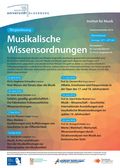
The series of lectures examines how knowledge is produced, recognised, stored and disseminated. At the centre are references between music and knowledge, but also more general questions about artistic, popular and academic knowledge. We are primarily concerned with different categories of musical knowledge, in particular the ordering functions that historiography and gender, ethnicity, nationality and genre (e.g. music theatre) or media (body, writing, image, music) take on.
| 09.04.2018 | PD Dr Stephanie Schroedter (University of Heidelberg) |
| 23.04.2018 | Dr Sarah-Maria Schober (University of Basel) |
| 07.05.2018 | Prof. Dr Thorsten Logge (University of Hamburg) Klios Medien - Ausführungen und Aufführungen von Geschichte in der Öffentlichkeit |
| 14.05.2018 | Dr Talia Bachir-Loopuyt (Université François-Rabelais Tours) Music, Culture and Knowledge: From ethnomusicology to the ethnography of musical worlds |
| 11.06.2018 | Prof. Dr Clemens Risi (University of Erlangen-Nuremberg) Affects, emotions and body knowledge in 17th and 19th century opera |
| 18.06.2018 | Prof Dr Signe Rotter-Broman (Berlin University of the Arts) Music - Science - History: International exhibitions and musical orders of knowledge in the late 19th century |
| 25.06.2018 | Prof. Dr Annegret Huber (University of Music and Performing Arts Vienna) Values | Truth | Value judgement. Orders of knowledge through structural analyses of music from a feminist perspective Attention! Room change: The Smart House Oldenburg, Schlossplatz 16, Oldenburg |
An event of the Institute of Music (Department of Cultural History of Music; Emmy Noether junior research group "Music History on Stage") in co-operation with the Research Training Group "Self-Formations", the Centre for Interdisciplinary Women's and Gender Studies and the Research Centre "Genealogy of the Present".
International Symposium
"Beethoven's Legacy": With Beethoven in exile
Concept: Dr Anna Langenbruch (University of Oldenburg), Dr Beate Angelika Kraus and Prof. Dr Christine Siegert (Beethoven-Haus Bonn)
01-03 March 2018
Beethoven-Haus Bonn
Transcultural multiple affiliations:
Spaces, Materialities, Memories
International and interdisciplinary conference organised by DFG Research Training Group 1608/2 and the Centre for Contemporary Genealogy
University of Oldenburg, 4–6 February 2016
Concept and organisation: Prof. Dr Dagmar Freist, Prof. Dr Sabine Kyora and Prof. Dr Melanie Unseld
How affiliations influence (self-)perception
How do I perceive myself, and where do others situate me? Social self-perception and the perception of others are often shaped by affiliations with groups, associations, a religion or similar. An international conference (flyer) at the University of Oldenburg from 4 to 6 February will explore the question of how multiple affiliations in different cultures (see also abstract) affect self-positioning. The presentations will explore how individuals situate their sense of self within various time-space dimensions that can be experienced in parallel, albeit offset in time and space. They will examine how people cope with ruptures, and how they experience, shape and address multiple affiliations. This also involves the loss or transformation of the meaning of affiliations, for example across generations. Following the conference, workshops will be held for early-career researchers, who will be able to explore these and other questions in greater depth based on their own research. The conference is a joint event organised by the Research Training Group ‘Self-Formations: Practices of Subjectivation from a Historical and Interdisciplinary Perspective’ and the university’s Centre for Contemporary Genealogy.
2012-2015
Conversation concert
Women playing music, clinking glasses, hissing cats, whistling kettles and annoyed husbands - is this what it was like in aristocratic and bourgeois parlours in England around 1800? Or rather, is that what it sounded like? The music of the opera houses and concert halls in the musical metropolises of the period around 1800 has been well researched, in contrast to the questions about domestic musical culture. Who played? What was played? Who listened? In a discussion concert, Prof Dr Melanie Unseld explores this question using caricatures by the English caricaturist James Gillray (1756-1815). Music plays an interesting and prominent role in these caricatures: neither the prima donnas of the time nor the glee club visitors were safe from Gillray's sharp pen. "Delights of Harmony"? - Probably not always. Compositions from this musical culture are performed to bring the caricatures to life: Sonatas and rondos by Johann Baptist Cramer, Veronica Cianchettini and Franziska Lebrun, ballads by Mrs Robert Arkwright and others: Brigitte Heuser (mezzo-soprano), Julia von Hasselbach (violin) and Elisabeth Reda (harpsichord).
THE DELIGHTS OF HARMONY
English salon culture around 1800
A dialogue concert with Melanie Unseld and Brigitte Heuser (mezzo-soprano), Julia von Hasselbach (violin), Elisabeth Reda (harpsichord)
Friday, 17 October 2014, 8 pm
The Haus des Hörens, Marie-Curie-Straße 2, 26129 Oldenburg
Organiser: Förderverein Haus des Hörens e.V.
Admission: 14 euros, reduced 10 euros
In co-operation with the research centre Music and Gender, Hanover University of Music, Drama and Media
Supported by the Mariann Steegmann Foundation
Wagner - Gender - Myths
In co-operation with the Oldenburg State Theatre
15 to 17 November 2013, Exerzierhalle Oldenburg
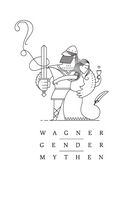
The "suffering, self-sacrificing woman", the "true knowing saviour", the "woman of the future" - Richard Wagner's writings and his music dramas are full of mystifications of the feminine. Similarly, the male counterpart, transformed into a virile heroic type or idealised as a genius artist. If one reviews these mythifications, it becomes clear that Wagner was fundamentally preoccupied with the relationship between the sexes.
Outcast and in the middle. Lectures and discussions on Leoš Janáček's "Katja Kabanová"
In co-operation with the Staatstheater Oldenburg
11. May 2012, Exerzierhalle Oldenburg
What must happen for a person to become an outsider in the midst of society? Leoš Janáček's operas repeatedly revolve around this question and it is also at the centre of his opera Kátja Kabanová. Lectures by academics from the University of Oldenburg and the Hanover University of Music, Drama and Media will provide insights into the opera's literary and musical background. In a round table discussion led by students from the University of Oldenburg, together with the director Lydia Steier and the musical director Thomas Dorsch, various aspects of the work and production will be examined in the context of our new production of Kátja Kabanová. With lectures by Prof. Dr Melanie Unseld (Musicology/Univ. Oldenburg), Prof. Dr Gun-Britt Kohler (Slavic Studies/Univ. Oldenburg) and Prof. Dr Stefan Weiss (Musicology/HMTM Hannover). A free event for anyone interested in opera and students.
In co-operation with the University of Oldenburg.
International musicology conference focussing on Helen Buchholtz and Lou Koster
In co-operation with the Cid femmes Luxembourg, the Cedom/Bibliothèque Nationale du Luxembour and the Centre de Rencontre Culturel Neumünster
4-5 May 2012, Salle José Ensch and Salle Robert Krieps, Luxembourg
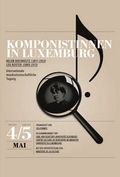
Concept and direction: Danielle Roster (Luxembourg) and Melanie Unseld (Oldenburg). The contributions to the conference will be published in 2013 in the series Music - Culture - Gender.
Further information
2008-2011
Transcultural Music Education Symposium
23/24 September 2011, Institute for Music, University of Oldenburg
Anecdote - Biography - Canon
19-21 March 2009, Swiss National Library, Bern, Centre Dürrenmatt Neuchatel
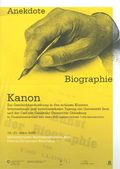
On historiography in the fine arts.
International and interdisciplinary conference organised by the University of Bern and the University of Oldenburg in cooperation with the Swiss Literary Archives.