Wagner gender myths
Wagner gender myths
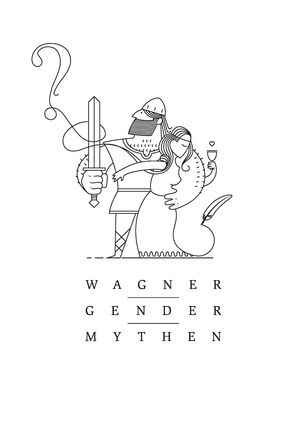
The "suffering, self-sacrificing woman", the "true knowing saviour", the "woman of the future" - Richard Wagner's writings and his music dramas are full of mystifications of the feminine. Something similar can be said about the male counterpart, transformed into a virile heroic type or idealised as a genius artist. If one reviews these mythifications, it becomes clear that Wagner was fundamentally preoccupied with the relationship between the sexes. The reception of Wagner has also long (and in comparison with other opera composers of the 19th century particularly explicitly and frequently) focussed on gender: both "women around Wagner" as well as female Wagner singers and the female characters in Wagner's works are at the centre of attention.
As constant as the focus is on the "woman" or "women around Wagner", the (implicit) adherence to an essentialist concept of gender obscures the essential: Wagner's continuous struggle for the relationship between the sexes, which took place against the backdrop of the idea of gender dualism. In his music dramas and in his writings, Wagner repeatedly took up what was current in contemporary thinking about gender dualism and heroism. And vice versa, his music dramas in particular were also understood as an artistic remodelling of these very ideas.
But questions remain: do the myth of the "woman" and the myth of the "hero" in Wagner really relate so clearly to the gender dichotomies of the 19th century? And how are the two related to each other? (How) were contemporary singers able to deal with these mythisations on stage and in real life? And what impact did these ideas have on the composer's marriage and family life? What images were created of him and his partners? Why was Wagner so influential in these mythisations, not least for Hollywood films? And how do we view these myths today?
The international and interdisciplinary symposium "Wagner - Gender - Myths" focuses on the mythicisation of women, heroes and artists. Contributions from the fields of musicology, history, medieval studies, English studies and cultural journalism shed light on these questions from different perspectives and offer an open view of the topic. The symposium will focus on Wagner's "Tristan and Isolde", which will be staged at the same time in a new production at the Oldenburg State Theatre under the direction of Alexander Müller-Elmau.
Speakers
Panel I: Myths and their representations: Artist - Hero - Woman
Melanie Unseld (Oldenburg) - Kordula Knaus (Graz/Bologna) - Anno Mungen (Bayreuth) - Barbara Eichner (Oxford)
Panel II: Artists and Family
Monika Wienfort (Berlin) - Dagny Beidler (Zurich) - Christine Fornoff (Oldenburg) - Beatrix Borchard (Hamburg) - Gesa Finke (Cologne)
Panel III: The "mystical pit": Tristan and Isolde
Albrecht Hausmann (Oldenburg) - Eva Rieger (Liechtenstein) - Thomas Seedorf (Karlsruhe) - Elisabeth Bronfen (Zurich)
Panel IV: Modern re-mythicisations
Christine Lemke-Matwey (Berlin) - Anna Langenbruch (Oldenburg) - Dietrich Helms (Osnabrück)