Contact

Press and Communication

+49 (0) 441 798-5446

News feed of the news

https://uol.de/en/news/rss (XML)
Copy address and paste into feed reader

News articles

News search

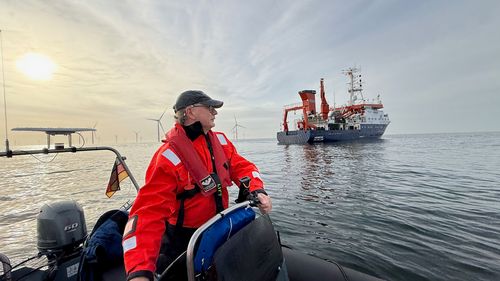
A man wearing a life jacket, an orange high-visibility jacket and a peaked cap is at the helm of a large inflatable boat. The water is relatively calm; in the background on the right is the research vessel Heincke, on the left a few wind turbines a little further away, and the setting sun, which bathes the scene in a golden light.
Thomas Badewien
Research Energy Top News Marine Sciences

Amidst the waves and wind turbines

A special research expedition recently took a team from Oldenburg to a stretch of sea north of Heligoland. The researchers had to overcome some unusual challenges amongst the huge turbines of an offshore wind farm.

more: Amidst the waves and wind turbines
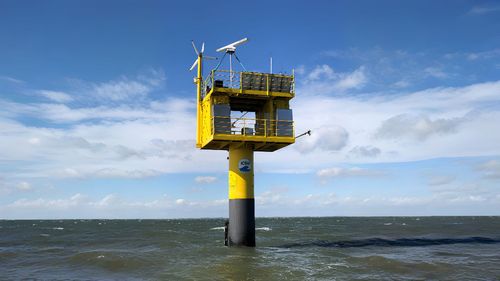
The picture shows the measuring pole in the sea; the sky is blue with a few clouds. The container is at the top of the pole. It has an open area in the middle, and there are several measuring instruments on the roof.
University of Oldenburg / Thomas Badewien (original photo enlarged using AI)
Research Top News Marine Sciences

Monitoring station off Spiekeroog is being replaced
Since 2002, a permanent monitoring station run by the university has been continuously collecting key environmental data between Langeoog and Spiekeroog. This year, the unique research facility is going to be replaced.

more: Monitoring station off Spiekeroog is being replaced
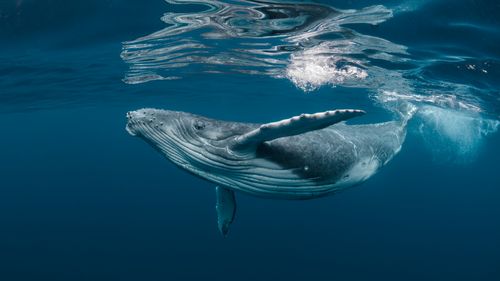
Humpback whale underwater
Adobe Stock / Craig Lambert Photo
NWA EXU Excellence Strategy Top News Marine Sciences

Marine Conservation on the High Seas

The UN High Seas Treaty came into force in January, raising questions over where protected areas should be established by 2030. Researchers from the universities of Oldenburg and Bremen are investigating this in the AGELESS project.

more: Marine Conservation on the High Seas
A person is wearing diving equipment and is diving in a coral reef.
Paula Hernandez
Research Top News Marine Sciences Marine Science

Propagating corals on the other side of the world

Coral reefs are dying all over the world. Is it possible to artificially reproduce marine animals in order to reforest reefs? Doctoral candidate Laura Fiegel travelled to the island of Moorea in the middle of the South Pacific for three months to conduct field experiments.

more: Propagating corals on the other side of the world
The image shows the Southern Ocean. The sea and sky are grey and there are lots of ice floes drifting on the sea, as well as a single jagged iceberg made of blue glacier ice.
Johann Klages / AWI
Research Top News Marine Sciences

Unexpected feedback in the climate system

Low algal growth despite high iron supply: Study uncovers surprising link between West Antarctic Ice Sheet retreat and the growth of marine algae over the past 500,000 years.

more: Unexpected feedback in the climate system
University of Oldenburg / Constanze Böttcher
Research Excellence Strategy Top News Marine Sciences

Oldenburg marine research on a joint mission

One university, two marine research institutions, one shared goal: a healthy ocean. An interview with Katharina Pahnke, Director of the Institute for Chemistry and Biology of the Marine Environment, ICBM, and Helmut Hillebrand, Director of the Helmholtz Institute for Functional Marine Biodiversity,…

more: Oldenburg marine research on a joint mission
A sandy area with green vegetation in the middle.
Oliver Zielinski/ University of Oldenburg
Top News Marine Sciences Marine Science

Biodiversity in the Wadden Sea: DynaCom project enters final phase

„DynaCom” aims to expand our understanding of biodiversity on islands. The German Research Foundation (DFG) is funding the project for another two years.

more: Biodiversity in the Wadden Sea: DynaCom project enters final phase
Sinikka Lennartz stands on a stage and holds a large, framed certificate in her hands. Falko Mohrs stands next to her, a screen with the Science Prize logo in the background.
MWK / Henning Scheffen
Excellence Strategy Top News Marine Sciences

The ocean in equations

Geoscientist Sinikka Lennartz has been awarded the Lower Saxony Science Prize for Early Career Researchers. She translates microscopic processes in the oceans into mathematical equations – and incorporates them into global Earth System Models.

more: The ocean in equations
Antarctic Krill
Carsten Pape
Top News Marine Sciences

Protect krill in Antarctica

If krill swarms in Antarctica shrink, this will have immediate consequences for many animal species. A team led by scientist Bettina Meyer is proposing a new concept for sustainable management, in close cooperation with fisheries.

more: Protect krill in Antarctica
Ein junger Hering schwimmt durch Wasser.
Foto: Ture Tempelmann
Research Top News Marine Sciences Marine Science

Pollutants in the Wadden Sea: researchers develop analysis tool

Pollutant levels in fish in the Wadden Sea are increasing. Researchers are developing a software tool that analyses the interactions between fish and pollutants and can be used for nature conservation projects.

more: Pollutants in the Wadden Sea: researchers develop analysis tool
Atlantic, hydrothermal vents, MARUM-QUEST, marine engineering / technology, Mid-Atlantic Ridge, ocean floor, sampling, black smoker, diving robots / ROV, deep sea
MARUM – Center for Marine Environmental Sciences, University of Bremen.
Excellence Strategy Marine Sciences

Iron’s Irony

A new review highlights how hydrothermal vents on the seafloor shape iron availability and influence the global oceanic element cycles. Researchers from Bremen and Oldenburg are involved. 

more: Iron’s Irony
A sea turtle swims underwater, half hidden behind some corals just above the sandy seabed.
Jan-Claas Dajka
Research Top News Marine Sciences

"Global policy is catching up with science"

The global biodiversity targets adopted in 2022 are aligned with science and represent a major advance on the Aichi Targets adopted in 2010, an international research team reports in the journal Frontiers in Ecology and the Environment.

more: "Global policy is catching up with science"
Photo of the Wadden Sea: clusters of oysters, small pools and silt form a varied mosaic.
University of Oldenburg / Daniel Schmidt
Research Excellence Strategy Top News Marine Sciences

Change in the Wadden Sea

Biodiversity in the Wadden Sea has undergone a noticeable reorganisation since the middle of the last century, according to a new study. Researchers from Oldenburg and Groningen have analysed biodiversity using a holistic approach for the first time.

more: Change in the Wadden Sea
Underwater image of a coral reef, showing various large and small corals of different shapes. Most of them are white and not coloured as usual.
Adobe Stock / The Ocean Agency
Research Excellence Strategy Top News Marine Sciences

Buying time for threatened coral reefs

A new paper published in Science by a team including ecologist Iliana Baums urges regulatory reform to accelerate coral restoration using assisted gene flow – an essential step to safeguard the economic and ecologic services that reefs provide. 

more: Buying time for threatened coral reefs
Oliver Wurl
Research Top News Marine Sciences

"You need to improvise at sea"

A team led by marine researcher Oliver Wurl is travelling the Atlantic on the research vessel Meteor. Four team members talk about life on board, the top millimetre of the ocean and working with a television crew.

more: "You need to improvise at sea"
The picture shows Gudrun Massmann. She stands in a laboratory at a glass model box filled with sand. She has put her arm on the box and is smiling at the camera.
University of Oldenburg / Markus Hibbeler
Research Top News Marine Sciences Biology

Research on sandy beaches is being expanded internationally

The German Research Foundation is funding the „DynaDeep” project by Oldenburg hydrogeologist Gudrun Massmann with around five million euros for a further four years. A large part of the research will take place on Spiekeroog.

more: Research on sandy beaches is being expanded internationally
Blick auf den Meeresboden, wo die Mikroben weiße, schwarze und orangefarbene Flächen bilden, die wie kleine Vulkankegen aussehen.
MARUM - Centre for Marine Environmental Sciences, University of Bremen (CC-BY 4.0)
Research Excellence Strategy Top News Marine Sciences

Why so many microbes fail to grow in the lab
Microbial ecosystems have tipping points where even small perturbations are enough to cause a collapse, according to a new study. Tom Clegg and Thilo Gross describe microbial communities as a network based on the exchange of metabolic by-products. 

more: Why so many microbes fail to grow in the lab
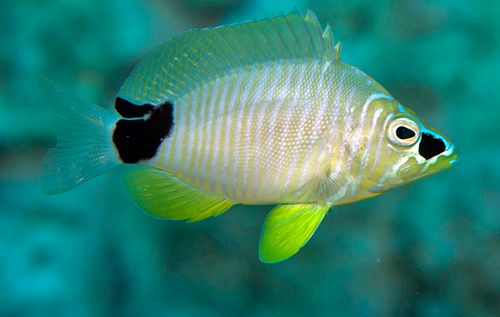
     Close-up of a yellow, black and white patterned fish swimming in a tropical sea.
I. Dominguez
Research Top News Marine Sciences

New fish species discovered in the Gulf of Mexico

Researchers led by Oscar Puebla have described a new species of fish in the Gulf of Mexico. The brightly patterned creature, Hypoplectrus espinosai, belongs to the hamlet group. The team published their findings in the journal Zootaxa.

more: New fish species discovered in the Gulf of Mexico
The picture shows the seabed in the deep sea. The greyish sediment is partly covered by yellow sulphur crusts. There are some glass tubes in the bottom, which are labelled with plastic strips and numbers.
WHOI Alvin group
Research Excellence Strategy Marine Sciences

New study on natural oil seeps in the deep sea

What is the role of hydrothermal vents in the cycle of dissolved organic matter in the ocean? Researchers from the Universities of Bremen and Oldenburg have analysed samples from the Guaymas Basin in the Gulf of California.

more: New study on natural oil seeps in the deep sea
Portrait of a young woman with long hair in front of a blurred green background.
University of Oldenburg / Daniel Schmidt
Excellence Strategy Top News People Marine Sciences

Sinikka Lennartz awarded Heinz Maier-Leibnitz Prize

For the first time, the most prestigious award for early-career researchers goes to an Oldenburg scientist: geoscientist Sinikka Lennartz receives the Heinz Maier-Leibnitz Prize for her computational modelling of organic carbon in the oceans.


more: Sinikka Lennartz awarded Heinz Maier-Leibnitz Prize
(Changed: 01 Oct 2026)  |  Kurz-URL:Shortlink: https://uol.de/p60209en
Zum Seitananfang scrollen Scroll to the top of the page

This page contains automatically translated content.