
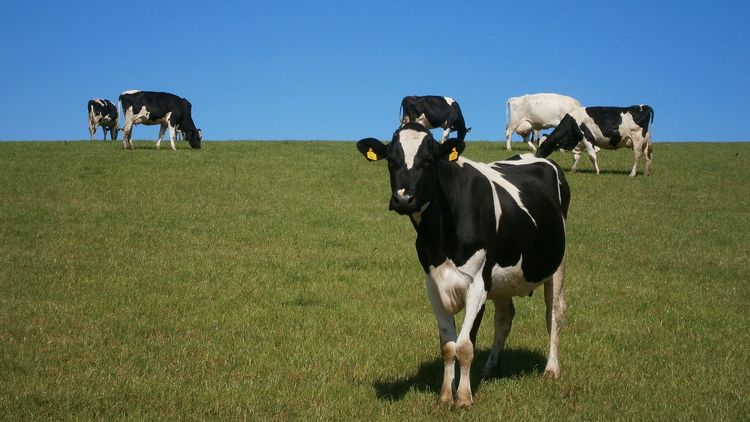

More intense drought in summer, more precipitation in winter, more frequent heavy rainfall - how can the water balance in grassland regions still be balanced? This is one of the questions being investigated by researchers from Oldenburg in a new joint project.
Grassland serves as a source of fodder for livestock, provides a natural habitat for plants and animals, offers us humans space for leisure and recreation and, at best, promotes climate protection. Grassland not only provides these diverse ecosystem services, but also characterises the landscape of the northwest German coastal region. Researchers from the University of Oldenburg and other scientific institutions in the state want to help preserve this cultural landscape and its many benefits in the face of a changing climate in the new joint project "Future Proof Grasslands". The project, led by the Grassland Centre Lower Saxony/Bremen, was recently launched and will run until autumn 2027.
"The ecosystem functions and services as well as the associated forms of use of grassland are acutely threatened by climate change," says geographer and deputy project spokesperson Prof Dr Ingo Mose from the University's Institute of Biology and Environmental Sciences. Current climate modelling predicts higher winter precipitation, more pronounced droughts in summer, more frequent heavy rainfall and a rise in sea level for the coastal region in the northwest. "Even a glance at the weather over the past five years makes the trend impressively clear," says Mose.
Regions such as East Frisia or the Wesermarsch, on which the project is focussing, are facing new problems and challenges for both coastal and inland protection. How can water management be successfully implemented there that includes not only drainage in the event of excess water but also proactive water retention to prevent shortages during periods of drought? How can sufficient water be stored throughout the region so that the water bodies can still absorb additional water in the event of sudden heavy rainfall?
The project team wants to find answers to these questions together with local agricultural businesses, water management, tourism, coastal and nature conservation as well as politics and local government. In addition to the Grassland Centre and the University of Oldenburg, the project team includes the University of Göttingen, Osnabrück University of Applied Sciences and the Jade University of Applied Sciences Oldenburg-Wilhelmshaven-Elsfleth, as well as the Thünen Institute and the State Office for Mining, Energy and Geology.
In addition to the "Applied Geography and Environmental Planning" working group headed by Mose, researchers from the "Ecological Economics" working group headed by Prof Dr Bernd Siebenhüner and the "Hydrogeology and Landscape Water Management" working group headed by Prof Dr Gudrun Massmann are also involved at the University of Oldenburg. The Lower Saxony Ministry of Science and Culture is funding the project with a good 5.1 million euros from the SPRUNG ("Top-level research for Lower Saxony") programme.


