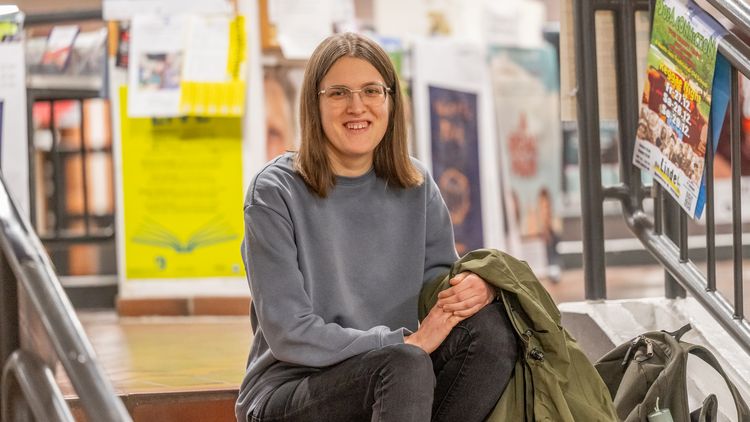

She loves languages and cultures, but also has a pronounced weakness for numbers: First-year student Johanna van Koningsveld became German champion in calendar arithmetic in December.
"Oh, you're not studying Maths or Computing Science?" Johanna van Koningsveld's choice of subject - Slavic and Dutch Studies at the University of Oldenburg - has recently been regularly astounding her competitors. The 21-year-old regularly and very successfully competes in maths competitions, such as the German mental arithmetic championships in Reken, North Rhine-Westphalia, in December. Among the participants, those with a relevant educational background are in the majority: "Many of them do something related to Computing Science," she says.
For her, it is not a contradiction to go in a completely different direction in her studies. In addition to maths, she simply loves languages and cultures, says Johanna. It was obvious to the Emden native that she wanted to study Dutch studies: "My home is close to the border, I also have ancestors from the Netherlands and I learnt the language at school." An exchange was also a lot of fun for her and sparked further interest in the neighbouring country, its language and culture. As a newly enrolled Slavic studies student, she has also "now started studying Polish, which I really like".
Johanna doesn't know whether her proven speed arithmetic skills make language learning easier in any way. But at least the maths training can be combined well with her studies: "I often train in between, whether on the bike to university or between two seminars." She uses an app that repeatedly generates tasks with random numbers - or car licence plates in traffic, for example - to provide her with numerical training material. "You can square them again and again, take roots or break them down into prime factors," she says.
Johanna's favourite discipline, however, is calendar calculation. So it doesn't interrupt the flow of conversation to ask her from time to time what day of the week the university was founded on 5 December 1973: "That was a Wednesday," she says without any hesitation. And 3 October 1991, when the university celebrated the naming of the university after Nobel Peace Prize winner Carl von Ossietzky in an official ceremony? "That was a Thursday."
Her training and, above all, her rapid identification of the days of the week paid off once again in December at the German Mental Arithmetic Championships: Johanna gave the correct day of the week for 98 out of 100 possible calendar entries within five minutes and became German champion - together with a competitor. She also came third in mental arithmetic, which combines several disciplines, somewhat to her own surprise. A few months earlier, she had come seventh in calendar arithmetic at the mental arithmetic world championships, making her the best participant from Germany.
Her passion for arithmetic is no coincidence: "My father is also a mental calculator and taught me just about everything," says Johanna. "I just enjoyed it, but I didn't practise much on my own before." Now that she's a student, she trains every day, spending an hour a day on calendar calculations alone. She also has a talent for drawing and enjoys making music, "but mental arithmetic - especially calendar maths - is now the hobby I focus on". Calendar maths also works for the future, of course. The university's 100th birthday on 5 December 2073? "That falls on a Tuesday."