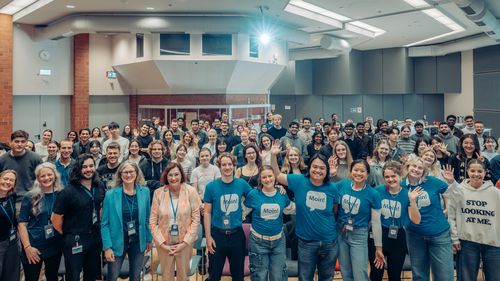
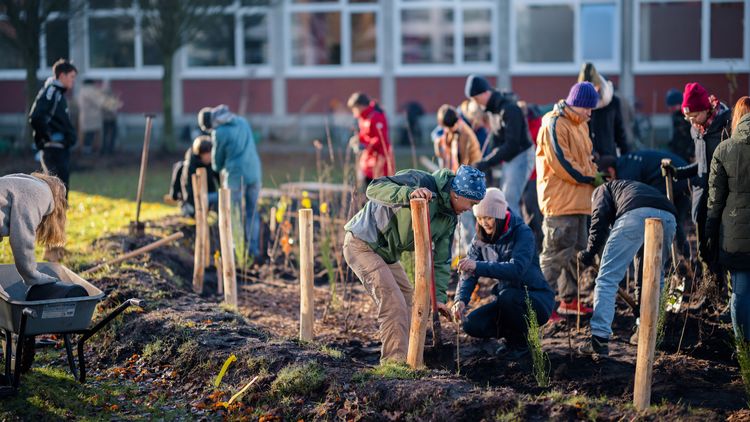

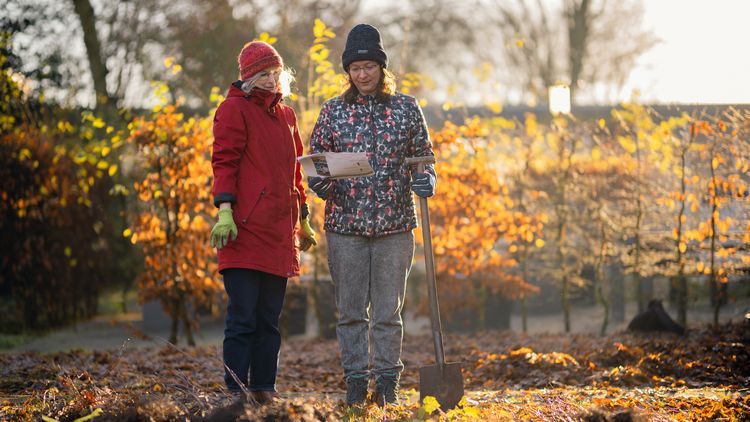
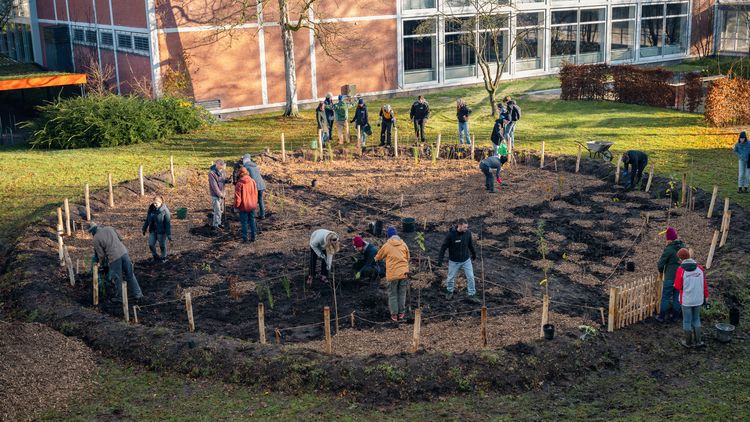


Around 40 members of the university - including many students - planted new trees together on the Haarentor campus at the end of November in icy temperatures and glorious sunshine. The campaign was initiated by the climate protection management team.
Digging planting holes, spreading mulch, sinking fence posts into the ground - the tasks involved in the planting campaign were many and varied. In total, the helpers planted a good 450 seedlings in the ground in an area of around 180 square metres between buildings A7 and A10. Native species such as English oak, red alder, hornbeam, hazel, small-leaved lime, bog birch, rowan and ash will grow into a small forest here over the next few years.
The "Tiny Forest" was planned by Anna Krämer, the university's climate protection manager. The aim is for the tiny forest to provide more biodiversity and a better microclimate and also contribute to climate adaptation. It is designed according to the so-called Miyawaki method, named after the Japanese plant sociologist Akira Miyawaki: at least 20 native species are planted in a small area, three plants per square metre. Within a few years, a small biotope with a high level of biodiversity develops. "At the beginning, we still have to look after the plants, but after around two to three years, the area is left to its own devices," explains Krämer. In Lower Saxony, the university is one of the first with its Tiny Forest. "Universities have only recently started using this method to design their spaces," she reports.
The Tiny Forest is also intended to improve the quality of life on campus: a path runs through the centre of the circular area and there will be benches to sit on in the future. The university has also expanded the classic Tiny Forest concept to include fruit trees and berry bushes such as apples, pears, raspberries, blueberries and redcurrants - visitors to the campus can snack in summer and come into direct contact with the microforest.
Students and staff from the neighbouring Institutes are particularly pleased about the enhancement of the open space. "I can look out over the forest from my office, so I'm delighted to be here today," says a member of staff from the Department of Psychology. Other participants are passionate gardeners or simply want to help shape the campus. Krämer is particularly pleased that so many international students are taking part.
The great response to the campaign and the many volunteers who took part motivate the climate protection manager: "We will be organising campaigns like this from time to time in the future, even if they are not quite as big." Next year, for example, members of the university can take part in nest box maintenance or mapping breeding birds. The next opportunity for university members and Oldenburg residents to dig in the soil together will probably be next summer, when the Haarenniederung will be cleared of invasive species on a day of action organised jointly with the city.