

How is a price created by supply and demand? How do people make economic decisions? How can social dilemmas be explained? Pupils, students and teachers can explore these and similar questions in the "Oldenburg Experimental Laboratory for Economics Education".
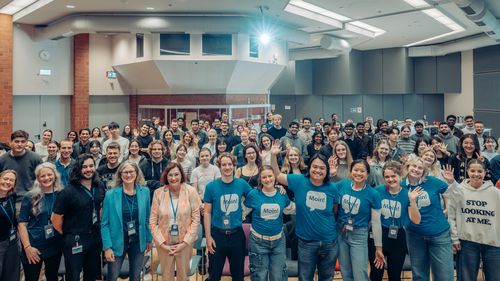
A Monday afternoon at the end of January: every seat in a laboratory room in building A03 is already taken. Around 25 students sit tightly packed at white tables. There is nothing to suggest that an experiment is about to take place here. "We don't have any bangs, no Bunsen burners and no test tubes," says Markus Allbauer-Jürgensen, research assistant at the Institute of Economics Education.
Instead, the "Oldenburg Experimental Laboratory for Economics Education", or OX-Lab for short, is all about decisions and social dilemmas. In the experiments that take place here, participants negotiate, for example, the price of apples, they have to consider what they want to use certain amounts of money for or how many fish they can take from a pond without jeopardising the stock.
Founded in 2018, the OX-Lab with its 30 tablet-supported and visually protected individual workstations is one of the so-called Oldenburg Teaching-Learning Spaces (OLELA) and was set up as part of the OLE+ project. The federal and state governments are funding this project as part of the "Quality Offensive Teacher Training" programme. The aim is to prepare student teachers even better for their academic appointments. As one of the first experimental laboratories for Economics Education in Germany, the OX-Lab fulfils several functions: It is an extracurricular place of learning that is visited by school classes, it also serves teacher training and is a place for specialised didactic research. Above all, however, students can familiarise themselves with economic experiments as a teaching method and design new experiments themselves.
Prospective teachers learn how economic experiments can be used in the classroom
"Experiments have been used in economic research since the 1960s, for example to test certain theories. They are not yet widely used as a teaching method in German schools," reports Prof Dr Dirk Loerwald. Apart from Oldenburg, there are only a few locations in Germany where experimentation in economics lessons is systematically integrated into teacher training, according to the scientific director of the OX-Lab.
Today, in the seminar entitled "Didactics of Economics Education II", student teachers Carlo, Christian, Jan-Philipp and Johann are trying out for the first time how a complex problem such as the influence of the shortage of skilled workers on the labour market can be presented to a class in a playful way. To do this, they developed an experiment themselves in which the fellow students present took part.
"You either represent a company that is looking for workers or you are applicants," explains Jan-Phillip. "Everyone is given a card with information about their role." In brief interviews, the two parties either agree on a position - or the skilled workers move on to the next interview. The number of vacancies changes in each round. After the second round, it becomes clear that the ratio of applications to vacancies determines how many interviews are successful, how high the wages are and how negotiations are conducted.
"Experiments often create an 'aha' effect for the participants," reports Loerwald. For example, curves and tables can be used to teach students how the market economy works - or by letting them negotiate prices themselves. Over several rounds between suppliers and consumers, an equilibrium price usually emerges and the "famous invisible hand of the market" becomes visible, says Loerwald. However, as the labour market experiment shows, the method also helps to classify results and transfer them to real-life contexts.
What air pollution has to do with the prisoner's dilemma
Dilemma situations in which individual and collective interests diverge can be illustrated by experiments from game theory, for example. The so-called prisoner's dilemma is famous. This refers to situations in which a collectively desired state is not achieved because it is more attractive from an individual perspective not to co-operate. "The results can be transferred very well to environmental problems such as air pollution or overuse of resources," says Allbauer-Jürgensen.
The advantage of classroom experiments is that they don't take long and arouse curiosity. Background knowledge and technical terms, on the other hand, can often be better conveyed using other methods. "Experiments are therefore usually at the beginning of a series of lessons," explains Loerwald. Many of the ideas developed in the OX-Lab can be implemented by teachers in the classroom with reasonable effort, say the Oldenburg business didactics experts. To make this work, they provide instructions and teaching materials that can be used without digital aids if required. "In training courses, teachers are often totally enthusiastic about the new method," adds Loerwald.
The students also enjoy their experimental seminar - although it is not always easy to break down complex topics into simple decisions. Carlo, Christian, Jan-Philipp and Johann have also experienced this. The seminar participants praise the four of them for the successful group dynamics - but also have suggestions as to how the reflection on the theoretical principles could be better guided following the experiment.