

Research profile
Research profile
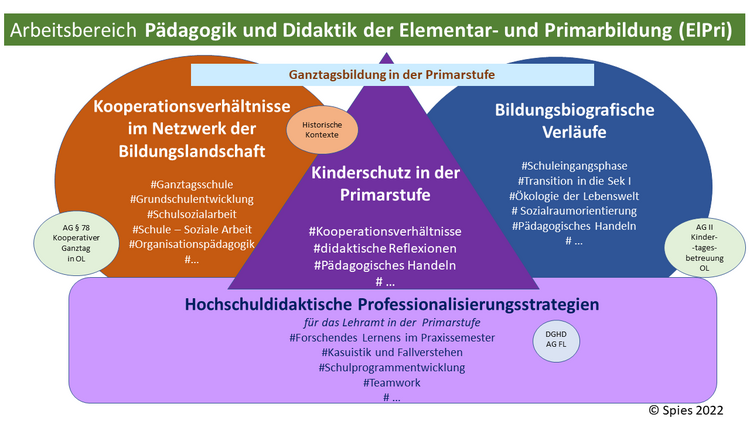
Co-operation relationships in the educational landscape network - all-day education at primary level
Social problems (differences/inequalities) and development requirements initiated by educational, social and labour market policies (all-day schools) are reflected in organisational development needs and measures that require concepts of educational action that go beyond the institutional tradition of differentiation. In the network of an educational landscape/educational region, school and socio-educational fields of action cooperate, among other things to reduce disadvantages in educational biographies that are dependent on origin, for example by conceptually integrating elementary education facilities into the school entry phase, implementing school social work or realising cooperative all-day formats. This is associated with changes in the development of learning cultures (structure of educational offers; didactic consequences) as well as the different subject-cultural maxims of professionalism (personnel development), which present cooperating educational settings as hybrid organisations with conceptual challenges in terms of pedagogical maxims and norms (dealing with differences and inequalities).
Publications
Spies, Anke (2024): Pedagogical responsibilities. Intergenerational search for clues in interdisciplinary discourse. Weinheim: Beltz Juventa.
Spies, Anke (2024): Cross-institutional co-operation in the primary school sector. In: Götz, Margarete/Hartinger, Andreas/Heinzel, Friederike, Kahlert, Joachim/Miller, Susanne/Sandfuchs, Uwe (eds.): Handbuch Grundschulpädagogik und Grundschuldidaktik. 5th fully revised and expanded ed. Bad Heilbrunn: UTB, pp. 135-140.
Spies, A. (2024): School social work in the all-day primary school. In: Flügel, A. et al (eds.): Grundschulforschung meets Kindheitsforschung reloaded (Jahrbuch Grundschulforschung, 28: Bad Heibrunn: Klinkhardt. S. ... https://doi.org/10.25656/01:31417
Wolf, Robert; Dunekacke, Simone; Spies, Anke; Eggert-Boraczynski, Julia (2024): The legal entitlement to all-day care in the field of multi-professional negotiation processes - starting points for co-operation? - In: Flügel, A. et al: Primary school research meets childhood research reloaded. Bad Heilbrunn: Klinkhardt, pp. 680-686.
Spies, Anke/Speck, Karsten/Steinbach, Anja (2023): School social work as an 'interface' in the action logics of an all-day primary school - On the dilemma between stabilisation mandate and school transformation. In: Zipperle, Mirjana/Baur, Katharina (eds.): Empirical facets of school social work. Weinheim: Beltz Juventa, pp. 234-248.
Spies, Anke/Wischmann, Anke (2023): The 'historical prototype' of an educational landscape. Coherence as a (primary) educational challenge in municipal education management. In: Brüggemann, Christian/Hermstein, Björn/Nikolai, Rita (eds.): Bildungskommunen. On the transformation of municipal policy and administration in the education sector. Weinheim: Beltz Juventa, pp. 33-52.
Spies, Anke (2022): Child protection at primary level. Professionalisation and school development needs. In: Education and Teaching, H. 3 - 4, pp. 272-282.
Spies, Anke (2018): School and social work. In: Graßhoff, Gunther/Renker, Anna/Schröer, Wolfgang (eds.): Soziale Arbeit. An elementary introduction. Wiesbaden: Springer VS, pp. 133-150.
Spies, Anke/Wolter, Jan (2018): The self-image of teachers in expectation of school social work. In: Miller, Susanne/Holler-Nowitzki, Birgit/Kottmann, Brigitte/Lesemann, Svenja/Letmathe-Henkel, Birte/Meyer, Nikolas/Schroeder, Rene/Velten, Katrin (eds.), Profession and discipline. Primary school pedagogy in discourse. Wiesbaden: Springer VS, pp. 230-236.
Pfahl, L./Edelstein, B./Spies, A. (2024): Educational systems, school development and pedagogical action as the subject of social science research. Wolfgang Edelstein in dialogue. In: Spies, A. (ed.): Pedagogical responsibilities. Interdisciplinary search for clues in the intergenerational discourse. Seven expert discussions (pp. 36-56) [Open Access]. Weinheim: Beltz Juventa.
Spies, A./Stecklina, G. (2024): The line of difference gender in the intra- and interdisciplinary debate on the requirements and conditions of the education system. Hannelore Faulstich-Wieland in dialogue. In: Spies, A. (ed.): Pädagogische Verantwortungen. Interdisciplinary search for clues in the intergenerational discourse. Seven expert discussions (pp. 57-79) [Open Access]. Weinheim: Beltz Juventa.
Spies, A./Chamakalayil, L. (2024): Migration society standardisation processes and requirements in the education system. Marianne Krüger-Potratz in conversation. In: Spies, A. (ed.): Pedagogical responsibilities. Interdisciplinary search for clues in the intergenerational discourse. Seven expert discussions (pp. 80-103) [Open Access]. Weinheim: Beltz Juventa.
Spies, A./Wunsch, R. (2024): Social space-orientated primary school development. Scientific theory formation and pedagogical practice in inter-institutional co-operation. Dietrich Benner in dialogue. In: Spies, A. (ed.): Pedagogical responsibilities. Interdisciplinary search for traces in intergenerational discourse. Seven expert discussions (pp. 104-124) [Open Access]. Weinheim: Beltz Juventa.
Spies, A./Speck, K. (2024): Social work and school. Pedagogical action in the cooperative relationship between social and school pedagogical institutions, professions and discursive analyses. Hans Günther Homfeldt in dialogue. In: Spies, A. (ed.): Pedagogical Responsibilities. Interdisciplinary search for clues in the intergenerational discourse. Seven expert discussions (pp. 125-144) [Open Access]. Weinheim: Beltz Juventa.
Spies, A./Bliemetsrieder, S. (2024): Interactions of social and professional developments in social and elementary educational discourses and fields of action. An interview with Maria-Eleonora Karsten. In: Spies, A. (ed.): Pedagogical responsibilities. Interdisciplinary search for clues in the intergenerational discourse. Seven expert discussions (pp. 145-163) [Open Access]. Weinheim: Beltz Juventa.
Spies, A./Wunsch, R. (2024): The genesis and reform history of SGB VIII as a basis for the development and organisation of socio-educational fields of action. An interview with Reinhard Wiesner. In: Spies, A. (ed.): Pedagogical Responsibilities. Interdisciplinary search for clues in the intergenerational discourse. Seven expert discussions (pp. 164-185) [Open Access]. Weinheim: Beltz Juventa.
Spies, A./Pfahl, L./Bliemetsrieder, S. (2024): Inclusions and omissions in pedagogical responsibilities. In: Spies, A. (ed.): Pedagogical responsibilities. Interdisciplinary search for clues in the intergenerational discourse. Seven expert discussions (pp. 215-227) [Open Access]. Weinheim: Beltz Juventa.
Spies, A./Prüshoff, H. (2023): Child protection in primary schools. Co-operation with the youth welfare system (Part I). Grundschule aktuell, Issue 164 (29-30).
Spies, A./Speck, K./Steinbach, A. (2023): School social work as an 'interface' in the action logics of an all-day primary school - On the dilemma between stabilisation mandate and school transformation. In: Zipperle, M./Maier, K. (eds.): Empirical facets of school social work. Weinheim: Beltz Juventa (234-248)
Spies A. (2018): School development. In: Bassarak, H. (ed.): Lexicon of school social work. Cologne: Nomos-Verlag (415-416)
de Boer, H./Fahrenwald, C./Spies, A. (2018): Professionalisation in Teacher Education As an Interorganizational Learning Challenge. Frontiers in Education, 3. doi.org/10.3389/feduc.2018.00004
Spies, A. (2017): Alliances with an inclusive mission - The co-operation of schools and youth welfare services in all-day schools. In: Budde, J./Dlugosch, A./Sturm, T. (eds.): (Re-)constructive inclusion research. Lines of difference - fields of action - empirical approaches. Opladen: Budrich Verlag (33-44)
Spies, A. (2017): Pedagogical action with reference to the line of difference gender - The position of school social work. In: Glockentöger, I./Adelt, E. (eds.): Gendersensible Bildung und Erziehung in der Schule. Grundlagen - Handlungsfelder - Praxis (Contributions to school development, pp. 85-98). Münster: Waxmann.
Spies, A. (2017): Gender as a structural category of professional action in school social work. In: Speck, K./Olk, T./Hollenstein, E./Nieslony, F. (eds.): Handbook of school social work (vol. 1, pp. 220-227). Weinheim: Beltz Juventa.
Spies, A./Knapp, K. (2016): School social work and educational child and youth protection. Challenges and perspectives in co-operation and networking. In: Federal Working Group for Child and Youth Protection (ed.): Youth protection goes to school! Child and youth protection as a task of school social work. Berlin: Bundesarbeitsgemeinschaft Kinder- und Jugendschutz e.V. (15-45)
Spies, A. (2016): In the field of tension between structural requirements, concept development and professional self-image - primary school and youth welfare on the way to a cooperative all-day setting. In: Lähnemann, C./Leuthold-Wergin, A./Hagelgans, H./Ritschel, L. (eds.): Professional co-operation in and with schools. Findings from practical research. Greifswald: MV-Verlag (117-130)
Spies /Stecklina 2015 Pedagogy
Spies, A. (2015): The transition from kindergarten to primary school - The time to set the course for starting lessons or mystified transition in the education system? In: Wetzel, K. (ed.): Public education in structural change. Upheavals, crisis zones, reform options (Research, Innovation and Social Work, pp. 33-52). Wiesbaden: Springer VS.
de Boer, H./Spies, A. (2014): Cooperation settings in the context of inclusive primary school development processes. In: Lichtblau, M./Blömer, D./Jüttner, A.-K./Koch, K./Krüger, M./Werning, R. (eds.): Forschung zu inklusiver Bildung - Gemeinsam anders lehren und lernen. Bad Heilbrunn: Klinkhardt (186-198).
Spies, A. (2014): Gender issues for inclusive (primary) school development - evidence for intersectional entanglements. In: Theurer, C./Siedenbiedel, C./Budde, J. (eds.): Lernen und Geschlecht (prolog - Theorie und Praxis der Schulpädagogik, vol. 22, pp. 68-88). Leverkusen-Opladen: Verlag Barbara Budrich.
Spies, A. (2013): Care in co-operation - Networked forms of care as an expression of municipal educational responsibility. In: Wolf, A./Dietrich-Daum, E./ Fleischer, E./Heidegger, M. (eds.): Child Care. Cultures, concepts and policies of external childcare. Weinheim, Basel: Beltz Juventa (66-79)
Spies, A. (2011): School absenteeism. In: Ehlert, Gudrun/Funk, Heide/Stecklina, Gerd (eds.): Wörterbuch Geschlecht und Soziale Arbeit. Weinheim: Juventa, pp.350-352.
Spies, Anke/Pötter, Nicole (2011): Social work in schools. Introduction to the field of school social work. Wiesbaden: VS Verlag für Sozialwissenschaften.
Spies/Stecklina ed. 2005 YH and school
Educational biographies
In the understanding of educational biographical research, educational biographies are socially meaningful constructions of subjects whose specific interpretation can be reconstructed with a view to the individual life course. Life-historical experiences with the structures and institutions of the educational system and the practice of pedagogical action are associated with coping with transitional requirements, which manifest themselves primarily at the transitions of the educational system (daycare centre - primary school - lower secondary level). The system-immanent conditions of the current education and upbringing system can be determined and the effects of pedagogical action can be reconstructed both from the perspective of the addressees and the professional perspectives of the actors and their professional biographical lines of development. The institutionalised conditions of educational trajectories and subjectivation processes determined in this way provide conclusions for the development of criteria for the assessment of pedagogical action, as well as the reproduction of difference and inequality relations as a consequence of this and consequently important information for the conception of university didactic settings to promote professionalisation processes.
Publications
Spies, Anke/Steinbach, Anja (2020). Education, biographicality and coping with life. In: Stecklina, Gerd/Wienforth, Jan (eds.): Handbook on Coping with Life and Social Work. Practice, theory and empiricism. Weinheim: Beltz Juventa, pp. 417-425.
Gerheim, U./Spies, A. (2017): Patterns of interpretation and pedagogical behaviour of teachers in the context of school career recommendations. In: Journal for Primary School Research ZFG 10(1), 63-75.
Spies, A./Rainer, H. (2016): The perpetuation of difference? - Counselling from an intersectional perspective. In: V. Fischer/M. Genenger-Stricker/A. Schmidt-Koddenberg (eds.): Diversity and disparity. Reference framework for social work in schools (Politik und Bildung, vol. 80, pp. 243-259). Bad Schwalbach/Ts: Wochenschau Verlag.
MENTOR PROJECT Balu and You
You can find more information here
And about the child protection centre in Oldenburg
With the mentoring project "Balu und Du" you can complete an internship for one year during your studies: You can find more information here
University didactic professionalisation strategies in the first phase of teacher training (research-based learning; casuistry; curriculum development)
In addition to research-based learning settings, casusitic approaches and structured curriculum development processes are seen as promising didactic and structural strategies for promoting professionalisation processes in the first phase of teacher training. Concepts of research-based learning are firmly anchored in the practical semester in Lower Saxony, among other things, and are intended to ensure the acquisition of research and evaluation skills as future tasks of prospective teachers in school development and to promote their understanding of the critical reception of research findings as well as evaluation procedures. Casuistic approaches follow case-orientated knowledge transfer for the theory-based and practice-related promotion of the ability to reflect as a characteristic of pedagogical professionalism. Both teaching methods are integrated into an educational science curriculum whose further development in line with current research findings and the changing task table of primary school teachers due to educational and socio-political developments, as well as the higher education didactic settings, entail research and evaluation requirements for the further development of the first phase of teacher training.
Publications
Spies, A. (2017): The peer-to-peer principle of research-based learning. In: Mieg, H. A./Lehmann, J. (eds.): Forschendes Lernen. How teaching at universities and universities of applied sciences can be modernised. Frankfurt am Main: Campus (129-137)
Spies, A./Michaelis, J./Gerheim, U./Hinsch, V. (2017): Research-based learning in Lower Saxony - The Oldenburg practical semester. In: Schüssler, R./Schöning, A./Schwier, V./Schicht, S./Gold, J./Weyland, U. (eds.): Forschendes Lernen im Praxissemester. Approaches, concepts, experiences. Bad Heilbrunn: Verlag Julius Klinkhardt (104-110)