Gender monitoring
Gender monitoring
University gender monitoring is based on data to visualise the gender ratio in different areas and for different groups. The data and analyses of the gender ratio are central to the development, implementation and review of tailored measures and programmes to promote gender equality. Gender equality data is collected annually and made available for internal management purposes.
Gender data 2024 available
Academic Controlling has updated the gender data for 2024 and included it in the overviews of the proportion of women by status group from degree programmes to professorships.
Provision and reporting
The Human Resources Department and Academic Controlling create the overviews and the Planning and Development Unit provides them in a bundled form. The University Senate and the KFG receive reports on the current status. Academic Controlling publishes some tables annually on its website. The Central Gender Equality Plan contains further charts. Some selected data on the situation and development of gender equality at the University of Oldenburg are presented graphically on this page.
Gender diversity
The University of Oldenburg recognises gender diversity as a reality. In accordance with the Personal Status Act, "diverse" is recorded as a third gender category and is partially recognised. The question of the appropriate depiction and representation of non-binary gendered persons has not yet been conclusively clarified.
In accordance with the requirements of the Lower Saxony Higher Education Act (NHG), the gender equality data presented here focuses on the category of women. In this way, underrepresentation of women at the university is visualised, developments in the binary gender ratio are observed and compared with nationwide figures.
Note on the data: The reference date for a year is 1 December, unless otherwise stated.
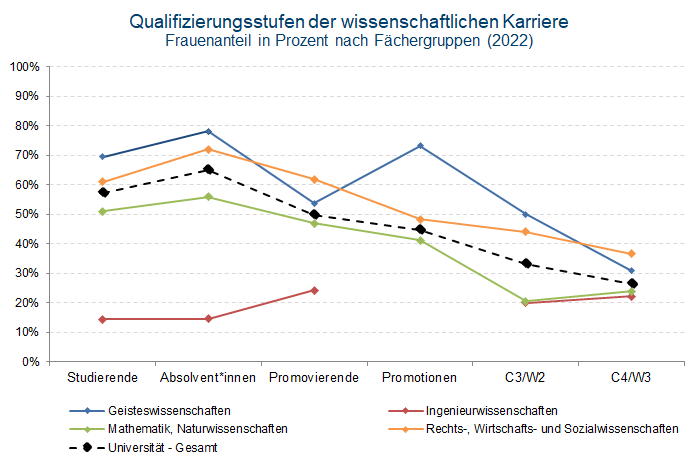
Women in the course of an academic career
The chart shows the proportion of women at different qualification levels of the academic career from studies to professorship. Professorships are focussed on in particular. This reveals the phenomenon of the 'leaky pipeline': the higher the qualification level, the fewer women are represented. More and more women are leaving the system on their way to an academic career. The data is also available in tabular form.
Students and graduates
The chart shows the development of the proportion of female students and graduates by subject group since 2013. The data is also available in tabular form.

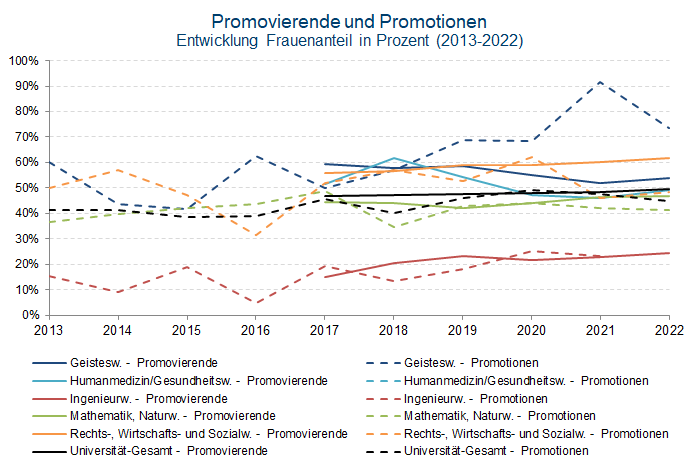
Doctoral students and doctorates
The chart shows the development of the proportion of female doctorates since 2013 and of completed doctorates since 2017 by subject group. The data is also available in tabular form.
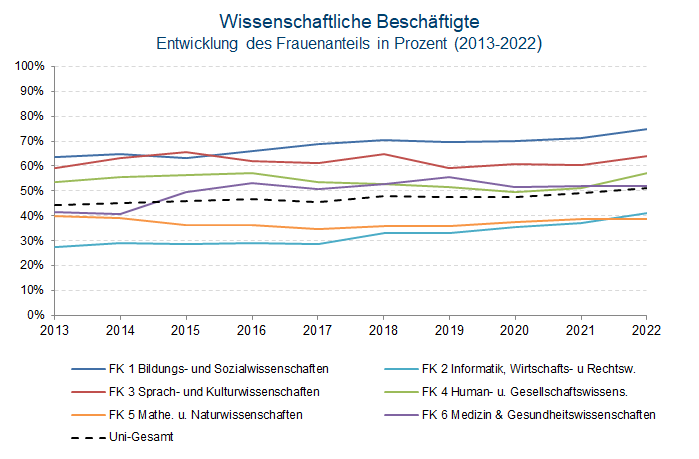
Scientific mid-level staff
The chart shows the development of the proportion of female academic employees by School since 2013. The data is also available in tabular form.
Professorships
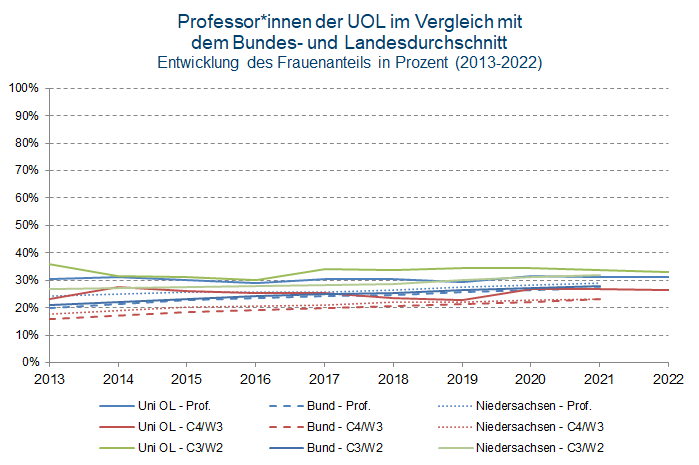
The following charts show the development of the proportion of female professors since 2013 in comparison with the national and state average and at the University of Oldenburg, differentiated by subject group. Some of the data is also available in tabular form.

Employees in technology and administration
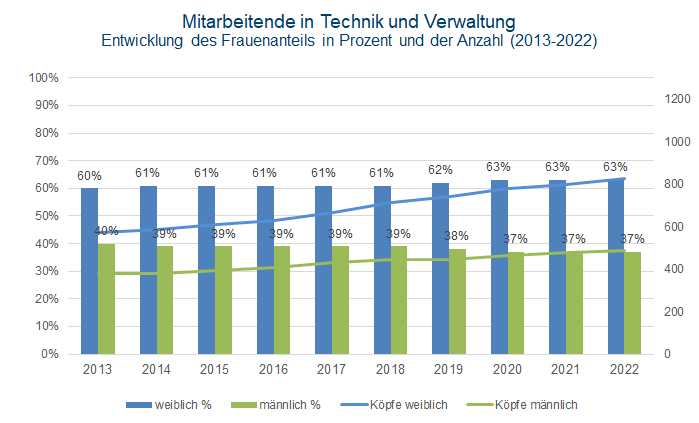
The non-scientific staff at the University of Oldenburg comprises 1,313 people. At 63 per cent, well over half of the technical and administrative staff (MTV) are women. Over the last ten years, the number of MTVs has risen continuously, while the gender ratio has hardly changed. The data is also available in tabular form.
MTV management staff
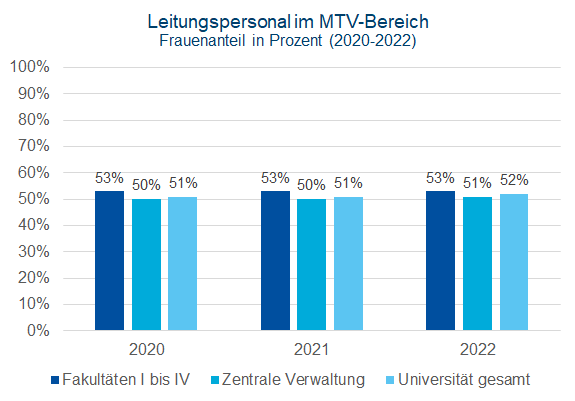
The gender ratio of MTV management staff is fairly balanced both in the School and in the University's central administration, with 50 per cent women, although the proportion of women among management staff is slightly lower than the proportion of women among all MTV staff at 63 per cent.
Bodies and committees
The chart shows the development of the proportion of women in the bodies and committees of the University of Oldenburg since 2018. The data is also available in tabular form.

Other equality data
In addition to the data collected and analysed at the university, there are other presentations from external institutions that are relevant to the University of Oldenburg's gender equality work. Such documents or information are named or linked here.
CEWS university ranking according to gender equality aspects
The Centre of Excellence Women in Science and Research (CEWS) of the GESIS Leibniz Institute of Social Sciences publishes a biennial university ranking according to gender equality aspects. The last ranking was published in 2025 : The University of Oldenburg performed well and is ranked in the overall ranking group 3 with 10 out of 12 points.
DFG Equal Opportunities Monitoring
The DFG publishes an annual equal opportunities monitoring report on all aspects of proposal submission and approval as well as participation in reviews and on DFG committees. The last monitoring was published in 2025.
Study on the gender pay gap for professorships
In 2018, the Institute for Higher Education Research published a study on the topic of "Gender Pay Gap for performance-related pay in the W salary scale of professors working at universities in Lower Saxony". An individual evaluation was prepared for the University of Oldenburg (only accessible internally).